Belgium NRT Smoking Cessation Aids Market Report: Trends, Growth and Forecast (2026-2032)
By Category (NRT Gum, NRT Inhalators, NRT Lozenges, NRT Patches, Other NRT Products), By Gender (Male, Female), By Sales Channel (Retail Online (Online Pharmacies, Brand-Owned Websites, E-commerce Marketplaces), Retail Offline (Hospital, Pharmacies, Drug Stores)), By End User (Individual / Consumer Self-Use, Healthcare-Professional-Supervised (Clinics, De-addiction Centers, Smoking Cessation Centers)) ... Read more
|
Major Players
|
Belgium NRT Smoking Cessation Aids Market Statistics and Insights, 2026
- Market Size Statistics
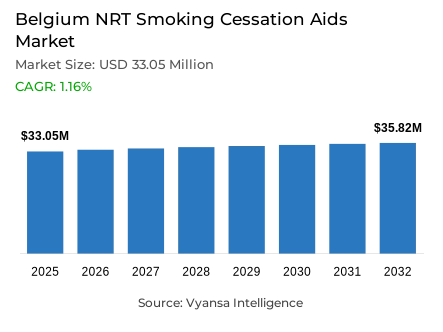
- Nrt smoking cessation aids market size in Belgium was valued at USD 33.05 million in 2025 and is estimated at USD 33.51 million in 2026.
- The market size is expected to grow to USD 35.82 million by 2032.
- Market to register a CAGR of around 1.16% during 2026-32.
- Category Shares
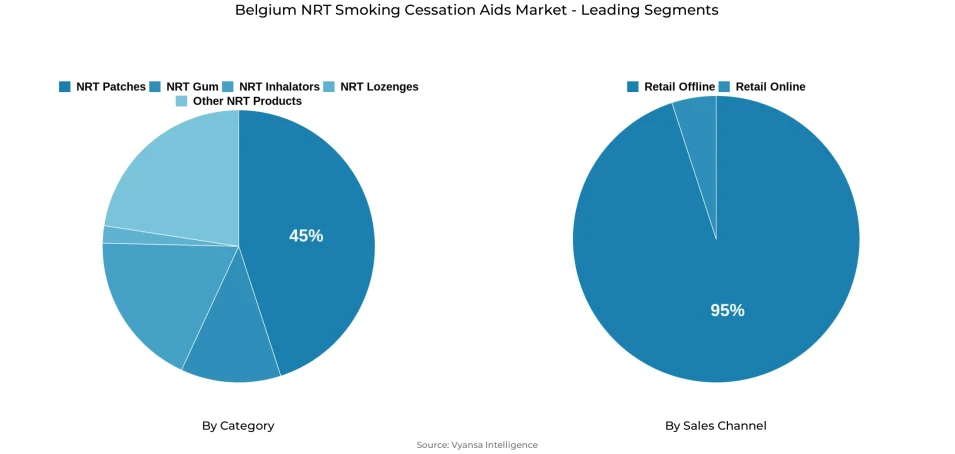
- Nrt patches grabbed market share of 45%.
- Competition
- More than 5 companies are actively engaged in producing nrt smoking cessation aids in Belgium.
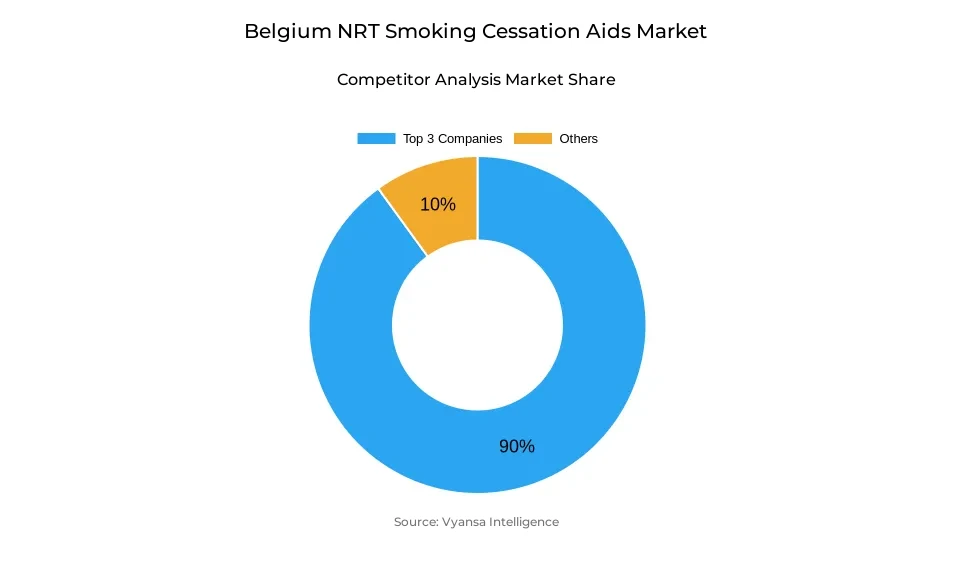
- Top 3 companies acquired around 90% of the market share.
- Haleon Belgium SA, Kenvue Belgium NV, Omega Pharma Belgium NV etc., are few of the top companies.
- Sales Channel
- Retail offline grabbed 95% of the market.
Belgium NRT Smoking Cessation Aids Market Outlook
The Belgium NRT smoking cessation aids market was valued at USD 33.05 million in 2025 and is projected to grow from USD 33.51 million in 2026 to USD 35.82 million by 2032, exhibiting a CAGR of 1.16% during the forecast period. The growth is moderate because the category is in a highly controlled nicotine environment and depends on healthcare-based purchasing behaviour. However, there is still a solid foundation of smokers who will keep the demand of medically approved cessation options, which will enable gradual but consistent growth in the next few years.
Tougher anti-smoking and anti-vaping regulations will continue to be a major growth driver. The prohibition of disposable e-cigarettes and stricter regulation of tobacco presence in retail areas are leading consumers to more plausible cessation avenues. In this context, NRT smoking cessation aids regain importance as trusted tools that support structured quitting attempts. At the same time, the smoking population in Belgium remains a significant source of potential users who are interested in getting help with the reduction of nicotine dependence.
Product preference patterns are also shaping the outlook for NRT smoking cessation aids. Patches continue to hold the strongest position, accounting for around 45% share, supported by convenience, discreet use, and once-daily dosing that fits easily into quitting routines. Although traditional formats remain dominant, consumers are gradually exploring alternatives such as inhalators and oral sprays that offer faster craving relief and more flexible use during daily activities.
Distribution dynamics further influence the trajectory of NRT smoking cessation aids in the country. Retail offline channels capture about 95% of sales, reflecting the pharmacy-led structure where professional guidance plays a central role in product selection. Because pharmacy access and healthcare trust remain key factors in consumer decisions, the category is likely to expand steadily through pharmacist recommendations, structured quit support, and continued alignment with public-health initiatives.
Belgium NRT Smoking Cessation Aids Market Growth DriverTighter Tobacco Rules Bring Quitting Aids Back Into Focus
One of the main factors that have led to the NRT smoking cessation aids market in Belgium is the tightening of the anti-vaping and anti-smoking policy framework, which forces smokers to revert to medically approved cessation aids. Disposable e-cigarettes are losing momentum due to the pressure of the regulations, and NRT products are becoming relevant again as viable and available cessation methods. This change is especially important in a category that used to lose customers to vaping-based substitutes.
This driver is supported by official measures in 2025. Belgian government prohibits the sale of disposable e-cigarettes as of 1 January 2025 and as of 1 April 2025, tobacco products may no longer be displayed visibly at authorised points of sale; in addition, food stores over 400 square metres are not allowed to sell them. Sciensano reports that 17.6% of adults aged 15+ still smoke, and 12.8% smoke daily, providing a substantial cessation base for NRT solutions.
Belgium NRT Smoking Cessation Aids Market ChallengeLow Visibility Keeps Demand Highly Intent-Driven
The main issue of the NRT smoking cessation aids market in Belgium is that the market is still dependent on the pharmacy-based, premeditated purchases instead of the spontaneous discovery. The sale of NRT aids is only possible in pharmacies, where there is a low shelf presence and a low level of promotion. As a result, growth relies primarily on already motivated smokers to quit or pharmacist-guided consumers, as opposed to general impulse-driven consumer involvement.
The wider retail landscape in 2025 explains how strictly regulated nicotine-related categories are in Belgium. Since 1 April 2025, tobacco products should not be visible in any authorised outlets, and the violation of the display ban may result in fines of up to EUR 800,000; the violation of the illegal sale in large food stores may lead to fines of up to EUR 24,000. Within a highly controlled setting, NRT brands will have to strive more by pharmacist recommendation and healthcare trust, as opposed to in-store visibility.
Unlock Market Intelligence
Explore the market potential with our data-driven report
Belgium NRT Smoking Cessation Aids Market TrendFormat Diversification Is Expanding Consumer Choice
A major trend that is evident in the NRT smoking cessation aids market in Belgium is the slow extension of the format preference beyond the conventional gum and patch. Inhalators are expected to experience the most rapid growth in 2025, and oral sprays also find their way to consumers who want to get rid of cravings quickly. Meanwhile, patches are the most established format since they are discrete, convenient, and can be used in conjunction with once-a-day smoking-cessation regimens.
This trend is developed in a more restrictive cessation policy environment. Since 31 December 2024, Belgium extends smoke-free regulations to such places as amusement parks, zoos, playgrounds, and sports grounds; smoking is also prohibited within a 10-metre zone around the entrances and exits of schools, hospitals, residential care centres, nurseries, and public libraries. These regulations strengthen the necessity of pragmatic, low-profile cessation models that may facilitate quitting within more limited social settings.
Belgium NRT Smoking Cessation Aids Market OpportunityDigital Support Opens White Space for Smarter Quitting
An evident opportunity in the NRT smoking cessation aids market in Belgium is related to connected, tech-enabled quitting support, with supplements medically approved products. Smart patches, mobile apps, progress tracking, behavioural nudges, and gamified features are some of the ways through which brands can enhance compliance without violating advertising regulations. Digital support can be used to enable brands to create a more effective engagement and make NRT use more personalised and effective ways in a market where traditional promotion is limited.
This is an important opportunity since the smoking base is still large. Sciensano’s 2025 tobacco burden data shows that 17.6% of adults aged 15+ still smoke, with 12.8% smoking daily, while Belgium’s latest anti‑tobacco measures continue to tighten access to alternative nicotine formats. Such a mix provides space to cessation ecosystems that enable smokers to actively move between intention and treatment. The NRT used with guidance and tracking tools can be more aligned with the direction of the public-health in Belgium.
Unlock Market Intelligence
Explore the market potential with our data-driven report
Belgium NRT Smoking Cessation Aids Market Segmentation Analysis
By Category
- NRT Gum
- NRT Inhalators
- NRT Lozenges
- NRT Patches
- Other NRT Products
The segment commands the highest share within the category of NRT smoking cessation aids, with NRT patches accounting for 45%. This highlights the fact that patches are still the most popular form because of good brand awareness, discreetness, and the ease of taking one dose a day. Patches offer a low-maintenance and easy quitting option to many users, which has continued to give them a leadership over other NRT formats.
They are also strong because of their ability to fulfill the expectations of the consumers and pharmacists. Patches enjoy the advantage of simplicity of use and general trust in a market where medically plausible and easy-to-follow solutions are the most important. Although inhalators and sprays gain more and more popularity, patches remain the most traditional and most acceptable solution in the category.
By Sales Channel
- Retail Online
- Online Pharmacies
- Brand-Owned Websites
- E-commerce Marketplaces
- Retail Offline
- Hospital
- Pharmacies
- Drug Stores
The segment also holds the highest share in the sales channel, where retail offline captures 95% of the market. This demonstrates that pharmacies are the exclusive distribution channel for NRT smoking cessation aids in Belgium. The medical credibility of the category is supported by that structure, as consumers are professionally advised on the most appropriate format, be it patch, gum, lozenge, spray, inhalator.
Meanwhile, this channel structure maintains the market small and very controlled. Because NRT products are not available in supermarkets or retail e-commerce platforms, the offline pharmacy access is the main channel to buy. As a result, the pharmacist relationship and in-store recommendation are especially significant in brands that aim to capture the quit-driven demand.
List of Companies Covered in Belgium NRT Smoking Cessation Aids Market
The companies listed below are highly influential in the Belgium nrt smoking cessation aids market, with a significant market share and a strong impact on industry developments.
- Haleon Belgium SA
- Kenvue Belgium NV
- Omega Pharma Belgium NV
Competitive Landscape
In 2025, Belgium’s NRT smoking cessation aids market remained highly concentrated, led by Kenvue Belgium NV, whose Nicorette brand continued to dominate with a 54.7% value share, supported by a broad portfolio of patches, gums, lozenges, and sprays that cater to diverse cessation preferences. Omega Pharma Belgium NV, distributing Perrigo’s NiQuitin, held second place with 31.8% of the market, leveraging the popularity of patch-based solutions and alignment with discreet, once-daily dosing. The recent acquisition of the Nicotinell brand by Dr. Reddy’s Laboratories signals potential future competition, though the brand currently holds a smaller share. Pharmacies remain the exclusive distribution channel, ensuring professional guidance but limiting spontaneous purchases and broader visibility. Market growth is modest but supported by regulatory measures banning disposable e-cigarettes, restricting vaping visibility, and reinforcing public health campaigns, which encourage smokers to reconsider NRT products as credible cessation solutions.
Frequently Asked Questions
Related Report
- Market Segmentation
- Research Scope
- Research Methodology
- Definitions and Assumptions
- Executive Summary
- Belgium NRT Smoking Cessation Aids Market Policies, Regulations, and Standards
- Belgium NRT Smoking Cessation Aids Market Dynamics
- Growth Factors
- Challenges
- Trends
- Opportunities
- Belgium NRT Smoking Cessation Aids Market Statistics, 2022-2032F
- Market Size & Growth Outlook
- By Revenues in USD Million
- Market Segmentation & Growth Outlook
- By Category
- NRT Gum- Market Insights and Forecast 2022-2032, USD Million
- NRT Inhalators- Market Insights and Forecast 2022-2032, USD Million
- NRT Lozenges- Market Insights and Forecast 2022-2032, USD Million
- NRT Patches- Market Insights and Forecast 2022-2032, USD Million
- Other NRT Products- Market Insights and Forecast 2022-2032, USD Million
- By Gender
- Male- Market Insights and Forecast 2022-2032, USD Million
- Female- Market Insights and Forecast 2022-2032, USD Million
- By Sales Channel
- Retail Online- Market Insights and Forecast 2022-2032, USD Million
- Online Pharmacies- Market Insights and Forecast 2022-2032, USD Million
- Brand-Owned Websites- Market Insights and Forecast 2022-2032, USD Million
- E-commerce Marketplaces- Market Insights and Forecast 2022-2032, USD Million
- Retail Offline- Market Insights and Forecast 2022-2032, USD Million
- Hospital- Market Insights and Forecast 2022-2032, USD Million
- Pharmacies- Market Insights and Forecast 2022-2032, USD Million
- Drug Stores- Market Insights and Forecast 2022-2032, USD Million
- Retail Online- Market Insights and Forecast 2022-2032, USD Million
- By End User
- Individual / Consumer Self-Use- Market Insights and Forecast 2022-2032, USD Million
- Healthcare-Professional-Supervised- Market Insights and Forecast 2022-2032, USD Million
- Clinics- Market Insights and Forecast 2022-2032, USD Million
- De-addiction Centers - Market Insights and Forecast 2022-2032, USD Million
- Smoking Cessation Centers- Market Insights and Forecast 2022-2032, USD Million
- By Competitors
- Competition Characteristics
- Market Share & Analysis
- By Category
- Market Size & Growth Outlook
- Belgium NRT Gum Market Statistics, 2022-2032
- Market Size & Growth Outlook
- By Revenues in USD Million
- Market Segmentation & Growth Outlook
- By Gender- Market Insights and Forecast 2022-2032, USD Million
- By Sales Channel- Market Insights and Forecast 2022-2032, USD Million
- By End User- Market Insights and Forecast 2022-2032, USD Million
- Market Size & Growth Outlook
- Belgium NRT Inhalators Market Statistics, 2022-2032
- Market Size & Growth Outlook
- By Revenues in USD Million
- Market Segmentation & Growth Outlook
- By Gender- Market Insights and Forecast 2022-2032, USD Million
- By Sales Channel- Market Insights and Forecast 2022-2032, USD Million
- By End User- Market Insights and Forecast 2022-2032, USD Million
- Market Size & Growth Outlook
- Belgium NRT Lozenges Market Statistics, 2022-2032
- Market Size & Growth Outlook
- By Revenues in USD Million
- Market Segmentation & Growth Outlook
- By Gender- Market Insights and Forecast 2022-2032, USD Million
- By Sales Channel- Market Insights and Forecast 2022-2032, USD Million
- By End User- Market Insights and Forecast 2022-2032, USD Million
- Market Size & Growth Outlook
- Belgium NRT Patches Market Statistics, 2022-2032
- Market Size & Growth Outlook
- By Revenues in USD Million
- Market Segmentation & Growth Outlook
- By Gender- Market Insights and Forecast 2022-2032, USD Million
- By Sales Channel- Market Insights and Forecast 2022-2032, USD Million
- By End User- Market Insights and Forecast 2022-2032, USD Million
- Market Size & Growth Outlook
- Belgium Other NRT Products Market Statistics, 2022-2032
- Market Size & Growth Outlook
- By Revenues in USD Million
- Market Segmentation & Growth Outlook
- By Gender- Market Insights and Forecast 2022-2032, USD Million
- By Sales Channel- Market Insights and Forecast 2022-2032, USD Million
- By End User- Market Insights and Forecast 2022-2032, USD Million
- Market Size & Growth Outlook
- Competitive Outlook
- Company Profiles
- Kenvue Belgium NV
- Business Description
- Product Portfolio
- Collaborations & Alliances
- Recent Developments
- Financial Details
- Others
- Omega Pharma Belgium NV
- Business Description
- Product Portfolio
- Collaborations & Alliances
- Recent Developments
- Financial Details
- Others
- Haleon Belgium SA
- Business Description
- Product Portfolio
- Collaborations & Alliances
- Recent Developments
- Financial Details
- Others
- Johnson & Johnson Consumer NV
- Business Description
- Product Portfolio
- Collaborations & Alliances
- Recent Developments
- Financial Details
- Others
- Janssen-Cilag NV
- Business Description
- Product Portfolio
- Collaborations & Alliances
- Recent Developments
- Financial Details
- Others
- GSK Consumer Healthcare
- Business Description
- Product Portfolio
- Collaborations & Alliances
- Recent Developments
- Financial Details
- Others
- Kenvue Belgium NV
- Company Profiles
- Disclaimer
| Segment | Sub-Segment |
|---|---|
| By Category |
|
| By Gender |
|
| By Sales Channel |
|
| By End User |
|
Research Methodology
This study followed a structured approach comprising four key phases to assess the size and scope of the electro-oxidation market. The process began with thorough secondary research to collect data on the target market, related markets, and broader industry context. These findings, along with preliminary assumptions and estimates, were then validated through extensive primary research involving industry experts from across the value chain. To calculate the overall market size, both top-down and bottom-up methodologies were employed. Finally, market segmentation and data triangulation techniques were applied to refine and validate segment-level estimations.
Secondary Research
The secondary research phase involved gathering data from a wide range of credible and published sources. This step helped in identifying industry trends, defining market segmentation, and understanding the market landscape and value chain.
Sources consulted during this phase included:
- Company annual reports, investor presentations, and press releases
- Industry white papers and certified publications
- Trade directories and market-recognized databases
- Articles from authoritative authors and reputable journals
- Gold and silver standard websites
Secondary research was critical in mapping out the industry's value chain and monetary flow, identifying key market segments, understanding regional variations, and tracking significant industry developments.
Other key sources:
- Financial disclosures
- Industry associations and trade bodies
- News outlets and business magazines
- Academic journals and research studies
- Paid industry databases
Primary Research
To validate secondary data and gain deeper market insights, primary research was conducted with key stakeholders across both the supply and demand sides of the market.
On the demand side, participants included decision-makers and influencers from end-user industries—such as CIOs, CTOs, and CSOs—who provided first-hand perspectives on market needs, product usage, and future expectations.
On the supply side, interviews were conducted with manufacturers, industry associations, and institutional participants to gather insights into current offerings, product pipelines, and market challenges.
Primary interviews provided critical inputs such as:
- Market size and revenue data
- Product and service breakdowns
- Market forecasts
- Regional and application-specific trends
Stakeholders consulted included:
- Leading OEM and solution providers
- Channel and distribution partners
- End users across various applications
- Independent consultants and industry specialists
Market Size Estimation and Data Triangulation
- Identifying Key Market Participants (Secondary Research)
- Goal: To identify the major players or companies in the target market. This typically involves using publicly available data sources such as industry reports, market research publications, and financial statements of companies.
- Tools: Reports from firms like Gartner, Forrester, Euromonitor, Statista, IBISWorld, and others. Public financial statements, news articles, and press releases from top market players.
- Extracting Earnings of Key Market Participants
- Goal: To estimate the earnings generated from the product or service being analyzed. This step helps in understanding the revenue potential of each market player in a specific geography.
- Methods: Earnings data can be gathered from:
- Publicly available financial reports (for listed companies).
- Interviews and primary data sources from professionals, such as Directors, VPs, SVPs, etc. This is especially useful for understanding more nuanced, internal data that isn't publicly disclosed.
- Annual reports and investor presentations of key players.
- Data Collation and Development of a Relevant Data Model
- Goal: To collate inputs from both primary and secondary sources into a structured, data-driven model for market estimation. This model will incorporate key market KPIs and any independent variables relevant to the market.
- Key KPIs: These could include:
- Market size, growth rate, and demand drivers.
- Industry-specific metrics like market share, average revenue per customer (ARPC), or average deal size.
- External variables, such as economic growth rates, inflation rates, or commodity prices, that could affect the market.
- Data Modeling: Based on this data, the market forecasts are developed for the next 5 years. A combination of trend analysis, scenario modeling, and statistical regression might be used to generate projections.
- Scenario Analysis
- Goal: To test different assumptions and validate how sensitive the market is to changes in key variables (e.g., market demand, regulatory changes, technological disruptions).
- Types of Scenarios:
- Base Case: Based on current assumptions and historical data.
- Best-Case Scenario: Assuming favorable market conditions, regulatory environments, and technological advancements.
- Worst-Case Scenario: Accounting for adverse factors, such as economic downturns, stricter regulations, or unexpected disruptions.












