Australia Weight Management and Wellbeing Market Report: Trends, Growth and Forecast (2026-2032)
By Category (Meal Replacement Products (Shakes, Bars, Ready-to-Drink (RTD) Beverages, Powder Mixes), OTC Obesity Products (Fat Absorption Inhibitors, Appetite Suppressants, Metabolism Boosters), Supplement Nutrition Drinks, Slimming Teas, Weight Loss Supplements), By Application (Obesity Management, Diabetes-Associated Weight Control, Cardiovascular Risk Reduction, Post-Bariatric Surgery Weight Maintenance, General Fitness & Lifestyle Weight Control), By End User (Hospitals, Specialty & Bariatric Clinics, Weight Loss Centers, Homecare/Individual Consumers), By Sales Channel (Retail Offline (Pharmacies & Drug Stores, Supermarkets/Hypermarkets, Specialty Nutrition Stores), Retail Online (E-commerce Platforms, Brand-Owned Websites)), By Region (Queensland, New South Wales, Victoria, South Australia, Others) ... Read more

|
Major Players
|
Australia Weight Management and Wellbeing Market Statistics and Insights, 2026
- Market Size Statistics
- Weight management and wellbeing market size in Australia was estimated at USD 315 million in 2025.
- The market size is expected to grow to USD 355 million by 2032.
- Market to register a CAGR of around 1.72% during 2026-32.
- Category Shares
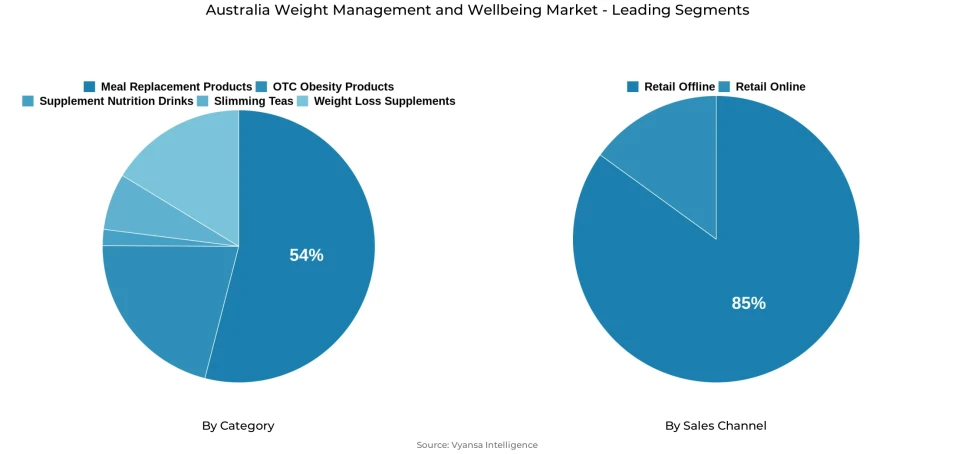
- Meal replacement grabbed market share of 54%.
- Competition
- More than 15 companies are actively engaged in producing weight management and wellbeing in Australia.
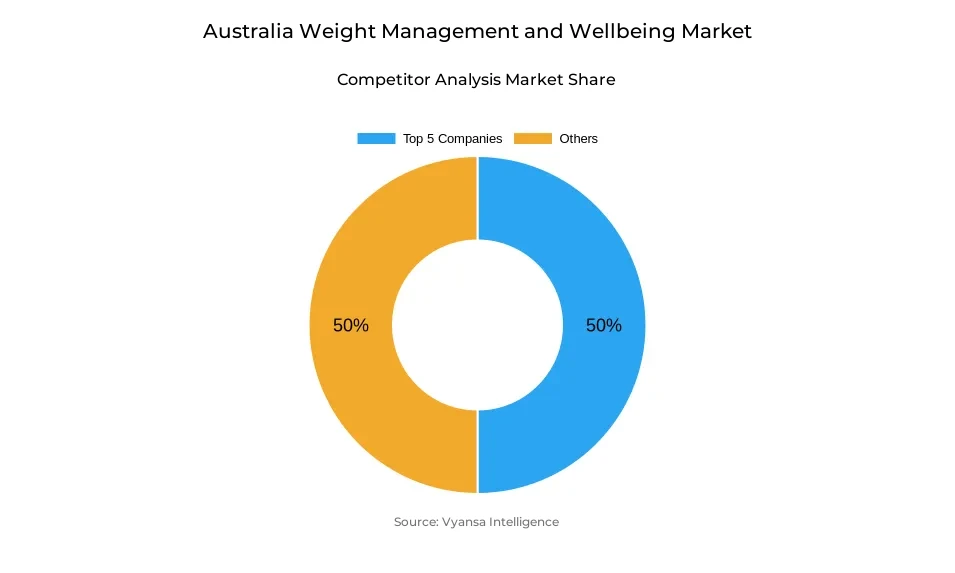
- Top 5 companies acquired around 50% of the market share.
- Abbott Australasia Pty Ltd, Nature's Care Pty Ltd, Global Brands Australia Pty Ltd, Herbalife Australasia Pty Ltd, Pharmacare Laboratories Pty Ltd etc., are few of the top companies.
- Sales Channel
- Retail offline grabbed 85% of the market.
Australia Weight Management and Wellbeing Market Outlook
The Australian weight management and wellbeing market was valued at USD 315 million in 2025 and is projected to grow from USD 320 million in 2026 to USD 355 million by 2032, registering a CAGR of approximately 1.72% during 2026-2032. The burden of Australian obesity continues to drive growth in 2026. The Australian Bureau of Statistics (ABS) reports that 65.8% of adults and 28% of children aged 5-17 are overweight or obese, reinforcing sustained demand for structured dietary solutions. Royal Australian College of General Practitioners (RACGP) still focuses on preventive care and lifestyle management, which promotes the use of structured nutrition within the framework of weight-management and wellbeing strategies.
One of the challenges in 2026 is the pharmaceutical replacement due to GLP-1 therapies. In October 2024, the Therapeutic Goods Administration (TGA) increased regulation of compounded GLP-1 receptor agonists due to high demand. It was estimated that about 20,000 Australians had used compounded GLP-1 replicas before these restrictions. Better access to prescription products in 2025 increases competition to traditional supplements, with appetite-reducing drugs decreasing the use of standalone weight-loss preparations.
One of the key trends is the combination of telehealth and medically supervised weight management. Digital prescribing pathways were extended between 2023-2025, integrating clinical oversight into consumer health journeys. Pharmacies and retailers are increasingly matching product lines with the nutritional requirements of GLP-1 users, especially protein and digestive support.
A new opportunity is the lifestyle-positioned nutrition in line with preventive health advice. The RACGP (2025) still suggests a balanced diet and exercise as the main measures, which supports the topicality of structured nutrition products. From a segmentation perspective, meal replacement holds 54% share within the category, while retail offline accounts for 85% within the sales channel, reflecting pharmacy‑led trust and in‑store advisory strength in 2026.
Australia Weight Management and Wellbeing Market Growth Driver
High Obesity Prevalence Sustains Preventive Health Demand
Australia is still plagued by a high prevalence of obesity, hence the need to have organized weight-management interventions. According to the latest National Health Survey conducted by the Australian Bureau of Statistics (ABS), 65.8% of adults and 28% of children aged 5–17 are overweight or obese, a trend that has intensified over the preceding decade. These statistics shed light on the endemic metabolic health risks among various demographics, with a greater prevalence in the regional and remote areas.
The Royal Australian College of General Practitioners (RACGP, 2025 updates) still focuses on preventive care, lifestyle management, and community-based obesity interventions. With the growth of awareness of obesity-related diseases like type 2 diabetes in 2026, consumers will continue to seek structured nutritional products, protein supplementation, and meal-management solutions to supplement the overall health plans.
Australia Weight Management and Wellbeing Market Challenge
Rapid GLP-1 Uptake Reshapes Traditional Product Demand
Consumer behaviour is being significantly affected by prescription glucagon-like peptide-1 (GLP-1) medicines. In response to the prevalent off-label demand, the Therapeutic Goods Administration (TGA) affirmed that regulation of compounded GLP-1 receptor agonists has been strengthened as of October 2024. Moreover, it is approximated that about 20,000 Australians were taking compounded GLP-1 replicas to manage their weight prior to the introduction of these regulatory measures.
Further stabilisation of prescription access and competition with traditional supplements has been achieved through the greater availability of Ozempic in July 2025. Since GLP-1 therapies directly lower caloric intake and appetite, meal-replacement products and weight-loss supplements are under structural pressure. This effect of pharmaceutical substitution is one of the fundamental challenges that affect category performance in 2026.
Unlock Market Intelligence
Explore the market potential with our data-driven report
Australia Weight Management and Wellbeing Market Trend
Telehealth-Integrated Weight Management Gains Traction
Online health apps are changing the way weight loss is accessed under medical supervision. Telehealth adoption increased during the post-pandemic period, and the prescribing of GLP-1 through online clinics grew significantly in 2023-2025. The combination of prescription management and complementary nutrition services is a convergence of clinical and consumer-health channels.
Pharmacies and retailers are also adapting their merchandising approaches to the nutritional requirements of GLP-1 users, including protein-rich supplements and digestive health products. This change is an example of a larger structural trend: personalised, technology-enabled healthcare delivery is being integrated into weight-control pathways in 2026.
Australia Weight Management and Wellbeing Market Opportunity
Preventive Care and Holistic Health Positioning Create Space for Complementary Products
In spite of pharmaceutical interference, preventive health measures are still at the center of national recommendations. The 2025 RACGP guidelines still highlight the use of a balanced diet, exercise, and community health interventions as the main interventions to control obesity, thus supporting the ongoing applicability of nutritional supplements as lifestyle support and not as quick-fix weight-loss remedies.
Since GLP-1 users need protein supplementation, digestive balance, and micronutrient intake regulation, complementary off-the-shelf nutrition products have an indirect benefit. The ability to create crossover products that address the needs of both medically managed and lifestyle-oriented consumers enhances long-term positioning in the changing health narratives.
Unlock Market Intelligence
Explore the market potential with our data-driven report
Australia Weight Management and Wellbeing Market Segmentation Analysis
By Category
- Meal Replacement Products
- OTC Obesity Products
- Supplement Nutrition Drinks
- Slimming Teas
- Weight Loss Supplements
The segment with the greatest market share within the category is meal replacement, commanding 54% of the share. This leadership is an indication of consumer trust in clinically positioned meal and protein-based formulations that are designed to provide structured dietary support.
These products have the advantage of brand credibility and availability in pharmacies, which helps maintain demand despite the competitive pressure in the wider weight-loss supplement categories. Their functional placement of balanced nutrition and sufficient protein increases category resilience in 2026.
By Sales Channel
- Retail Offline
- Retail Online
The segment with the most substantial market share within the sales channel is retail offline, capturing 85% of the share. Pharmacy-led sales, in-store professional advice, and established consumer buying behavior are the foundations of offline strength.
Despite the growth of retail e-commerce, physical outlets are still important in making purchases based on trust especially when it comes to clinically positioned products. Pharmacies and supermarkets are highly visible and controllable in merchandising, which strengthens offline leadership in 2026.
List of Companies Covered in Australia Weight Management and Wellbeing Market
The companies listed below are highly influential in the Australia weight management and wellbeing market, with a significant market share and a strong impact on industry developments.
- Abbott Australasia Pty Ltd
- Nature's Care Pty Ltd
- Global Brands Australia Pty Ltd
- Herbalife Australasia Pty Ltd
- Pharmacare Laboratories Pty Ltd
- Nestlé Australia Ltd
- Roche Products Pty Ltd
- Optipharm Pty Ltd
- Atkins Nutritionals Australia Pty Ltd
- Tony Ferguson Weight Management Pty Ltd
Competitive Landscape
The competitive landscape in 2025 is led by Herbalife Australasia Pty Ltd, holding a 16.2% value share, maintaining its position through a strong direct selling model and a focus on rapid weight reduction solutions. The company benefits from distributor-led engagement and brand recognition among consumers seeking structured weight loss support. However, the rise of GLP-1 prescription medicines is reshaping demand patterns, influencing traditional supplement positioning. Pharmacare Laboratories Pty Ltd ranks second with a 12.6% share, supported by its Fat Blaster and Nature’s Way brands across meal replacements and weight-loss supplements. Pharmacare leverages pharmacy distribution, grocery presence, and a dedicated e-commerce platform to sustain visibility. While Herbalife relies on multi-level marketing reach, Pharmacare benefits from mainstream retail penetration, creating a competitive dynamic between direct selling and pharmacy-led strategies within a structurally evolving category.
Frequently Asked Questions
Related Report
- Market Segmentation
- Research Scope
- Research Methodology
- Definitions and Assumptions
- Executive Summary
- Australia Weight Management and Wellbeing Market Policies, Regulations, and Standards
- Australia Weight Management and Wellbeing Market Dynamics
- Growth Factors
- Challenges
- Trends
- Opportunities
- Australia Weight Management and Wellbeing Market Statistics, 2022-2032F
- Market Size & Growth Outlook
- By Revenues in USD Million
- Market Segmentation & Growth Outlook
- By Category
- Meal Replacement Products- Market Insights and Forecast 2022-2032, USD Million
- Shakes- Market Insights and Forecast 2022-2032, USD Million
- Bars- Market Insights and Forecast 2022-2032, USD Million
- Ready-to-Drink (RTD) Beverages- Market Insights and Forecast 2022-2032, USD Million
- Powder Mixes- Market Insights and Forecast 2022-2032, USD Million
- OTC Obesity Products- Market Insights and Forecast 2022-2032, USD Million
- Fat Absorption Inhibitors- Market Insights and Forecast 2022-2032, USD Million
- Appetite Suppressants- Market Insights and Forecast 2022-2032, USD Million
- Metabolism Boosters- Market Insights and Forecast 2022-2032, USD Million
- Supplement Nutrition Drinks- Market Insights and Forecast 2022-2032, USD Million
- Slimming Teas- Market Insights and Forecast 2022-2032, USD Million
- Weight Loss Supplements- Market Insights and Forecast 2022-2032, USD Million
- Meal Replacement Products- Market Insights and Forecast 2022-2032, USD Million
- By Application
- Obesity Management- Market Insights and Forecast 2022-2032, USD Million
- Diabetes-Associated Weight Control- Market Insights and Forecast 2022-2032, USD Million
- Cardiovascular Risk Reduction- Market Insights and Forecast 2022-2032, USD Million
- Post-Bariatric Surgery Weight Maintenance- Market Insights and Forecast 2022-2032, USD Million
- General Fitness & Lifestyle Weight Control- Market Insights and Forecast 2022-2032, USD Million
- By End User
- Hospitals- Market Insights and Forecast 2022-2032, USD Million
- Specialty & Bariatric Clinics- Market Insights and Forecast 2022-2032, USD Million
- Weight Loss Centers- Market Insights and Forecast 2022-2032, USD Million
- Homecare/Individual Consumers- Market Insights and Forecast 2022-2032, USD Million
- By Sales Channel
- Retail Offline- Market Insights and Forecast 2022-2032, USD Million
- Pharmacies & Drug Stores- Market Insights and Forecast 2022-2032, USD Million
- Supermarkets/Hypermarkets- Market Insights and Forecast 2022-2032, USD Million
- Specialty Nutrition Stores- Market Insights and Forecast 2022-2032, USD Million
- Retail Online- Market Insights and Forecast 2022-2032, USD Million
- E-commerce Platforms- Market Insights and Forecast 2022-2032, USD Million
- Brand-Owned Websites- Market Insights and Forecast 2022-2032, USD Million
- Retail Offline- Market Insights and Forecast 2022-2032, USD Million
- By Region
- Queensland
- New South Wales
- Victoria
- South Australia
- Others
- By Competitors
- Competition Characteristics
- Market Share & Analysis
- By Category
- Market Size & Growth Outlook
- Australia Meal Replacement Products Market Statistics, 2022-2032
- Market Size & Growth Outlook
- By Revenues in USD Million
- Market Segmentation & Growth Outlook
- By Application- Market Insights and Forecast 2022-2032, USD Million
- By End User- Market Insights and Forecast 2022-2032, USD Million
- By Sales Channel- Market Insights and Forecast 2022-2032, USD Million
- By Region- Market Insights and Forecast 2022-2032, USD Million
- Market Size & Growth Outlook
- Australia OTC Obesity Products Market Statistics, 2022-2032
- Market Size & Growth Outlook
- By Revenues in USD Million
- Market Segmentation & Growth Outlook
- By Application- Market Insights and Forecast 2022-2032, USD Million
- By End User- Market Insights and Forecast 2022-2032, USD Million
- By Sales Channel- Market Insights and Forecast 2022-2032, USD Million
- By Region- Market Insights and Forecast 2022-2032, USD Million
- Market Size & Growth Outlook
- Australia Supplement Nutrition Drinks Market Statistics, 2022-2032
- Market Size & Growth Outlook
- By Revenues in USD Million
- Market Segmentation & Growth Outlook
- By Application- Market Insights and Forecast 2022-2032, USD Million
- By End User- Market Insights and Forecast 2022-2032, USD Million
- By Sales Channel- Market Insights and Forecast 2022-2032, USD Million
- By Region- Market Insights and Forecast 2022-2032, USD Million
- Market Size & Growth Outlook
- Australia Slimming Teas Market Statistics, 2022-2032
- Market Size & Growth Outlook
- By Revenues in USD Million
- Market Segmentation & Growth Outlook
- By Application- Market Insights and Forecast 2022-2032, USD Million
- By End User- Market Insights and Forecast 2022-2032, USD Million
- By Sales Channel- Market Insights and Forecast 2022-2032, USD Million
- By Region- Market Insights and Forecast 2022-2032, USD Million
- Market Size & Growth Outlook
- Australia Weight Loss Supplements Market Statistics, 2022-2032
- Market Size & Growth Outlook
- By Revenues in USD Million
- Market Segmentation & Growth Outlook
- By Application- Market Insights and Forecast 2022-2032, USD Million
- By End User- Market Insights and Forecast 2022-2032, USD Million
- By Sales Channel- Market Insights and Forecast 2022-2032, USD Million
- By Region- Market Insights and Forecast 2022-2032, USD Million
- Market Size & Growth Outlook
- Competitive Outlook
- Company Profiles
- Herbalife Australasia Pty Ltd
- Business Description
- Product Portfolio
- Collaborations & Alliances
- Recent Developments
- Financial Details
- Others
- Pharmacare Laboratories Pty Ltd
- Business Description
- Product Portfolio
- Collaborations & Alliances
- Recent Developments
- Financial Details
- Others
- Nestle Australia Ltd
- Business Description
- Product Portfolio
- Collaborations & Alliances
- Recent Developments
- Financial Details
- Others
- Roche Products Pty Ltd
- Business Description
- Product Portfolio
- Collaborations & Alliances
- Recent Developments
- Financial Details
- Others
- Optipharm Pty Ltd
- Business Description
- Product Portfolio
- Collaborations & Alliances
- Recent Developments
- Financial Details
- Others
- Abbott Australasia Pty Ltd
- Business Description
- Product Portfolio
- Collaborations & Alliances
- Recent Developments
- Financial Details
- Others
- Nature's Care Pty Ltd
- Business Description
- Product Portfolio
- Collaborations & Alliances
- Recent Developments
- Financial Details
- Others
- Global Brands Australia Pty Ltd
- Business Description
- Product Portfolio
- Collaborations & Alliances
- Recent Developments
- Financial Details
- Others
- Atkins Nutritionals Australia Pty Ltd
- Business Description
- Product Portfolio
- Collaborations & Alliances
- Recent Developments
- Financial Details
- Others
- Tony Ferguson Weight Management Pty Ltd
- Business Description
- Product Portfolio
- Collaborations & Alliances
- Recent Developments
- Financial Details
- Others
- Herbalife Australasia Pty Ltd
- Company Profiles
- Disclaimer
| Segment | Sub-Segment |
|---|---|
| By Category |
|
| By Application |
|
| By End User |
|
| By Sales Channel |
|
| By Region |
|
Research Methodology
This study followed a structured approach comprising four key phases to assess the size and scope of the electro-oxidation market. The process began with thorough secondary research to collect data on the target market, related markets, and broader industry context. These findings, along with preliminary assumptions and estimates, were then validated through extensive primary research involving industry experts from across the value chain. To calculate the overall market size, both top-down and bottom-up methodologies were employed. Finally, market segmentation and data triangulation techniques were applied to refine and validate segment-level estimations.
Secondary Research
The secondary research phase involved gathering data from a wide range of credible and published sources. This step helped in identifying industry trends, defining market segmentation, and understanding the market landscape and value chain.
Sources consulted during this phase included:
- Company annual reports, investor presentations, and press releases
- Industry white papers and certified publications
- Trade directories and market-recognized databases
- Articles from authoritative authors and reputable journals
- Gold and silver standard websites
Secondary research was critical in mapping out the industry's value chain and monetary flow, identifying key market segments, understanding regional variations, and tracking significant industry developments.
Other key sources:
- Financial disclosures
- Industry associations and trade bodies
- News outlets and business magazines
- Academic journals and research studies
- Paid industry databases
Primary Research
To validate secondary data and gain deeper market insights, primary research was conducted with key stakeholders across both the supply and demand sides of the market.
On the demand side, participants included decision-makers and influencers from end-user industries—such as CIOs, CTOs, and CSOs—who provided first-hand perspectives on market needs, product usage, and future expectations.
On the supply side, interviews were conducted with manufacturers, industry associations, and institutional participants to gather insights into current offerings, product pipelines, and market challenges.
Primary interviews provided critical inputs such as:
- Market size and revenue data
- Product and service breakdowns
- Market forecasts
- Regional and application-specific trends
Stakeholders consulted included:
- Leading OEM and solution providers
- Channel and distribution partners
- End users across various applications
- Independent consultants and industry specialists
Market Size Estimation and Data Triangulation
- Identifying Key Market Participants (Secondary Research)
- Goal: To identify the major players or companies in the target market. This typically involves using publicly available data sources such as industry reports, market research publications, and financial statements of companies.
- Tools: Reports from firms like Gartner, Forrester, Euromonitor, Statista, IBISWorld, and others. Public financial statements, news articles, and press releases from top market players.
- Extracting Earnings of Key Market Participants
- Goal: To estimate the earnings generated from the product or service being analyzed. This step helps in understanding the revenue potential of each market player in a specific geography.
- Methods: Earnings data can be gathered from:
- Publicly available financial reports (for listed companies).
- Interviews and primary data sources from professionals, such as Directors, VPs, SVPs, etc. This is especially useful for understanding more nuanced, internal data that isn't publicly disclosed.
- Annual reports and investor presentations of key players.
- Data Collation and Development of a Relevant Data Model
- Goal: To collate inputs from both primary and secondary sources into a structured, data-driven model for market estimation. This model will incorporate key market KPIs and any independent variables relevant to the market.
- Key KPIs: These could include:
- Market size, growth rate, and demand drivers.
- Industry-specific metrics like market share, average revenue per customer (ARPC), or average deal size.
- External variables, such as economic growth rates, inflation rates, or commodity prices, that could affect the market.
- Data Modeling: Based on this data, the market forecasts are developed for the next 5 years. A combination of trend analysis, scenario modeling, and statistical regression might be used to generate projections.
- Scenario Analysis
- Goal: To test different assumptions and validate how sensitive the market is to changes in key variables (e.g., market demand, regulatory changes, technological disruptions).
- Types of Scenarios:
- Base Case: Based on current assumptions and historical data.
- Best-Case Scenario: Assuming favorable market conditions, regulatory environments, and technological advancements.
- Worst-Case Scenario: Accounting for adverse factors, such as economic downturns, stricter regulations, or unexpected disruptions.












