Australia Small Cooking Appliances Market Report: Trends, Growth and Forecast (2026-2032)
By Appliances (Breadmakers, Coffee Machines (Standard Coffee Machines (Espresso Coffee Machines, Filter Coffee Machines), Pod Coffee Machines (Hard Pods, Soft Pods)), Coffee Mills, Fryers (Air Fryers, Oil Based Fryers), Electric Grills, Electric Steamers, Freestanding Hobs (Gas, Induction, Standard Electric, Mixed, Vitroceramic), Kettles, Rice Cookers, Slow Cookers, Others), By Sales Channel (Retail Offline (Grocery Retailers (Hypermarkets), Non-Grocery Retailers (General Merchandise Stores, Department Stores, Variety Stores, Appliances and Electronics Specialists, Home Products Specialists)), Retail Online), By Region (Queensland, New South Wales, Victoria, South Australia, Others) ... Read more

|
Major Players
|
Australia Small Cooking Appliances Market Statistics and Insights, 2026
- Market Size Statistics
- Small cooking appliances market size in Australia was valued at USD 850 million in 2025 and is estimated at USD 860 million in 2026.
- The market size is expected to grow to USD 935 million by 2032.
- Market to register a CAGR of around 1.37% during 2026-32.
- Appliances Shares
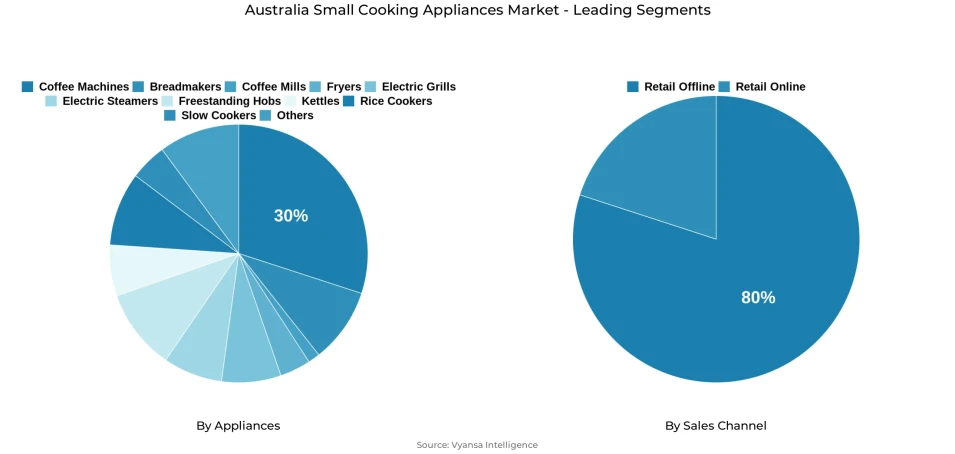
- Coffee machines grabbed market share of 30%.
- Competition
- More than 15 companies are actively engaged in producing small cooking appliances in Australia.
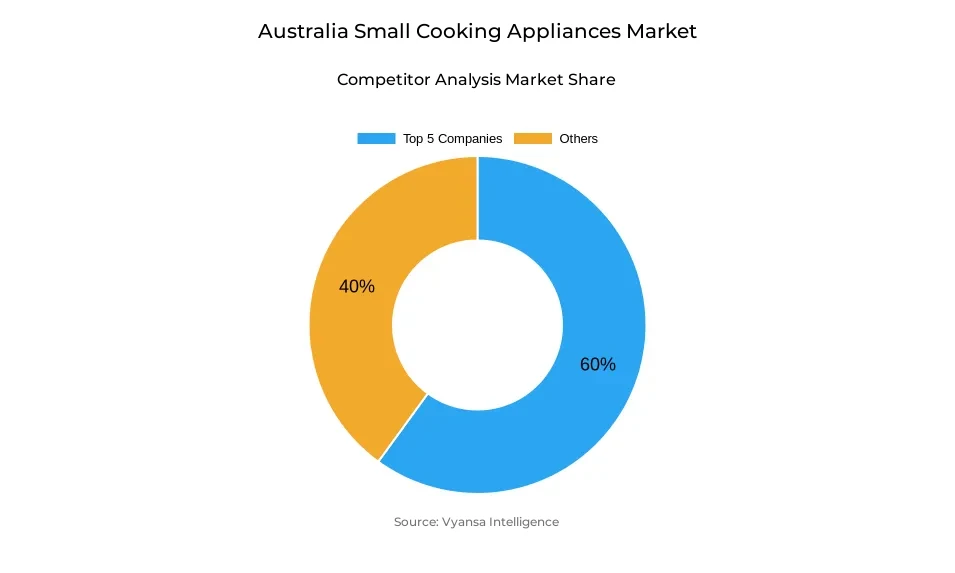
- Top 5 companies acquired around 60% of the market share.
- Spectrum Brands Australia Pty Ltd, SEB Australia Pty Ltd Group, Philips Electronics Australia Ltd, Breville Group Ltd, Newell Australia Pty Ltd etc., are few of the top companies.
- Sales Channel
- Retail offline grabbed 80% of the market.
Australia Small Cooking Appliances Market Outlook
Australia small cooking appliances market size was valued at USD 850 million in 2025 and is projected to grow from USD 860 million in 2026 to USD 935 million by 2032, exhibiting a CAGR of 1.37% during the forecast period. Growth remains steady as busy routines and tighter household budgets keep demand centered on products that save time and offer more than one function. Appliances such as air fryers and rice cookers continue to attract interest because they support faster and easier meal preparation at home.
Demand is supported by the continued importance of home-based routines and the need for practical value. Official data shows that 36% of employed people usually worked from home in August 2025, which supports regular use of small cooking appliances in daily life. At the same time, rising residential standing-offer electricity prices from 1 July 2025 in SE Queensland, South Australia, and New South Wales keep energy-saving products relevant. Health-focused meal preparation also supports interest in multifunctional appliances that help consumers prepare meals more easily with less oil and more control.
At the same time, replacement demand remains slower because many households already purchased basic appliances during the pandemic. This makes buyers more cautious, with stronger price comparison and higher response to promotions. Australian Bureau of Statistics (ABS) reports that living cost indexes rose between 2.3% and 4.2% in the 12 months to the December 2025 quarter, while spending on furnishings and household equipment fell 1.7% month on month in December 2025. These conditions keep many consumers selective when buying small cooking appliances.
The outlook is also supported by stronger digital research before purchase, even as physical stores remain the leading channel. ABS reports online retail sales reached AUD 4,492.1 million in May 2025, equal to about 12.0% of total retail turnover, giving brands room to build awareness through recipe-led and feature-based communication. Coffee machines lead the appliances category with a 30% share, while retail offline holds 80% of sales, as buyers still prefer to compare design, finish, controls, and build quality in person before purchase.
Australia Small Cooking Appliances Market Growth DriverTime-Saving Cooking Keeps Interest Alive
Because of busy routines and tighter household budgets, consumers are looking for appliances that save them time and do more, in one device. The continued popularity of air fryers and rice cookers is due to the fact they assist the consumer in preparing meals quickly, with less work in the kitchen, and can support the everyday preparation of meals at home. The continued interest in these appliances is partly attributed to the fact that the consumer is looking for real, practical value since they will not be replacing their old appliances regularly.
Official data supports this preference for convenience and efficiency. In August 2025, 36% of employed people usually worked from home in Australia, showing the continued importance of home-based routines. At the same time, the Australian Energy Regulator says that from 1 July 2025, residential standing-offer electricity prices rose by 0.5% to 3.7% in SE Queensland, 2.3% to 3.2% in South Australia, and 8.3% to 9.7% in New South Wales, which keeps energy-saving appliances relevant.
Australia Small Cooking Appliances Market ChallengeBudget Pressure Keeps Replacement Buying Soft
A significant limitation to continued growth in new appliances, primarily small cooking appliances, is caution from consumers who have already purchased prior to the pandemic. Many households have already purchased the basic features of small cooking appliances, and therefore, replacement sales have been slower than anticipated. Consumers remain interested in new, functional products but place more emphasis on price comparison than before and respond to promotions more than in the past, resulting in more difficulty for brands to generate rapid replacement sales across the category.
Official figures reflect this pressure on discretionary household buying. ABS says the living cost indexes rise between 2.3% and 4.2% in the 12 months to the December 2025 quarter. ABS also reports that in December 2025, household spending on furnishings and household equipment falls 1.7% month on month, while discretionary goods and services spending declines 0.3%. This shows why many consumers remain careful when buying non-essential kitchen appliances.
Unlock Market Intelligence
Explore the market potential with our data-driven report
Australia Small Cooking Appliances Market TrendHealth-Focused Cooking Shapes Product Choice
In Australian households today, health-oriented food preparation is becoming an important part of cooking at home. The introduction of appliances that allow for the air-frying, steaming or pressure cooking of food is creating a market for new types of convenience-based cooking products. Consumers want more products that make it easier for them to prepare meals, which has resulted in an increase in demand for multipurpose cooking devices with modern and simple designs.
According to new ABS nutrition data, this trend is also mirrored by the amount of Australians who follow a dietary pattern or diet (24.9% of people) and their main dietary types are food avoidance (37.9%), energy restriction (30.5%) and single nutrient restriction diets (24.0%). The ABS also estimates that 31.3% of Australian energy intake comes from discretionary foods. The statistics are encouraging to consumers as manufacturers introduce new ways to make easier meal prep and healthy meal prep with smaller cooking appliances.
Australia Small Cooking Appliances Market OpportunityDigital Content Builds Product Discovery
As consumers are increasingly spending time researching product features, cooking recipes and special promotions for food items at the grocery store; brands have more opportunities to use recipe-based content, cooking advice and influencer style communication to promote product advantages and showcase new product capabilities (eg. dual-zone cooking or product convenience features).
CCTV provides useful statistics to support why this digital approach is necessary; the Australian Bureau of Statistics (ABS) has reported that the total online retail sale was $4,492.1 million in May 2025, or 8.4% higher than the corresponding period in 2024. The corresponding amount of total retail turnover, seasonally adjusted, in May 2025 was $37,293.0 million. Collectively, there is a combined available digital space for brands to engage with consumers before the actual purchase.
Unlock Market Intelligence
Explore the market potential with our data-driven report
Australia Small Cooking Appliances Market Segmentation Analysis
By Appliances
- Breadmakers
- Coffee Machines
- Standard Coffee Machines
- Espresso Coffee Machines
- Filter Coffee Machines
- Pod Coffee Machines
- Hard Pods
- Soft Pods
- Standard Coffee Machines
- Coffee Mills
- Fryers
- Air Fryers
- Oil Based Fryers
- Electric Grills
- Electric Steamers
- Freestanding Hobs
- Gas
- Induction
- Standard Electric
- Mixed
- Vitroceramic
- Kettles
- Rice Cookers
- Slow Cookers
- Others
The segment has the highest share around segment under the appliances category, and this highest market share is of coffee machines, with 30%. This segment leads because design, premium feel, and everyday convenience matter strongly in Australia’s small kitchen appliance space. The category also benefits from the visible appeal of pod coffee machines and other stylish countertop products, which are often seen as both practical and aspirational in modern kitchens.
Official data supports continued home-based use and household buying activity. ABS reports that 36% of employed people usually work from home in August 2025, which supports regular at-home beverage preparation. ABS also says household spending on furnishings and household equipment rises 2.0% in June 2025. Together, these conditions support steady interest in coffee machines as functional and design-led kitchen appliances.
By Sales Channel
- Retail Offline
- Grocery Retailers
- Hypermarkets
- Non-Grocery Retailers
- General Merchandise Stores
- Department Stores
- Variety Stores
- Appliances and Electronics Specialists
- Home Products Specialists
- Grocery Retailers
- Retail Online
The segment has the highest share around segment under the sales channel, and this highest market share is of retail offline, with 80%. This channel stays ahead because buyers often prefer to see small cooking appliances in person before purchase. Store visits help them compare size, finish, controls, build quality, and ease of use, which is important in a category where design, functionality, and price all influence the decision.
Official figures support the continued strength of store-led retail. ABS reports total seasonally adjusted retail turnover of AUD 37,293.0 million in May 2025, while online retail sales are AUD 4,492.1 million in the same month, equal to about 12.0% of total retail turnover. This broader retail structure supports the leading role of offline channels for small cooking appliances, especially when consumers want demonstrations, immediate collection, or in-store promotions.
List of Companies Covered in Australia Small Cooking Appliances Market
The companies listed below are highly influential in the Australia small cooking appliances market, with a significant market share and a strong impact on industry developments.
- Spectrum Brands Australia Pty Ltd
- SEB Australia Pty Ltd Group
- Philips Electronics Australia Ltd
- Breville Group Ltd
- Newell Australia Pty Ltd
- Wesfarmers Ltd
- Woolworths Group Ltd
- De'Longhi Australia Pty Ltd
- Glen Dimplex Australia Pty Ltd
- Ninja Kitchens Pty Ltd
Competitive Landscape
The competitive landscape of small cooking appliances in Australia in 2025 remained highly competitive and innovation-driven, with brands such as Sunbeam actively adapting to shifting consumer demand. Sunbeam sought to differentiate itself through innovation, notably launching a patented air fryer to stand out in a crowded market. Competition was shaped by a strong focus on multifunctionality, convenience, and health-oriented features, with air fryers and rice cookers gaining traction despite the overall category decline. Players such as Panasonic also strengthened their presence through digital engagement strategies, including social media-driven content and community building. Overall, the market was characterised by intense competition, frequent promotions, and increasing emphasis on premiumisation, branding, and online engagement to capture value-conscious yet quality-seeking consumers.
Frequently Asked Questions
Related Report
- Market Segmentation
- Research Scope
- Research Methodology
- Definitions and Assumptions
- Executive Summary
- Australia Small Cooking Appliances Market Policies, Regulations, and Standards
- Australia Small Cooking Appliances Market Dynamics
- Growth Factors
- Challenges
- Trends
- Opportunities
- Australia Small Cooking Appliances Market Statistics, 2022-2032F
- Market Size & Growth Outlook
- By Revenues in USD Million
- Market Segmentation & Growth Outlook
- By Appliances
- Breadmakers- Market Insights and Forecast 2022-2032, USD Million
- Coffee Machines- Market Insights and Forecast 2022-2032, USD Million
- Standard Coffee Machines- Market Insights and Forecast 2022-2032, USD Million
- Espresso Coffee Machines- Market Insights and Forecast 2022-2032, USD Million
- Filter Coffee Machines- Market Insights and Forecast 2022-2032, USD Million
- Pod Coffee Machines- Market Insights and Forecast 2022-2032, USD Million
- Hard Pods- Market Insights and Forecast 2022-2032, USD Million
- Soft Pods- Market Insights and Forecast 2022-2032, USD Million
- Standard Coffee Machines- Market Insights and Forecast 2022-2032, USD Million
- Coffee Mills- Market Insights and Forecast 2022-2032, USD Million
- Fryers- Market Insights and Forecast 2022-2032, USD Million
- Air Fryers- Market Insights and Forecast 2022-2032, USD Million
- Oil Based Fryers- Market Insights and Forecast 2022-2032, USD Million
- Electric Grills- Market Insights and Forecast 2022-2032, USD Million
- Electric Steamers- Market Insights and Forecast 2022-2032, USD Million
- Freestanding Hobs- Market Insights and Forecast 2022-2032, USD Million
- Gas- Market Insights and Forecast 2022-2032, USD Million
- Induction- Market Insights and Forecast 2022-2032, USD Million
- Standard Electric- Market Insights and Forecast 2022-2032, USD Million
- Mixed- Market Insights and Forecast 2022-2032, USD Million
- Vitroceramic- Market Insights and Forecast 2022-2032, USD Million
- Kettles- Market Insights and Forecast 2022-2032, USD Million
- Rice Cookers- Market Insights and Forecast 2022-2032, USD Million
- Slow Cookers- Market Insights and Forecast 2022-2032, USD Million
- Others- Market Insights and Forecast 2022-2032, USD Million
- By Sales Channel
- Retail Offline- Market Insights and Forecast 2022-2032, USD Million
- Grocery Retailers- Market Insights and Forecast 2022-2032, USD Million
- Hypermarkets- Market Insights and Forecast 2022-2032, USD Million
- Non-Grocery Retailers- Market Insights and Forecast 2022-2032, USD Million
- General Merchandise Stores- Market Insights and Forecast 2022-2032, USD Million
- Department Stores- Market Insights and Forecast 2022-2032, USD Million
- Variety Stores- Market Insights and Forecast 2022-2032, USD Million
- Appliances and Electronics Specialists- Market Insights and Forecast 2022-2032, USD Million
- Home Products Specialists- Market Insights and Forecast 2022-2032, USD Million
- Grocery Retailers- Market Insights and Forecast 2022-2032, USD Million
- Retail Online- Market Insights and Forecast 2022-2032, USD Million
- Retail Offline- Market Insights and Forecast 2022-2032, USD Million
- By Region
- Queensland
- New South Wales
- Victoria
- South Australia
- Others
- By Competitors
- Competition Characteristics
- Market Share & Analysis
- By Appliances
- Market Size & Growth Outlook
- Australia Breadmakers Market Statistics, 2022-2032
- Market Size & Growth Outlook
- By Revenues in USD Million
- Market Segmentation & Growth Outlook
- By Sales Channel- Market Insights and Forecast 2022-2032, USD Million
- By Region- Market Insights and Forecast 2022-2032, USD Million
- Market Size & Growth Outlook
- Australia Coffee Machines Market Statistics, 2022-2032
- Market Size & Growth Outlook
- By Revenues in USD Million
- Market Segmentation & Growth Outlook
- By Sales Channel- Market Insights and Forecast 2022-2032, USD Million
- By Region- Market Insights and Forecast 2022-2032, USD Million
- Market Size & Growth Outlook
- Australia Coffee Mills Market Statistics, 2022-2032
- Market Size & Growth Outlook
- By Revenues in USD Million
- Market Segmentation & Growth Outlook
- By Sales Channel- Market Insights and Forecast 2022-2032, USD Million
- By Region- Market Insights and Forecast 2022-2032, USD Million
- Market Size & Growth Outlook
- Australia Fryers Market Statistics, 2022-2032
- Market Size & Growth Outlook
- By Revenues in USD Million
- Market Segmentation & Growth Outlook
- By Sales Channel- Market Insights and Forecast 2022-2032, USD Million
- By Region- Market Insights and Forecast 2022-2032, USD Million
- Market Size & Growth Outlook
- Australia Electric Grills Market Statistics, 2022-2032
- Market Size & Growth Outlook
- By Revenues in USD Million
- Market Segmentation & Growth Outlook
- By Sales Channel- Market Insights and Forecast 2022-2032, USD Million
- By Region- Market Insights and Forecast 2022-2032, USD Million
- Market Size & Growth Outlook
- Australia Electric Steamers Market Statistics, 2022-2032
- Market Size & Growth Outlook
- By Revenues in USD Million
- Market Segmentation & Growth Outlook
- By Sales Channel- Market Insights and Forecast 2022-2032, USD Million
- By Region- Market Insights and Forecast 2022-2032, USD Million
- Market Size & Growth Outlook
- Australia Freestanding Hobs Market Statistics, 2022-2032
- Market Size & Growth Outlook
- By Revenues in USD Million
- Market Segmentation & Growth Outlook
- By Sales Channel- Market Insights and Forecast 2022-2032, USD Million
- By Region- Market Insights and Forecast 2022-2032, USD Million
- Market Size & Growth Outlook
- Australia Kettles Market Statistics, 2022-2032
- Market Size & Growth Outlook
- By Revenues in USD Million
- Market Segmentation & Growth Outlook
- By Sales Channel- Market Insights and Forecast 2022-2032, USD Million
- By Region- Market Insights and Forecast 2022-2032, USD Million
- Market Size & Growth Outlook
- Australia Rice Cookers Market Statistics, 2022-2032
- Market Size & Growth Outlook
- By Revenues in USD Million
- Market Segmentation & Growth Outlook
- By Sales Channel- Market Insights and Forecast 2022-2032, USD Million
- By Region- Market Insights and Forecast 2022-2032, USD Million
- Market Size & Growth Outlook
- Australia Slow Cookers Market Statistics, 2022-2032
- Market Size & Growth Outlook
- By Revenues in USD Million
- Market Segmentation & Growth Outlook
- By Sales Channel- Market Insights and Forecast 2022-2032, USD Million
- By Region- Market Insights and Forecast 2022-2032, USD Million
- Market Size & Growth Outlook
- Competitive Outlook
- Company Profiles
- Breville Group Ltd
- Business Description
- Product Portfolio
- Collaborations & Alliances
- Recent Developments
- Financial Details
- Others
- Newell Australia Pty Ltd
- Business Description
- Product Portfolio
- Collaborations & Alliances
- Recent Developments
- Financial Details
- Others
- Wesfarmers Ltd
- Business Description
- Product Portfolio
- Collaborations & Alliances
- Recent Developments
- Financial Details
- Others
- Woolworths Group Ltd
- Business Description
- Product Portfolio
- Collaborations & Alliances
- Recent Developments
- Financial Details
- Others
- De'Longhi Australia Pty Ltd
- Business Description
- Product Portfolio
- Collaborations & Alliances
- Recent Developments
- Financial Details
- Others
- Spectrum Brands Australia Pty Ltd
- Business Description
- Product Portfolio
- Collaborations & Alliances
- Recent Developments
- Financial Details
- Others
- SEB Australia Pty Ltd Group
- Business Description
- Product Portfolio
- Collaborations & Alliances
- Recent Developments
- Financial Details
- Others
- Philips Electronics Australia Ltd
- Business Description
- Product Portfolio
- Collaborations & Alliances
- Recent Developments
- Financial Details
- Others
- Glen Dimplex Australia Pty Ltd
- Business Description
- Product Portfolio
- Collaborations & Alliances
- Recent Developments
- Financial Details
- Others
- Ninja Kitchens Pty Ltd
- Business Description
- Product Portfolio
- Collaborations & Alliances
- Recent Developments
- Financial Details
- Others
- Breville Group Ltd
- Company Profiles
- Disclaimer
| Segment | Sub-Segment |
|---|---|
| By Appliances |
|
| By Sales Channel |
|
| By Region |
|
Research Methodology
This study followed a structured approach comprising four key phases to assess the size and scope of the electro-oxidation market. The process began with thorough secondary research to collect data on the target market, related markets, and broader industry context. These findings, along with preliminary assumptions and estimates, were then validated through extensive primary research involving industry experts from across the value chain. To calculate the overall market size, both top-down and bottom-up methodologies were employed. Finally, market segmentation and data triangulation techniques were applied to refine and validate segment-level estimations.
Secondary Research
The secondary research phase involved gathering data from a wide range of credible and published sources. This step helped in identifying industry trends, defining market segmentation, and understanding the market landscape and value chain.
Sources consulted during this phase included:
- Company annual reports, investor presentations, and press releases
- Industry white papers and certified publications
- Trade directories and market-recognized databases
- Articles from authoritative authors and reputable journals
- Gold and silver standard websites
Secondary research was critical in mapping out the industry's value chain and monetary flow, identifying key market segments, understanding regional variations, and tracking significant industry developments.
Other key sources:
- Financial disclosures
- Industry associations and trade bodies
- News outlets and business magazines
- Academic journals and research studies
- Paid industry databases
Primary Research
To validate secondary data and gain deeper market insights, primary research was conducted with key stakeholders across both the supply and demand sides of the market.
On the demand side, participants included decision-makers and influencers from end-user industries—such as CIOs, CTOs, and CSOs—who provided first-hand perspectives on market needs, product usage, and future expectations.
On the supply side, interviews were conducted with manufacturers, industry associations, and institutional participants to gather insights into current offerings, product pipelines, and market challenges.
Primary interviews provided critical inputs such as:
- Market size and revenue data
- Product and service breakdowns
- Market forecasts
- Regional and application-specific trends
Stakeholders consulted included:
- Leading OEM and solution providers
- Channel and distribution partners
- End users across various applications
- Independent consultants and industry specialists
Market Size Estimation and Data Triangulation
- Identifying Key Market Participants (Secondary Research)
- Goal: To identify the major players or companies in the target market. This typically involves using publicly available data sources such as industry reports, market research publications, and financial statements of companies.
- Tools: Reports from firms like Gartner, Forrester, Euromonitor, Statista, IBISWorld, and others. Public financial statements, news articles, and press releases from top market players.
- Extracting Earnings of Key Market Participants
- Goal: To estimate the earnings generated from the product or service being analyzed. This step helps in understanding the revenue potential of each market player in a specific geography.
- Methods: Earnings data can be gathered from:
- Publicly available financial reports (for listed companies).
- Interviews and primary data sources from professionals, such as Directors, VPs, SVPs, etc. This is especially useful for understanding more nuanced, internal data that isn't publicly disclosed.
- Annual reports and investor presentations of key players.
- Data Collation and Development of a Relevant Data Model
- Goal: To collate inputs from both primary and secondary sources into a structured, data-driven model for market estimation. This model will incorporate key market KPIs and any independent variables relevant to the market.
- Key KPIs: These could include:
- Market size, growth rate, and demand drivers.
- Industry-specific metrics like market share, average revenue per customer (ARPC), or average deal size.
- External variables, such as economic growth rates, inflation rates, or commodity prices, that could affect the market.
- Data Modeling: Based on this data, the market forecasts are developed for the next 5 years. A combination of trend analysis, scenario modeling, and statistical regression might be used to generate projections.
- Scenario Analysis
- Goal: To test different assumptions and validate how sensitive the market is to changes in key variables (e.g., market demand, regulatory changes, technological disruptions).
- Types of Scenarios:
- Base Case: Based on current assumptions and historical data.
- Best-Case Scenario: Assuming favorable market conditions, regulatory environments, and technological advancements.
- Worst-Case Scenario: Accounting for adverse factors, such as economic downturns, stricter regulations, or unexpected disruptions.












