South Korea Sleep Aids Market Report: Trends, Growth and Forecast (2026-2032)
By Product (Single Ingredient (Doxylamine Succinate, Diphenhydramine, Melatonin), Combination Ingredient (Diphenhydramine + Acetaminophen, Other Antihistamine-Based Combinations), Herbal & Traditional Sleep Aids (Valerian root, Passionflower, Chamomile, Kava, Multi-Herbal Sleep Blends)), By Sleep Disorder (Insomnia, Sleep Apnea, Restless Legs Syndrome, Narcolepsy, Sleep Walking, Others), By Age Group (Young to Mid Adults (25-44 Years), Middle-Aged Adults (45-64 Years), Geriatric Population (65+ Years)), By Sales Channel (Retail Online, Retail Offline), By End User (Homecare/Individual Consumers, Hospitals, Sleep Centers & Clinics), By Formulation (Tablets, Gummies, Capsules, Liquid, Sublingual) ... Read more
|
Major Players
|
South Korea Sleep Aids Market Statistics and Insights, 2026
- Market Size Statistics
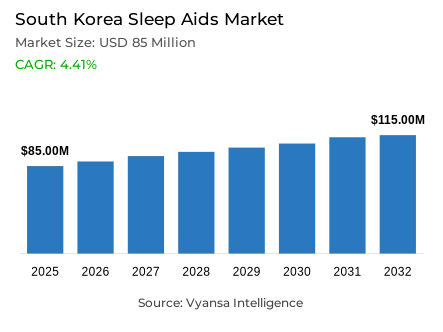
- Sleep aids market size in South Korea was estimated at USD 85 million in 2025.
- The market size is expected to grow to USD 115 million by 2032.
- Market to register a CAGR of around 4.41% during 2026-32.
- Product Shares
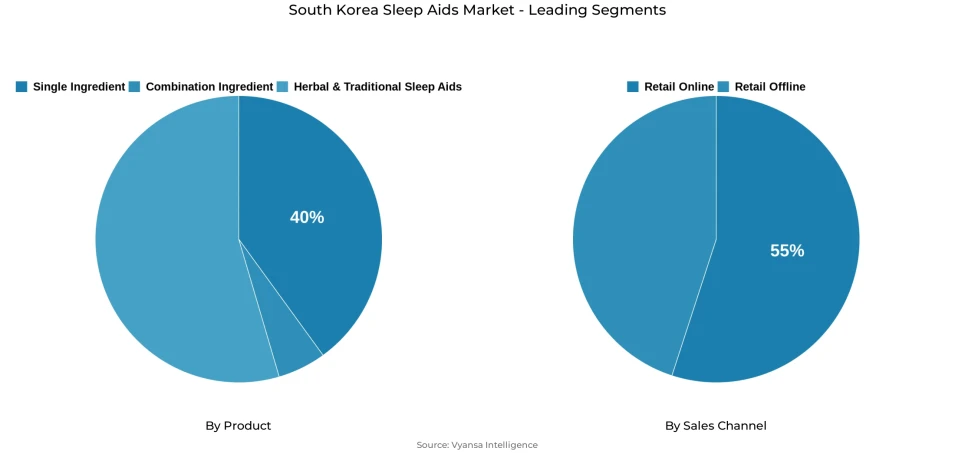
- Melatonin grabbed market share of 40%.
- Competition
- More than 5 companies are actively engaged in producing sleep aids in South Korea.
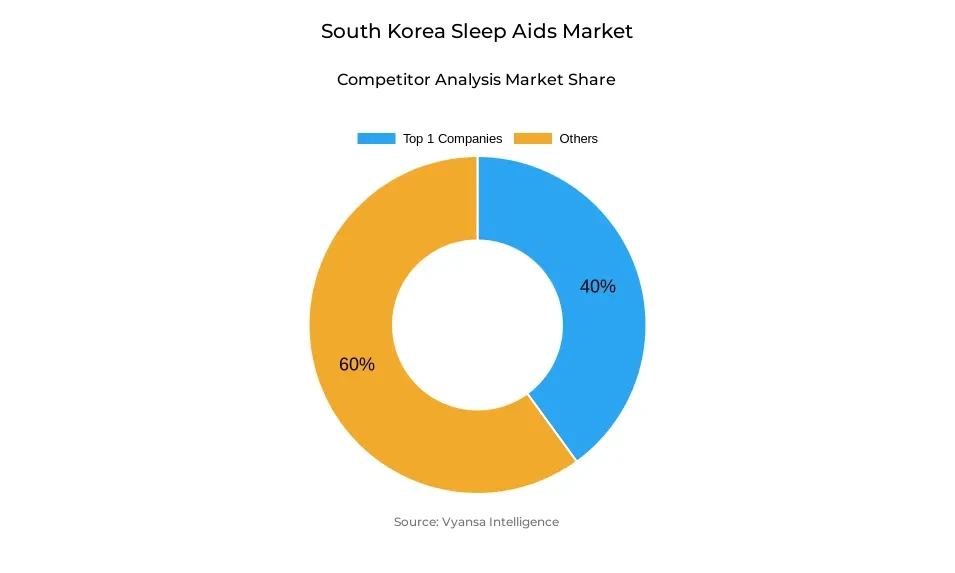
- Top 1 companies acquired around 40% of the market share.
- Kwang Dong Pharm Co Ltd etc., are few of the top companies.
- Sales channel
- Retail online grabbed 55% of the market.
South Korea Sleep Aids Market Outlook
The South Korea sleep aids market is valued at USD 85 million in 2025 and is projected to reach USD 115 million by 2032, reflecting a CAGR of 4.41%. Growth is driven by a clear shift in end user expectations—from general relaxation positioning toward more defined sleep-induction outcomes. Younger end users, in particular, are seeking faster and more tangible effects, intensifying competitive dynamics among domestic manufacturers.
Regulatory classification plays a defining role in shaping the market. As melatonin is categorized as a pharmaceutical ingredient and not freely available over the counter, companies have adapted by developing plant-based alternatives positioned within food or health supplement categories. Despite regulatory limits, melatonin-related products collectively account for approximately 40% of market share. Plant-derived formulations, including those extracted from premium pistachio sources, appeal to end users who perceive botanical origins as safer and less habit-forming.
Innovation in delivery systems is accelerating. Oral dissolving films, probiotic-infused blends, and multifunctional wellness combinations are gaining visibility. Established players such as Kwang Dong Pharm continue to compete alongside newer entrants introducing antihistamine-based sleep-induction products, broadening the competitive mix beyond traditional relaxation formulas.
Retail Online accounts for around 55% of total market share, reflecting strong digital adoption and preference for discreet product comparison. This channel facilitates rapid dissemination of new launches and niche brand visibility.The Ministry of Food and Drug Safety (MFDS) has intensified oversight, particularly concerning imported products with undeclared ingredients. Enhanced labeling requirements and compliance checks are reinforcing trust in domestically manufactured products. As smaller and specialized brands expand, the industry is becoming more fragmented yet innovation-driven, with transparency, botanical positioning, and regulatory alignment emerging as key determinants of sustainable growth through 2032.
South Korea Sleep Aids Market Growth DriverPlant-Derived Melatonin Expands Addressable Consumer Base
Regulatory restrictions surrounding conventional melatonin have accelerated end user migration toward plant-based and wellness-oriented alternatives in South Korea. Products positioned around mildness, perceived safety, and routine lifestyle compatibility are reshaping category demand in 2025. This shift broadens the addressable end user base beyond traditional pharmaceutical-style sleep aids, particularly among individuals who prefer natural ingredient narratives.
JW Jungwo Pharmaceutical announced the launch of Melamind in June 2025, formulated with 2 mg of plant-derived melatonin extracted from pistachios, combined with probiotics and botanical ingredients. Such hybrid formulations encourage trial among end users who previously avoided synthetic melatonin products, expanding category penetration through food- and wellness-adjacent positioning.
South Korea Sleep Aids Market ChallengePharmaceutical Classification of Melatonin Creates Channel Friction
Melatonin classification as a pharmaceutical ingredient limits its availability in conventional over-the-counter channels, constraining expansion of traditional melatonin-based products. This regulatory structure creates a mismatch between end user demand for sleep induction and the scope of legally marketable OTC claims, increasing reliance on alternative or imported products.
The Ministry of Food and Drug Safety (MFDS) reported that inspections of 50 foreign direct-purchase products marketed for insomnia or mood effects identified 14 items containing import-restricted ingredients. Additionally, two products labeled as melatonin-free were found to contain measurable melatonin. These findings heighten safety concerns and undermine end user trust, increasing reputational risk across the broader category.
Unlock Market Intelligence
Explore the market potential with our data-driven report
South Korea Sleep Aids Market TrendShift From Relaxation Claims to Direct Sleep-Induction Outcomes
End user expectations are evolving from general relaxation benefits toward measurable sleep induction outcomes. Products promising clearer onset timing and quantifiable sleep improvement are gaining visibility, intensifying competitive dynamics. Relaxation-only positioning is increasingly insufficient for end users seeking targeted results.
This shift has encouraged exploration of alternatives beyond traditional melatonin narratives, including pharmacologically active agents such as diphenhydramine, alongside plant-based melatonin derivatives marketed through food-category channels. The market is therefore balancing wellness-focused language with stronger sleep-induction propositions, even as regulatory boundaries continue to define permissible OTC positioning.
South Korea Sleep Aids Market OpportunityCompliance-Led Transparency Builds Long-Term Category Trust
Heightened regulatory scrutiny creates opportunity for compliant domestic brands to differentiate through transparency and safety assurance. Clear labeling, conservative claim language, and documented quality controls are emerging as competitive advantages, particularly amid end user confusion caused by cross-border retail onlin channels.
MFDS enforcement actions against improperly labeled or restricted imported products reinforce the importance of regulatory alignment. Brands investing in compliant product classification and responsible innovation can build sustained trust while expanding into plant-based melatonin substitutes and adjacent sleep formats. By aligning closely with evolving safety standards, manufacturers are positioned to strengthen long-term credibility and support category growth through 2032.
Unlock Market Intelligence
Explore the market potential with our data-driven report
South Korea Sleep Aids Market Segmentation Analysis
By Product
- Single Ingredient
- Combination Ingredient
- Herbal & Traditional Sleep Aids
The segment with highest market share under Product is Melatonin, accounting for approximately 40% of total market share. This dominance reflects strong end user preference for clearly defined sleep-induction cues, even within a regulatory environment that places limits on conventional over-the-counter melatonin positioning. Despite some lingering concerns regarding side effects, the association of melatonin with predictable circadian rhythm support continues to anchor category demand.
The 40% share also explains the accelerating visibility of plant-based melatonin alternatives. These products preserve the recognisable melatonin linkage while navigating alternative classification pathways, enabling brands to broaden appeal among risk-averse end users. As a result, innovation increasingly centers on differentiated delivery formats, supportive co-ingredients, portability, and wellness-oriented messaging. Through 2032, melatonin—whether synthetic or plant-derived—remains the structural reference point guiding formulation development and competitive positioning.
By Sales Channel
- Retail Online
- Retail Offline
Retail Online accounts for approximately 55% of total market share, making it the dominant sales channel. This leadership reflects a end user preference for discreet purchasing, detailed product comparison, and independent evaluation of ingredient claims—particularly important in a category where regulatory classification shapes labeling and availability.
Online platforms provide strong visibility for emerging brands through social media integration and targeted digital promotion, reducing dependence on physical shelf placement. Trust markers such as transparent ingredient disclosure, compliant health claims, and clear safe-use instructions are increasingly decisive in influencing purchase decisions. Brands that optimise official online storefronts and maintain regulatory-aligned communication are positioned to sustain repeat buying and channel leadership through 2032.
List of Companies Covered in South Korea Sleep Aids Market
The companies listed below are highly influential in the South Korea sleep aids market, with a significant market share and a strong impact on industry developments.
Competitive Landscape
South Korea sleep aids market is expanding strongly in 2025, driven by rising demand for plant-based and wellness-oriented formulations amid regulatory limits on synthetic melatonin, which is classified as a pharmaceutical ingredient and not permitted for OTC sale. JW Pharmaceutical introduced Melamind, featuring melatonin extracted from pistachios, reflecting growing consumer acceptance of plant-derived alternatives positioned under food or processed goods categories. Meanwhile, Kwang Dong Pharm Co Ltd retains category leadership but faces pressure as preferences shift from relaxation-focused products toward more direct sleep-inducing solutions. Regulatory scrutiny by the Ministry of Food and Drug Safety is strengthening oversight, particularly around imported melatonin-labelled products, supporting safer market development and encouraging responsible innovation.
Frequently Asked Questions
Related Report
- Market Segmentation
- Research Scope
- Research Methodology
- Definitions and Assumptions
- Executive Summary
- South Korea Sleep Aids Market Policies, Regulations, and Standards
- South Korea Sleep Aids Market Dynamics
- Growth Factors
- Challenges
- Trends
- Opportunities
- South Korea Sleep Aids Market Statistics, 2022-2032F
- Market Size & Growth Outlook
- By Revenues in USD Million
- Market Segmentation & Growth Outlook
- By Product
- Single Ingredient- Market Insights and Forecast 2022-2032, USD Million
- Doxylamine Succinate- Market Insights and Forecast 2022-2032, USD Million
- Diphenhydramine- Market Insights and Forecast 2022-2032, USD Million
- Melatonin- Market Insights and Forecast 2022-2032, USD Million
- Combination Ingredient- Market Insights and Forecast 2022-2032, USD Million
- Diphenhydramine + Acetaminophen- Market Insights and Forecast 2022-2032, USD Million
- Other Antihistamine-Based Combinations- Market Insights and Forecast 2022-2032, USD Million
- Herbal & Traditional Sleep Aids- Market Insights and Forecast 2022-2032, USD Million
- Valerian root- Market Insights and Forecast 2022-2032, USD Million
- Passionflower- Market Insights and Forecast 2022-2032, USD Million
- Chamomile- Market Insights and Forecast 2022-2032, USD Million
- Kava- Market Insights and Forecast 2022-2032, USD Million
- Multi-Herbal Sleep Blends- Market Insights and Forecast 2022-2032, USD Million
- Single Ingredient- Market Insights and Forecast 2022-2032, USD Million
- By Sleep Disorder
- Insomnia- Market Insights and Forecast 2022-2032, USD Million
- Sleep Apnea- Market Insights and Forecast 2022-2032, USD Million
- Restless Legs Syndrome- Market Insights and Forecast 2022-2032, USD Million
- Narcolepsy- Market Insights and Forecast 2022-2032, USD Million
- Sleep Walking- Market Insights and Forecast 2022-2032, USD Million
- Others- Market Insights and Forecast 2022-2032, USD Million
- By Age Group
- Young to Mid Adults (25-44 Years)- Market Insights and Forecast 2022-2032, USD Million
- Middle-Aged Adults (45-64 Years)- Market Insights and Forecast 2022-2032, USD Million
- Geriatric Population (65+ Years)- Market Insights and Forecast 2022-2032, USD Million
- By Sales Channel
- Retail Online- Market Insights and Forecast 2022-2032, USD Million
- Retail Offline- Market Insights and Forecast 2022-2032, USD Million
- By End User
- Homecare/Individual Consumers- Market Insights and Forecast 2022-2032, USD Million
- Hospitals- Market Insights and Forecast 2022-2032, USD Million
- Sleep Centers & Clinics- Market Insights and Forecast 2022-2032, USD Million
- By Formulation
- Tablets- Market Insights and Forecast 2022-2032, USD Million
- Gummies- Market Insights and Forecast 2022-2032, USD Million
- Capsules- Market Insights and Forecast 2022-2032, USD Million
- Liquid- Market Insights and Forecast 2022-2032, USD Million
- Sublingual- Market Insights and Forecast 2022-2032, USD Million
- By Competitors
- Competition Characteristics
- Market Share & Analysis
- By Product
- Market Size & Growth Outlook
- South Korea Single Ingredient Sleep Aids Market Statistics, 2022-2032
- Market Size & Growth Outlook
- By Revenues in USD Million
- Market Segmentation & Growth Outlook
- By Sleep Disorder- Market Insights and Forecast 2022-2032, USD Million
- By Age Group- Market Insights and Forecast 2022-2032, USD Million
- By Sales Channel- Market Insights and Forecast 2022-2032, USD Million
- By End User- Market Insights and Forecast 2022-2032, USD Million
- By Formulation- Market Insights and Forecast 2022-2032, USD Million
- Market Size & Growth Outlook
- South Korea Combination Ingredient Sleep Aids Market Statistics, 2022-2032
- Market Size & Growth Outlook
- By Revenues in USD Million
- Market Segmentation & Growth Outlook
- By Sleep Disorder- Market Insights and Forecast 2022-2032, USD Million
- By Age Group- Market Insights and Forecast 2022-2032, USD Million
- By Sales Channel- Market Insights and Forecast 2022-2032, USD Million
- By End User- Market Insights and Forecast 2022-2032, USD Million
- By Formulation- Market Insights and Forecast 2022-2032, USD Million
- Market Size & Growth Outlook
- South Korea Herbal & Traditional Sleep Aids Market Statistics, 2022-2032
- Market Size & Growth Outlook
- By Revenues in USD Million
- Market Segmentation & Growth Outlook
- By Sleep Disorder- Market Insights and Forecast 2022-2032, USD Million
- By Age Group- Market Insights and Forecast 2022-2032, USD Million
- By Sales Channel- Market Insights and Forecast 2022-2032, USD Million
- By End User- Market Insights and Forecast 2022-2032, USD Million
- By Formulation- Market Insights and Forecast 2022-2032, USD Million
- Market Size & Growth Outlook
- Competitive Outlook
- Company Profiles
- Kwang Dong Pharm Co Ltd
- Business Description
- Product Portfolio
- Collaborations & Alliances
- Recent Developments
- Financial Details
- Others
- Cho Seon Pharm Co Ltd
- Business Description
- Product Portfolio
- Collaborations & Alliances
- Recent Developments
- Financial Details
- Others
- Others
- Business Description
- Product Portfolio
- Collaborations & Alliances
- Recent Developments
- Financial Details
- Others
- Kwang Dong Pharm Co Ltd
- Company Profiles
- Disclaimer
| Segment | Sub-Segment |
|---|---|
| By Product |
|
| By Sleep Disorder |
|
| By Age Group |
|
| By Sales Channel |
|
| By End User |
|
| By Formulation |
|
Research Methodology
This study followed a structured approach comprising four key phases to assess the size and scope of the electro-oxidation market. The process began with thorough secondary research to collect data on the target market, related markets, and broader industry context. These findings, along with preliminary assumptions and estimates, were then validated through extensive primary research involving industry experts from across the value chain. To calculate the overall market size, both top-down and bottom-up methodologies were employed. Finally, market segmentation and data triangulation techniques were applied to refine and validate segment-level estimations.
Secondary Research
The secondary research phase involved gathering data from a wide range of credible and published sources. This step helped in identifying industry trends, defining market segmentation, and understanding the market landscape and value chain.
Sources consulted during this phase included:
- Company annual reports, investor presentations, and press releases
- Industry white papers and certified publications
- Trade directories and market-recognized databases
- Articles from authoritative authors and reputable journals
- Gold and silver standard websites
Secondary research was critical in mapping out the industry's value chain and monetary flow, identifying key market segments, understanding regional variations, and tracking significant industry developments.
Other key sources:
- Financial disclosures
- Industry associations and trade bodies
- News outlets and business magazines
- Academic journals and research studies
- Paid industry databases
Primary Research
To validate secondary data and gain deeper market insights, primary research was conducted with key stakeholders across both the supply and demand sides of the market.
On the demand side, participants included decision-makers and influencers from end-user industries—such as CIOs, CTOs, and CSOs—who provided first-hand perspectives on market needs, product usage, and future expectations.
On the supply side, interviews were conducted with manufacturers, industry associations, and institutional participants to gather insights into current offerings, product pipelines, and market challenges.
Primary interviews provided critical inputs such as:
- Market size and revenue data
- Product and service breakdowns
- Market forecasts
- Regional and application-specific trends
Stakeholders consulted included:
- Leading OEM and solution providers
- Channel and distribution partners
- End users across various applications
- Independent consultants and industry specialists
Market Size Estimation and Data Triangulation
- Identifying Key Market Participants (Secondary Research)
- Goal: To identify the major players or companies in the target market. This typically involves using publicly available data sources such as industry reports, market research publications, and financial statements of companies.
- Tools: Reports from firms like Gartner, Forrester, Euromonitor, Statista, IBISWorld, and others. Public financial statements, news articles, and press releases from top market players.
- Extracting Earnings of Key Market Participants
- Goal: To estimate the earnings generated from the product or service being analyzed. This step helps in understanding the revenue potential of each market player in a specific geography.
- Methods: Earnings data can be gathered from:
- Publicly available financial reports (for listed companies).
- Interviews and primary data sources from professionals, such as Directors, VPs, SVPs, etc. This is especially useful for understanding more nuanced, internal data that isn't publicly disclosed.
- Annual reports and investor presentations of key players.
- Data Collation and Development of a Relevant Data Model
- Goal: To collate inputs from both primary and secondary sources into a structured, data-driven model for market estimation. This model will incorporate key market KPIs and any independent variables relevant to the market.
- Key KPIs: These could include:
- Market size, growth rate, and demand drivers.
- Industry-specific metrics like market share, average revenue per customer (ARPC), or average deal size.
- External variables, such as economic growth rates, inflation rates, or commodity prices, that could affect the market.
- Data Modeling: Based on this data, the market forecasts are developed for the next 5 years. A combination of trend analysis, scenario modeling, and statistical regression might be used to generate projections.
- Scenario Analysis
- Goal: To test different assumptions and validate how sensitive the market is to changes in key variables (e.g., market demand, regulatory changes, technological disruptions).
- Types of Scenarios:
- Base Case: Based on current assumptions and historical data.
- Best-Case Scenario: Assuming favorable market conditions, regulatory environments, and technological advancements.
- Worst-Case Scenario: Accounting for adverse factors, such as economic downturns, stricter regulations, or unexpected disruptions.












