Norway Sleep Aids Market Report: Trends, Growth and Forecast (2026-2032)
By Product (Single Ingredient (Doxylamine Succinate, Diphenhydramine, Melatonin), Combination Ingredient (Diphenhydramine + Acetaminophen, Other Antihistamine-Based Combinations), Herbal & Traditional Sleep Aids (Valerian root, Passionflower, Chamomile, Kava, Multi-Herbal Sleep Blends)), By Sleep Disorder (Insomnia, Sleep Apnea, Restless Legs Syndrome, Narcolepsy, Sleep Walking, Others), By Age Group (Young to Mid Adults (25-44 Years), Middle-Aged Adults (45-64 Years), Geriatric Population (65+ Years)), By Sales Channel (Retail Online, Retail Offline), By End User (Homecare/Individual Consumers, Hospitals, Sleep Centers & Clinics), By Formulation (Tablets, Gummies, Capsules, Liquid, Sublingual) ... Read more
|
Major Players
|
Norway Sleep Aids Market Statistics and Insights, 2026
- Market Size Statistics
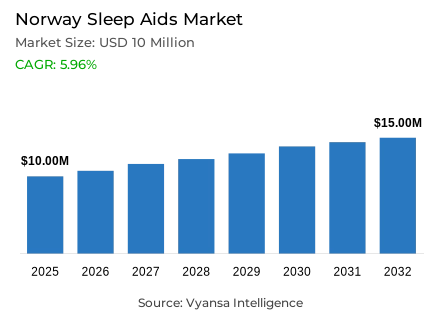
- Sleep aids market size in Norway was estimated at USD 10 million in 2025.
- The market size is expected to grow to USD 15 million by 2032.
- Market to register a CAGR of around 5.96% during 2026-32.
- Product Shares
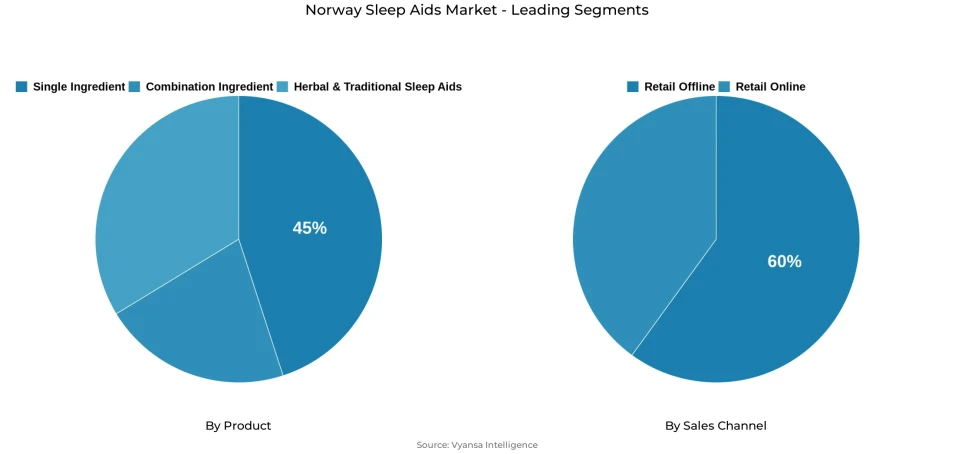
- Single ingredient grabbed market share of 45%.
- Competition
- More than 5 companies are actively engaged in producing sleep aids in Norway.
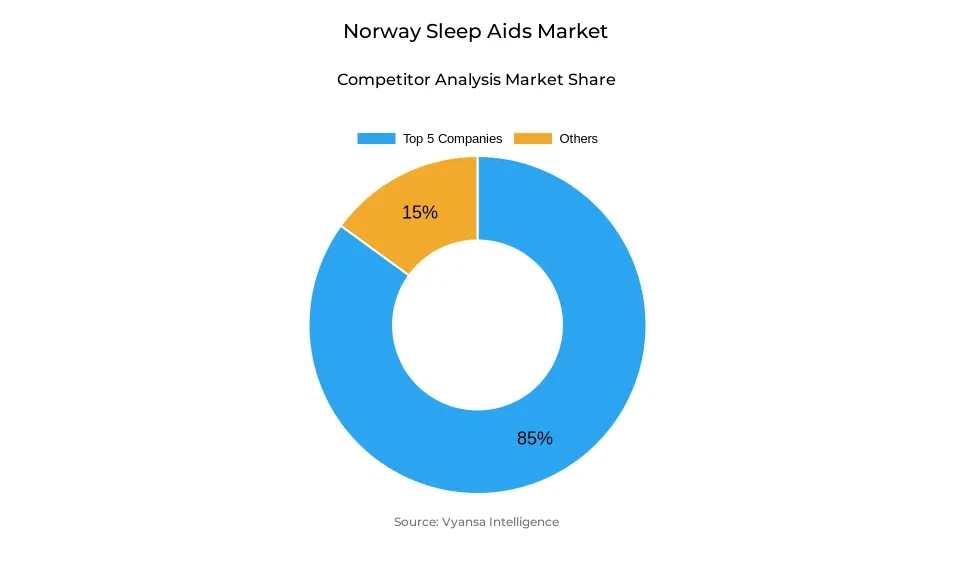
- Top 5 companies acquired around 85% of the market share.
- Norsk Medisinaldepot AS, Lifeline Pharma AS, Orion Pharma AS, Sana Pharma Medical AS, Orkla Health AS etc., are few of the top companies.
- Sales channel
- Retail offline grabbed 60% of the market.
Norway Sleep Aids Market Outlook
The Norway sleep aids market is experiencing stable expansion, supported by the normalization of melatonin within daily wellness routines. The market is valued at USD 10 million in 2025 and is projected to reach USD 15 million by 2032, reflecting a CAGR of 5.96%. Growth is underpinned by demographic ageing and a broader preventive-health orientation, where sleep support is increasingly integrated into mental and physical wellbeing strategies.
Consumer perception has shifted meaningfully, with melatonin increasingly viewed as a routine supplement rather than a medicinal intervention. This repositioning has reduced stigma, particularly among middle-aged and older adults. At the same time, Norwegians frequently combine mild OTC supplementation with structured sleep hygiene practices and mindfulness applications, reflecting a blended product-and-behaviour approach to sleep improvement.
Competitive dynamics include established suppliers such as Sana Pharma Medical AS alongside growing pharmacy private-label competition. Chains including Apotek 1 are strengthening market presence through competitively priced alternatives. While innovation remains relatively conservative in traditional formats such as capsules and sprays, increasing adoption of wearable sleep trackers may support data-informed product positioning in the medium term.
Pharmacies remain the cornerstone of distribution, offering trusted consultation and product reassurance. Retail online continues to expand as a price-comparison and review-based channel. By 2032, deeper integration of sleep aids within broader vitamin and supplement portfolios is expected to reinforce category resilience and steady value growth.
Norway Sleep Aids Market Growth DriverLow-Dose Melatonin Availability Supports Routine and Planned End User Purchasing
Melatonin remains central to the Norwegian sleep aids category, supported by the structured availability of regulated, low-dose over-the-counter formulations. Its positioning—closer to a supplement-style routine aid than a strong sedative—reduces hesitation among end users managing mild or occasional sleep disturbances. This facilitates planned and repeat purchasing behaviour, particularly among individuals seeking a single, clearly defined active ingredient with predictable outcomes.
The Norwegian Medicines Agency authorizes OTC melatonin in tablets of 2 mg, 3 mg, 4 mg, and 5 mg, and as an oral solution of 1 mg per millilitre, with maximum approved pack sizes defined. This clearly structured regulatory framework provides transparency for both manufacturers and pharmacies, supporting stable assortment planning and consistent consumer access.
Norway Sleep Aids Market ChallengeDigital Sleep Hygiene Alternatives Moderate Frequency of Product-Based Purchases
High digital literacy and adoption of non-pharmacological sleep management tools are moderating product purchase frequency. Structured sleep hygiene routines, relaxation apps, and self-monitoring platforms allow some end users to manage mild disturbances without consistent reliance on OTC solutions. As a result, purchasing patterns are often intermittent rather than habitual.
Digital accessibility is near universal. Statistics Norway reports that in 2025, 100% of individuals aged 16–79 used the internet within the past three months, while 97% used it for email and 97% for online banking. This level of digital integration supports rapid uptake of app-based sleep management alternatives, raising the competitive threshold for product-only positioning in the category.
Unlock Market Intelligence
Explore the market potential with our data-driven report
Norway Sleep Aids Market TrendRetail Online Comparison Behaviour Gains Increasing Relevance
Retail online channels are becoming increasingly relevant as comparison platforms within the Norwegian market. End users value the ability to review ingredient lists, evaluate pricing differences, and substitute between branded and own-label products. This aligns with a trial-based approach to sleep support, where efficacy perception varies between individuals.
Statistics Norway’s ICT survey indicates that in 2025, 42% of individuals aged 16–79 reported selling goods or services online, while 62% reported purchasing or ordering digital content such as films or music. These figures reflect mature digital transaction behaviour, supporting the continued development of online research-and-buy pathways alongside traditional pharmacy retail.
Norway Sleep Aids Market OpportunityTravel-Related Sleep Disruption Creates a Well-Defined and Recurring Demand Trigger
Travel-induced sleep disruption represents a recurring and anticipatory trigger for sleep aid purchases. Products positioned for jet lag mitigation or circadian rhythm adjustment benefit from planned buying behaviour prior to departure or immediately upon return. This reduces stigma and supports repeat demand cycles.
According to the Travel Survey by Statistics Norway, outbound travel activity remains significant, with 0.72 million outbound trips recorded in the fourth quarter of 2025 and 7.02 million total trips in the same quarter. Tourist spending reached NOK 46.52 billion during Q4 2025. This sustained travel volume creates a clear commercial opportunity for pharmacies and online retailers to bundle sleep aids within travel kits and circadian adjustment messaging frameworks, reinforcing repeat and situational demand drivers.
Unlock Market Intelligence
Explore the market potential with our data-driven report
Norway Sleep Aids Market Segmentation Analysis
By Product
- Single Ingredient
- Combination Ingredient
- Herbal & Traditional Sleep Aids
The segment with highest market share under Product is Single-Ingredient products account for approximately 45% of total market value, making them the dominant segment. This leadership is largely driven by melatonin’s established presence as a clearly dosed, predictable active ingredient. Consumers appreciate transparency and simplicity, particularly when managing circadian rhythm adjustment or mild sleep latency issues.
The clarity of mono-ingredient formulations appeals strongly to older demographics and first-time users who prioritize dosage precision and perceived safety. Although herbal and combination alternatives are available, they often face skepticism regarding efficacy consistency. Single-ingredient positioning is therefore expected to remain the anchor of Norway’s sleep aids landscape through 2032, aligned with preventive wellness preferences.
By Sales Channel
- Retail Online
- Retail Offline
Retail Offline holds approximately 60% of total market share, maintaining leadership within the sales channel structure. Physical pharmacies continue to serve as trusted advisory environments, particularly for older end users seeking dosage guidance and reassurance regarding supplement combinations.
Although retail online is gaining momentum due to convenience and pricing transparency, immediate access and personalized consultation sustain offline dominance. Pharmacies frequently merchandise sleep aids alongside vitamins and general wellness supplements, reinforcing routine integration into daily health practices. This established retail infrastructure and high consumer trust are expected to preserve offline channel leadership in Norway through 2032.
List of Companies Covered in Norway Sleep Aids Market
The companies listed below are highly influential in the Norway sleep aids market, with a significant market share and a strong impact on industry developments.
- Norsk Medisinaldepot AS
- Lifeline Pharma AS
- Orion Pharma AS
- Sana Pharma Medical AS
- Orkla Health AS
- Norges NaturmedisinSentral AS
- Apotek 1 Norge AS
Competitive Landscape
Norway sleep aids market is led by Sana Pharma Medical AS, whose Sedix, Melatonin, and Lunixen brands anchor a melatonin-dominated category that has become normalised as part of daily wellness routines. However, share erosion is evident as pharmacy private labels from Apotek 1 (Metode) and Vitusapotek (Vidi Pluss) expand with lower-priced alternatives, intensifying price competition and limiting brand loyalty. Orkla’s Möller’s Pharma and Orion Pharma maintain niche positions, often blending melatonin with valerian or targeting jet lag, though herbal efficacy scepticism constrains uptake. Indirect competition from sleep apps, wearables, and non-pharmaceutical sleep hygiene tools is rising, particularly among younger consumers. Differentiation opportunities lie in premiumised formulations, data-informed personalised marketing, bundle positioning with magnesium and vitamins, and stronger value propositions within pharmacy e-commerce.
Frequently Asked Questions
Related Report
- Market Segmentation
- Research Scope
- Research Methodology
- Definitions and Assumptions
- Executive Summary
- Norway Sleep Aids Market Policies, Regulations, and Standards
- Norway Sleep Aids Market Dynamics
- Growth Factors
- Challenges
- Trends
- Opportunities
- Norway Sleep Aids Market Statistics, 2022-2032F
- Market Size & Growth Outlook
- By Revenues in USD Million
- Market Segmentation & Growth Outlook
- By Product
- Single Ingredient- Market Insights and Forecast 2022-2032, USD Million
- Doxylamine Succinate- Market Insights and Forecast 2022-2032, USD Million
- Diphenhydramine- Market Insights and Forecast 2022-2032, USD Million
- Melatonin- Market Insights and Forecast 2022-2032, USD Million
- Combination Ingredient- Market Insights and Forecast 2022-2032, USD Million
- Diphenhydramine + Acetaminophen- Market Insights and Forecast 2022-2032, USD Million
- Other Antihistamine-Based Combinations- Market Insights and Forecast 2022-2032, USD Million
- Herbal & Traditional Sleep Aids- Market Insights and Forecast 2022-2032, USD Million
- Valerian root- Market Insights and Forecast 2022-2032, USD Million
- Passionflower- Market Insights and Forecast 2022-2032, USD Million
- Chamomile- Market Insights and Forecast 2022-2032, USD Million
- Kava- Market Insights and Forecast 2022-2032, USD Million
- Multi-Herbal Sleep Blends- Market Insights and Forecast 2022-2032, USD Million
- Single Ingredient- Market Insights and Forecast 2022-2032, USD Million
- By Sleep Disorder
- Insomnia- Market Insights and Forecast 2022-2032, USD Million
- Sleep Apnea- Market Insights and Forecast 2022-2032, USD Million
- Restless Legs Syndrome- Market Insights and Forecast 2022-2032, USD Million
- Narcolepsy- Market Insights and Forecast 2022-2032, USD Million
- Sleep Walking- Market Insights and Forecast 2022-2032, USD Million
- Others- Market Insights and Forecast 2022-2032, USD Million
- By Age Group
- Young to Mid Adults (25-44 Years)- Market Insights and Forecast 2022-2032, USD Million
- Middle-Aged Adults (45-64 Years)- Market Insights and Forecast 2022-2032, USD Million
- Geriatric Population (65+ Years)- Market Insights and Forecast 2022-2032, USD Million
- By Sales Channel
- Retail Online- Market Insights and Forecast 2022-2032, USD Million
- Retail Offline- Market Insights and Forecast 2022-2032, USD Million
- By End User
- Homecare/Individual Consumers- Market Insights and Forecast 2022-2032, USD Million
- Hospitals- Market Insights and Forecast 2022-2032, USD Million
- Sleep Centers & Clinics- Market Insights and Forecast 2022-2032, USD Million
- By Formulation
- Tablets- Market Insights and Forecast 2022-2032, USD Million
- Gummies- Market Insights and Forecast 2022-2032, USD Million
- Capsules- Market Insights and Forecast 2022-2032, USD Million
- Liquid- Market Insights and Forecast 2022-2032, USD Million
- Sublingual- Market Insights and Forecast 2022-2032, USD Million
- By Competitors
- Competition Characteristics
- Market Share & Analysis
- By Product
- Market Size & Growth Outlook
- Norway Single Ingredient Sleep Aids Market Statistics, 2022-2032
- Market Size & Growth Outlook
- By Revenues in USD Million
- Market Segmentation & Growth Outlook
- By Sleep Disorder- Market Insights and Forecast 2022-2032, USD Million
- By Age Group- Market Insights and Forecast 2022-2032, USD Million
- By Sales Channel- Market Insights and Forecast 2022-2032, USD Million
- By End User- Market Insights and Forecast 2022-2032, USD Million
- By Formulation- Market Insights and Forecast 2022-2032, USD Million
- Market Size & Growth Outlook
- Norway Combination Ingredient Sleep Aids Market Statistics, 2022-2032
- Market Size & Growth Outlook
- By Revenues in USD Million
- Market Segmentation & Growth Outlook
- By Sleep Disorder- Market Insights and Forecast 2022-2032, USD Million
- By Age Group- Market Insights and Forecast 2022-2032, USD Million
- By Sales Channel- Market Insights and Forecast 2022-2032, USD Million
- By End User- Market Insights and Forecast 2022-2032, USD Million
- By Formulation- Market Insights and Forecast 2022-2032, USD Million
- Market Size & Growth Outlook
- Norway Herbal & Traditional Sleep Aids Market Statistics, 2022-2032
- Market Size & Growth Outlook
- By Revenues in USD Million
- Market Segmentation & Growth Outlook
- By Sleep Disorder- Market Insights and Forecast 2022-2032, USD Million
- By Age Group- Market Insights and Forecast 2022-2032, USD Million
- By Sales Channel- Market Insights and Forecast 2022-2032, USD Million
- By End User- Market Insights and Forecast 2022-2032, USD Million
- By Formulation- Market Insights and Forecast 2022-2032, USD Million
- Market Size & Growth Outlook
- Competitive Outlook
- Company Profiles
- Sana Pharma Medical AS
- Business Description
- Product Portfolio
- Collaborations & Alliances
- Recent Developments
- Financial Details
- Others
- Orkla Health AS
- Business Description
- Product Portfolio
- Collaborations & Alliances
- Recent Developments
- Financial Details
- Others
- Orion Pharma AS
- Business Description
- Product Portfolio
- Collaborations & Alliances
- Recent Developments
- Financial Details
- Others
- Norges NaturmedisinSentral AS
- Business Description
- Product Portfolio
- Collaborations & Alliances
- Recent Developments
- Financial Details
- Others
- Apotek 1 Norge AS
- Business Description
- Product Portfolio
- Collaborations & Alliances
- Recent Developments
- Financial Details
- Others
- Norsk Medisinaldepot AS
- Business Description
- Product Portfolio
- Collaborations & Alliances
- Recent Developments
- Financial Details
- Others
- Lifeline Pharma AS
- Business Description
- Product Portfolio
- Collaborations & Alliances
- Recent Developments
- Financial Details
- Others
- Wingfirm Pharma AS
- Business Description
- Product Portfolio
- Collaborations & Alliances
- Recent Developments
- Financial Details
- Others
- Others
- Business Description
- Product Portfolio
- Collaborations & Alliances
- Recent Developments
- Financial Details
- Others
- Sana Pharma Medical AS
- Company Profiles
- Disclaimer
| Segment | Sub-Segment |
|---|---|
| By Product |
|
| By Sleep Disorder |
|
| By Age Group |
|
| By Sales Channel |
|
| By End User |
|
| By Formulation |
|
Research Methodology
This study followed a structured approach comprising four key phases to assess the size and scope of the electro-oxidation market. The process began with thorough secondary research to collect data on the target market, related markets, and broader industry context. These findings, along with preliminary assumptions and estimates, were then validated through extensive primary research involving industry experts from across the value chain. To calculate the overall market size, both top-down and bottom-up methodologies were employed. Finally, market segmentation and data triangulation techniques were applied to refine and validate segment-level estimations.
Secondary Research
The secondary research phase involved gathering data from a wide range of credible and published sources. This step helped in identifying industry trends, defining market segmentation, and understanding the market landscape and value chain.
Sources consulted during this phase included:
- Company annual reports, investor presentations, and press releases
- Industry white papers and certified publications
- Trade directories and market-recognized databases
- Articles from authoritative authors and reputable journals
- Gold and silver standard websites
Secondary research was critical in mapping out the industry's value chain and monetary flow, identifying key market segments, understanding regional variations, and tracking significant industry developments.
Other key sources:
- Financial disclosures
- Industry associations and trade bodies
- News outlets and business magazines
- Academic journals and research studies
- Paid industry databases
Primary Research
To validate secondary data and gain deeper market insights, primary research was conducted with key stakeholders across both the supply and demand sides of the market.
On the demand side, participants included decision-makers and influencers from end-user industries—such as CIOs, CTOs, and CSOs—who provided first-hand perspectives on market needs, product usage, and future expectations.
On the supply side, interviews were conducted with manufacturers, industry associations, and institutional participants to gather insights into current offerings, product pipelines, and market challenges.
Primary interviews provided critical inputs such as:
- Market size and revenue data
- Product and service breakdowns
- Market forecasts
- Regional and application-specific trends
Stakeholders consulted included:
- Leading OEM and solution providers
- Channel and distribution partners
- End users across various applications
- Independent consultants and industry specialists
Market Size Estimation and Data Triangulation
- Identifying Key Market Participants (Secondary Research)
- Goal: To identify the major players or companies in the target market. This typically involves using publicly available data sources such as industry reports, market research publications, and financial statements of companies.
- Tools: Reports from firms like Gartner, Forrester, Euromonitor, Statista, IBISWorld, and others. Public financial statements, news articles, and press releases from top market players.
- Extracting Earnings of Key Market Participants
- Goal: To estimate the earnings generated from the product or service being analyzed. This step helps in understanding the revenue potential of each market player in a specific geography.
- Methods: Earnings data can be gathered from:
- Publicly available financial reports (for listed companies).
- Interviews and primary data sources from professionals, such as Directors, VPs, SVPs, etc. This is especially useful for understanding more nuanced, internal data that isn't publicly disclosed.
- Annual reports and investor presentations of key players.
- Data Collation and Development of a Relevant Data Model
- Goal: To collate inputs from both primary and secondary sources into a structured, data-driven model for market estimation. This model will incorporate key market KPIs and any independent variables relevant to the market.
- Key KPIs: These could include:
- Market size, growth rate, and demand drivers.
- Industry-specific metrics like market share, average revenue per customer (ARPC), or average deal size.
- External variables, such as economic growth rates, inflation rates, or commodity prices, that could affect the market.
- Data Modeling: Based on this data, the market forecasts are developed for the next 5 years. A combination of trend analysis, scenario modeling, and statistical regression might be used to generate projections.
- Scenario Analysis
- Goal: To test different assumptions and validate how sensitive the market is to changes in key variables (e.g., market demand, regulatory changes, technological disruptions).
- Types of Scenarios:
- Base Case: Based on current assumptions and historical data.
- Best-Case Scenario: Assuming favorable market conditions, regulatory environments, and technological advancements.
- Worst-Case Scenario: Accounting for adverse factors, such as economic downturns, stricter regulations, or unexpected disruptions.












