India NRT Smoking Cessation Aids Market Report: Trends, Growth and Forecast (2026-2032)
By Category (NRT Gum, NRT Inhalators, NRT Lozenges, NRT Patches, Other NRT Products), By Gender (Male, Female), By Sales Channel (Retail Online (Online Pharmacies, Brand-Owned Websites, E-commerce Marketplaces), Retail Offline (Hospital, Pharmacies, Drug Stores)), By End User (Individual / Consumer Self-Use, Healthcare-Professional-Supervised (Clinics, De-addiction Centers, Smoking Cessation Centers)), By Region (North, East, West, South) ... Read more
|
Major Players
|
India NRT Smoking Cessation Aids Market Statistics and Insights, 2026
- Market Size Statistics
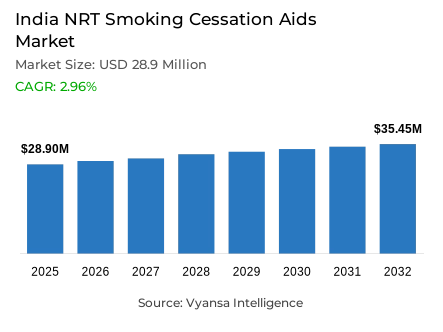
- Nrt smoking cessation aids market size in India was valued at USD 28.9 million in 2025 and is estimated at USD 30.59 million in 2026.
- The market size is expected to grow to USD 35.45 million by 2032.
- Market to register a CAGR of around 2.96% during 2026-32.
- Category Shares
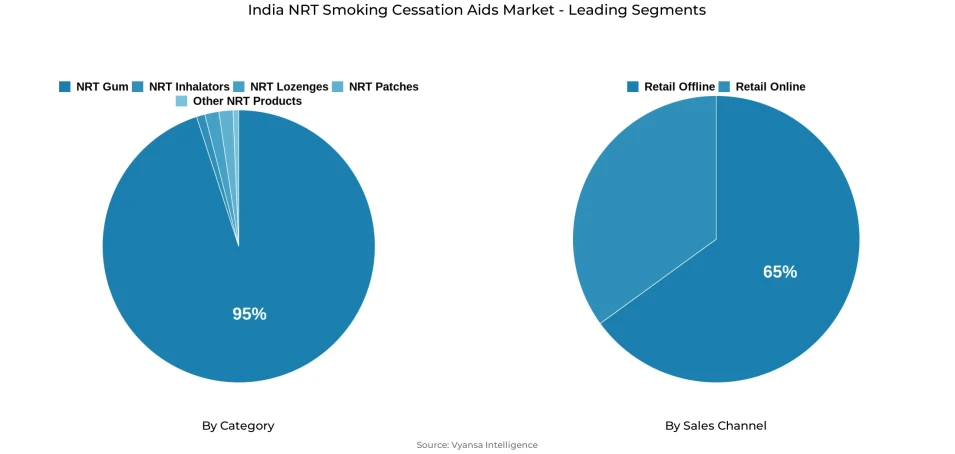
- Nrt gum grabbed market share of 95%.
- Competition
- More than 5 companies are actively engaged in producing nrt smoking cessation aids in India.
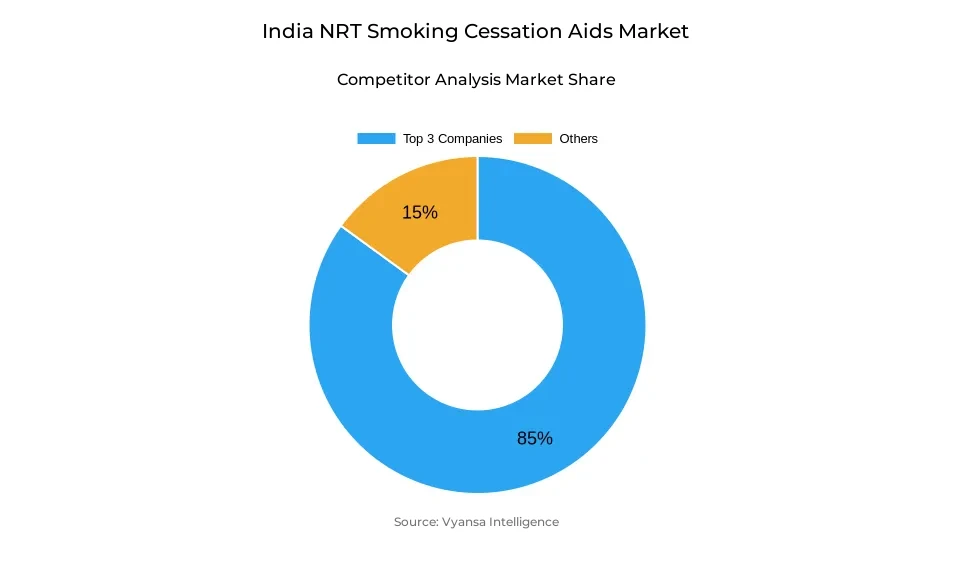
- Top 3 companies acquired around 85% of the market share.
- Elder Pharmaceuticals Ltd, Cipla Ltd, ITC Ltd etc., are few of the top companies.
- Sales Channel
- Retail offline grabbed 65% of the market.
India NRT Smoking Cessation Aids Market Outlook
The India NRT smoking cessation aids market size was valued at USD 28.9 million in 2025 and is projected to grow from USD 30.59 million in 2026 to USD 35.45 million by 2032, exhibiting a CAGR of around 2.96% during the forecast period. Growth is supported by a rising focus on healthier lifestyles and stronger tobacco-control initiatives, which continue to encourage smokers to consider quitting and seek structured support solutions.
A key driver comes from the growing health and wellness mindset, particularly among younger urban consumers. Quitting smoking is increasingly linked with fitness, mental wellbeing, and disease prevention, which raises the relevance of NRT smoking cessation aids as structured tools for managing nicotine cravings. Government initiatives also reinforce this environment. The Ministry of Health and Family Welfare reported in 2025 that tobacco use among schoolchildren aged 13–15 declined to 8.5% from 14.6%, while nationwide efforts under the National Tobacco Control Programme continue to promote quitting.
Despite rising awareness, affordability remains a major challenge in adoption. Price sensitivity influences purchasing decisions, and some smokers compare the cost of cessation products with cheaper or self-directed quitting attempts. Within the product segmentation, NRT gum accounts for about 95% share, reflecting its strong position as the most affordable and widely accepted format within NRT smoking cessation aids, making it a practical option for many smokers attempting to quit.
Distribution patterns also shape purchasing behaviour. Retail offline channels hold around 65% share, as pharmacies and supermarkets provide easy access and build trust among first-time users. Consumers often prefer buying cessation products during routine store visits rather than through purely digital channels. At the same time, India’s quit-support ecosystem continues to expand, with services such as the National Tobacco Quitline (1800 112 356), mCessation programme, and new Tobacco Cessation Centre guidelines in Ayush institutions, which create opportunities to combine behavioural support with NRT smoking cessation aids for more structured quitting journeys.
India NRT Smoking Cessation Aids Market Growth DriverWellness-Led Quitting Gains Strong Consumer Relevance
One of the key motivations behind the nicotine replacement therapy (NRT) smoking cessation support in the Indian market is the increased health and wellness focus of consumers, especially younger urban consumers. Quitting smoking is becoming more of a component of a more comprehensive lifestyle change that includes fitness, mental health, and prevention of disease. As a result, nicotine replacement products become more relevant, with smokers requiring organized means that can help them lead healthier lifestyles and help them to separate themselves with tobacco consumption.
This context is supported by governmental and public-health programs. In 2025, the Ministry of Health and Family Welfare reports that tobacco use among school children aged 13–15 has decreased to 8.5% from 14.6%, while India maintains nationwide tobacco‑control activity through the National Tobacco Control Programme. This testifies to a broader anti-tobacco culture that supports quit intent and reinforces the context of smoking-cessation solutions.
India NRT Smoking Cessation Aids Market ChallengeAffordability Continues to Hold Back Wider Adoption
One of the major threats facing the NRT smoking cessation aids market in India is affordability. Even when consumers indicate that they want to quit, price is a major obstacle in a highly price-sensitive market. The success of nicotine gum is mostly due to the fact that it is the cheapest form, and the more expensive ones will not make smokers invest in a full-fledged cessation program. This weakness limits adoption to a smaller group than would be predicted by quit intent alone.
The pressure mentioned above is in a wider cost-of-living environment. The National Statistics Office reports that India’s headline consumer price index (CPI) inflation was 4.31% in January 2025 and 3.34% in March 2025. Even though inflation has been tamed, such levels are still consequential to lower and middle-income smokers in terms of the price of NRT compared to less expensive or free quitting efforts. Pricing remains one of the biggest obstacles to further category penetration in this environment.
Unlock Market Intelligence
Explore the market potential with our data-driven report
India NRT Smoking Cessation Aids Market TrendPersonalised Formats Are Shaping Purchase Preference
One of the obvious trends in the NRT smoking cessation market in India is the growing popularity of the personalised format choice. Gum, patches, lozenges, sprays, and inhalers are all products that meet different needs as consumers choose products depending on their lifestyle and smoking behaviour. This is important since smokers do not see cessation as a standardized process anymore, they want formats that fit their schedules, desires, and privacy.
This is in line with the trend of the cessation framework in India that is increasingly becoming more structured and support-based. The operational guidelines of the Tobacco Cessation Centres of the Ministry of Health and Family Welfare focus on professional assistance in quitting, and the National Tobacco Quitline and mCessation programme are the supplementary access points. Collectively, these systems facilitate a more customised cessation process where product format is incorporated into a more comprehensive personalised quitting process.
India NRT Smoking Cessation Aids Market OpportunityBehavioural Support Creates the Next Growth Lever
One of the NRT smoking cessation aids market opportunities that India has is the incorporation of nicotine replacement products with behavioural therapy and digital support. A more integrated quitting strategy is becoming more relevant, with smokers becoming aware that effective cessation may need both craving management and behaviour change. This leaves space to brands and healthcare providers to position NRT not as a product, but as a component of a holistic quit-support ecosystem.
This model is already supported by the public-health infrastructure of India. The National Tobacco Quitline is available on 1800 112356, and mCessation is available on 01122901701. The government also attests the introduction of operational guidelines of Tobacco Cessation Centres in Ayush institutions in 2025, thus increasing the formal support base of quitting. This increases the chances of NRT products to expand alongside counselling, follow-up, and digital intervention.
Unlock Market Intelligence
Explore the market potential with our data-driven report
India NRT Smoking Cessation Aids Market Segmentation Analysis
By Category
- NRT Gum
- NRT Inhalators
- NRT Lozenges
- NRT Patches
- Other NRT Products
The segment enjoys the highest share within the category of NRT smoking cessation aids, with NRT gum commanding 95% of the market. This leadership role recognizes gum as the most popular format since it is cheap, convenient, and fits light and moderate smokers. Gum is the most viable entry point to consumers who want to quit in a market that is dominated by price sensitivity.
Its management also indicates its compatibility with the Indian daily buying behaviour. Gum is easier to test and easier to use in everyday life than patches, sprays, or inhalers and does not necessitate significant change of habit. Affordability, familiarity, and convenience are the reasons why gum will continue to dominate other forms of NRT in the category mix.
By Sales Channel
- Retail Online
- Online Pharmacies
- Brand-Owned Websites
- E-commerce Marketplaces
- Retail Offline
- Hospital
- Pharmacies
- Drug Stores
The segment similarly commands the highest share among sales channels, where retail offline accounts for 65% of the market. This leadership shows that NRT smoking cessation aids are very accessible in pharmacies and supermarkets, which gives consumers direct physical access to products like gum, lozenges, and patches. Store-based availability is crucial in terms of visibility and trust in a market where awareness is still in the process of formation.
Habit and convenience are also advantageous to offline retail. A significant number of smokers still like to buy cessation products on a regular basis when they visit pharmacies or stores instead of taking a fully online trip. Online platforms are increasing access, but the physical channel remains dominant due to its familiarity, quicker purchase, and easier product discovery by first-time users.
List of Companies Covered in India NRT Smoking Cessation Aids Market
The companies listed below are highly influential in the India nrt smoking cessation aids market, with a significant market share and a strong impact on industry developments.
Competitive Landscape
In 2025, the competitive landscape of NRT smoking cessation aids in India is strongly dominated by Cipla Ltd, which holds a 74.1% value share through its Nicotex brand. Nicotex benefits from a wide portfolio including nicotine gum, lozenges and patches, alongside strong brand awareness initiatives and an extensive distribution network across pharmacies, supermarkets and online platforms. ITC Ltd ranks second with a 14.8% share, maintaining a smaller but notable presence in the category. The market is characterised by high concentration and strong brand leadership, with nicotine gum remaining the dominant format due to its affordability and ease of use. Increasing consumer awareness around health and wellness and growing efforts to quit smoking are supporting category growth, although affordability challenges and the emergence of natural or herbal alternatives are creating additional competitive pressure.
Frequently Asked Questions
Related Report
- Market Segmentation
- Research Scope
- Research Methodology
- Definitions and Assumptions
- Executive Summary
- India NRT Smoking Cessation Aids Market Policies, Regulations, and Standards
- India NRT Smoking Cessation Aids Market Dynamics
- Growth Factors
- Challenges
- Trends
- Opportunities
- India NRT Smoking Cessation Aids Market Statistics, 2022-2032F
- Market Size & Growth Outlook
- By Revenues in USD Million
- Market Segmentation & Growth Outlook
- By Category
- NRT Gum- Market Insights and Forecast 2022-2032, USD Million
- NRT Inhalators- Market Insights and Forecast 2022-2032, USD Million
- NRT Lozenges- Market Insights and Forecast 2022-2032, USD Million
- NRT Patches- Market Insights and Forecast 2022-2032, USD Million
- Other NRT Products- Market Insights and Forecast 2022-2032, USD Million
- By Gender
- Male- Market Insights and Forecast 2022-2032, USD Million
- Female- Market Insights and Forecast 2022-2032, USD Million
- By Sales Channel
- Retail Online- Market Insights and Forecast 2022-2032, USD Million
- Online Pharmacies- Market Insights and Forecast 2022-2032, USD Million
- Brand-Owned Websites- Market Insights and Forecast 2022-2032, USD Million
- E-commerce Marketplaces- Market Insights and Forecast 2022-2032, USD Million
- Retail Offline- Market Insights and Forecast 2022-2032, USD Million
- Hospital- Market Insights and Forecast 2022-2032, USD Million
- Pharmacies- Market Insights and Forecast 2022-2032, USD Million
- Drug Stores- Market Insights and Forecast 2022-2032, USD Million
- Retail Online- Market Insights and Forecast 2022-2032, USD Million
- By End User
- Individual / Consumer Self-Use- Market Insights and Forecast 2022-2032, USD Million
- Healthcare-Professional-Supervised- Market Insights and Forecast 2022-2032, USD Million
- Clinics- Market Insights and Forecast 2022-2032, USD Million
- De-addiction Centers - Market Insights and Forecast 2022-2032, USD Million
- Smoking Cessation Centers- Market Insights and Forecast 2022-2032, USD Million
- By Region
- North
- East
- West
- South
- By Competitors
- Competition Characteristics
- Market Share & Analysis
- By Category
- Market Size & Growth Outlook
- India NRT Gum Market Statistics, 2022-2032
- Market Size & Growth Outlook
- By Revenues in USD Million
- Market Segmentation & Growth Outlook
- By Gender- Market Insights and Forecast 2022-2032, USD Million
- By Sales Channel- Market Insights and Forecast 2022-2032, USD Million
- By End User- Market Insights and Forecast 2022-2032, USD Million
- By Region- Market Insights and Forecast 2022-2032, USD Million
- Market Size & Growth Outlook
- India NRT Inhalators Market Statistics, 2022-2032
- Market Size & Growth Outlook
- By Revenues in USD Million
- Market Segmentation & Growth Outlook
- By Gender- Market Insights and Forecast 2022-2032, USD Million
- By Sales Channel- Market Insights and Forecast 2022-2032, USD Million
- By End User- Market Insights and Forecast 2022-2032, USD Million
- By Region- Market Insights and Forecast 2022-2032, USD Million
- Market Size & Growth Outlook
- India NRT Lozenges Market Statistics, 2022-2032
- Market Size & Growth Outlook
- By Revenues in USD Million
- Market Segmentation & Growth Outlook
- By Gender- Market Insights and Forecast 2022-2032, USD Million
- By Sales Channel- Market Insights and Forecast 2022-2032, USD Million
- By End User- Market Insights and Forecast 2022-2032, USD Million
- By Region- Market Insights and Forecast 2022-2032, USD Million
- Market Size & Growth Outlook
- India NRT Patches Market Statistics, 2022-2032
- Market Size & Growth Outlook
- By Revenues in USD Million
- Market Segmentation & Growth Outlook
- By Gender- Market Insights and Forecast 2022-2032, USD Million
- By Sales Channel- Market Insights and Forecast 2022-2032, USD Million
- By End User- Market Insights and Forecast 2022-2032, USD Million
- By Region- Market Insights and Forecast 2022-2032, USD Million
- Market Size & Growth Outlook
- India Other NRT Products Market Statistics, 2022-2032
- Market Size & Growth Outlook
- By Revenues in USD Million
- Market Segmentation & Growth Outlook
- By Gender- Market Insights and Forecast 2022-2032, USD Million
- By Sales Channel- Market Insights and Forecast 2022-2032, USD Million
- By End User- Market Insights and Forecast 2022-2032, USD Million
- By Region- Market Insights and Forecast 2022-2032, USD Million
- Market Size & Growth Outlook
- Competitive Outlook
- Company Profiles
- Nicotex Cipla Ltd
- Business Description
- Product Portfolio
- Collaborations & Alliances
- Recent Developments
- Financial Details
- Others
- Kwiknic ITC Ltd
- Business Description
- Product Portfolio
- Collaborations & Alliances
- Recent Developments
- Financial Details
- Others
- Nulife (Torrent Pharma GmbH)
- Business Description
- Product Portfolio
- Collaborations & Alliances
- Recent Developments
- Financial Details
- Others
- Others
- Business Description
- Product Portfolio
- Collaborations & Alliances
- Recent Developments
- Financial Details
- Others
- Nicotex Cipla Ltd
- Company Profiles
- Disclaimer
| Segment | Sub-Segment |
|---|---|
| By Category |
|
| By Gender |
|
| By Sales Channel |
|
| By End User |
|
| By Region |
|
Research Methodology
This study followed a structured approach comprising four key phases to assess the size and scope of the electro-oxidation market. The process began with thorough secondary research to collect data on the target market, related markets, and broader industry context. These findings, along with preliminary assumptions and estimates, were then validated through extensive primary research involving industry experts from across the value chain. To calculate the overall market size, both top-down and bottom-up methodologies were employed. Finally, market segmentation and data triangulation techniques were applied to refine and validate segment-level estimations.
Secondary Research
The secondary research phase involved gathering data from a wide range of credible and published sources. This step helped in identifying industry trends, defining market segmentation, and understanding the market landscape and value chain.
Sources consulted during this phase included:
- Company annual reports, investor presentations, and press releases
- Industry white papers and certified publications
- Trade directories and market-recognized databases
- Articles from authoritative authors and reputable journals
- Gold and silver standard websites
Secondary research was critical in mapping out the industry's value chain and monetary flow, identifying key market segments, understanding regional variations, and tracking significant industry developments.
Other key sources:
- Financial disclosures
- Industry associations and trade bodies
- News outlets and business magazines
- Academic journals and research studies
- Paid industry databases
Primary Research
To validate secondary data and gain deeper market insights, primary research was conducted with key stakeholders across both the supply and demand sides of the market.
On the demand side, participants included decision-makers and influencers from end-user industries—such as CIOs, CTOs, and CSOs—who provided first-hand perspectives on market needs, product usage, and future expectations.
On the supply side, interviews were conducted with manufacturers, industry associations, and institutional participants to gather insights into current offerings, product pipelines, and market challenges.
Primary interviews provided critical inputs such as:
- Market size and revenue data
- Product and service breakdowns
- Market forecasts
- Regional and application-specific trends
Stakeholders consulted included:
- Leading OEM and solution providers
- Channel and distribution partners
- End users across various applications
- Independent consultants and industry specialists
Market Size Estimation and Data Triangulation
- Identifying Key Market Participants (Secondary Research)
- Goal: To identify the major players or companies in the target market. This typically involves using publicly available data sources such as industry reports, market research publications, and financial statements of companies.
- Tools: Reports from firms like Gartner, Forrester, Euromonitor, Statista, IBISWorld, and others. Public financial statements, news articles, and press releases from top market players.
- Extracting Earnings of Key Market Participants
- Goal: To estimate the earnings generated from the product or service being analyzed. This step helps in understanding the revenue potential of each market player in a specific geography.
- Methods: Earnings data can be gathered from:
- Publicly available financial reports (for listed companies).
- Interviews and primary data sources from professionals, such as Directors, VPs, SVPs, etc. This is especially useful for understanding more nuanced, internal data that isn't publicly disclosed.
- Annual reports and investor presentations of key players.
- Data Collation and Development of a Relevant Data Model
- Goal: To collate inputs from both primary and secondary sources into a structured, data-driven model for market estimation. This model will incorporate key market KPIs and any independent variables relevant to the market.
- Key KPIs: These could include:
- Market size, growth rate, and demand drivers.
- Industry-specific metrics like market share, average revenue per customer (ARPC), or average deal size.
- External variables, such as economic growth rates, inflation rates, or commodity prices, that could affect the market.
- Data Modeling: Based on this data, the market forecasts are developed for the next 5 years. A combination of trend analysis, scenario modeling, and statistical regression might be used to generate projections.
- Scenario Analysis
- Goal: To test different assumptions and validate how sensitive the market is to changes in key variables (e.g., market demand, regulatory changes, technological disruptions).
- Types of Scenarios:
- Base Case: Based on current assumptions and historical data.
- Best-Case Scenario: Assuming favorable market conditions, regulatory environments, and technological advancements.
- Worst-Case Scenario: Accounting for adverse factors, such as economic downturns, stricter regulations, or unexpected disruptions.












