India Ayurvedic Personal Care Products Market Report: Trends, Growth and Forecast (2026-2032)
By Product Type (Skin Care, Hair Care, Oral Care, Bath & Body Care, Baby Care, Grooming Products, Hygiene/Wellness Personal Care), By Category/Application (Daily Care, Preventive Care, Problem-solution Care, Premium Ritual-based Care), By Ingredient Type (Herbal/Natural, Organic Ayurvedic, Classical Ayurvedic Ingredient-based, Hybrid Ayurvedic + Modern Actives), By Age Group (Infants & Children (0-12 Years), Teenagers (13-19 Years), Adults (20-59 Years), Seniors (60 Years & Above)), By Gender (Men, Women, Unisex), By Price (Premium, Mass), By Sales Channel (Retail Offline (General Trade, Modern Trade/Supermarkets/Hypermarkets, Pharmacies/Chemists, Specialty Stores, Brand Outlets), Retail Online (Brand Websites/D2C, E-commerce Marketplaces, Quick Commerce/Online Pharmacy Platforms, Social Commerce)), By Region (North, East, West, South) ... Read more
|
Major Players
|
India Ayurvedic Personal Care Products Market Statistics and Insights, 2026
- Market Size Statistics
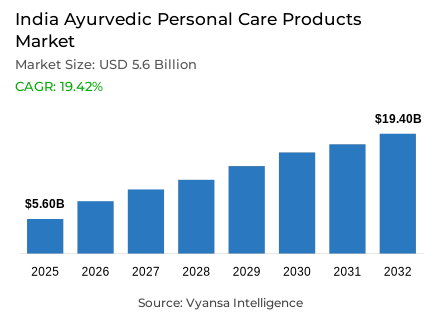
- Ayurvedic personal care products market size in India was valued at USD 5.6 billion in 2025 and is estimated at USD 6.2 billion in 2026.
- The market size is expected to grow to USD 19.4 billion by 2032.
- Market to register a CAGR of around 19.42% during 2026-32.
- Product Type Shares
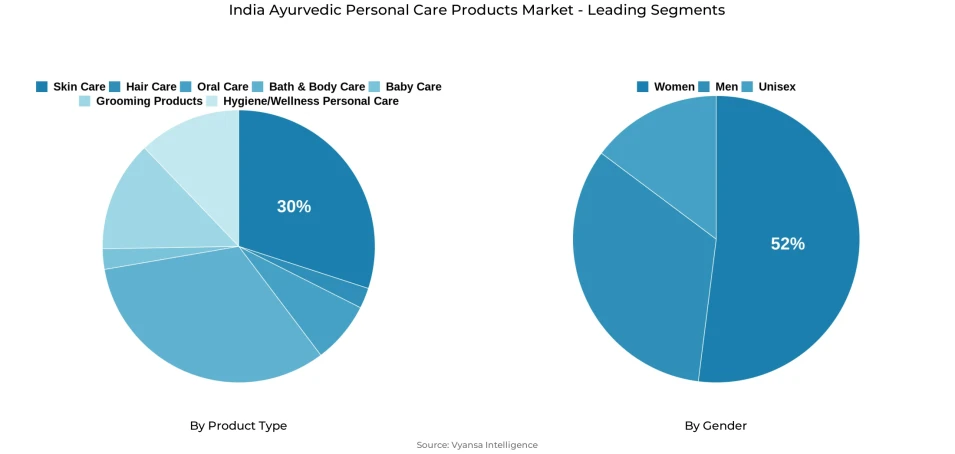
- Skin care grabbed market share of 30%.
- Competition
- More than 10 companies are actively engaged in producing ayurvedic personal care products in India.
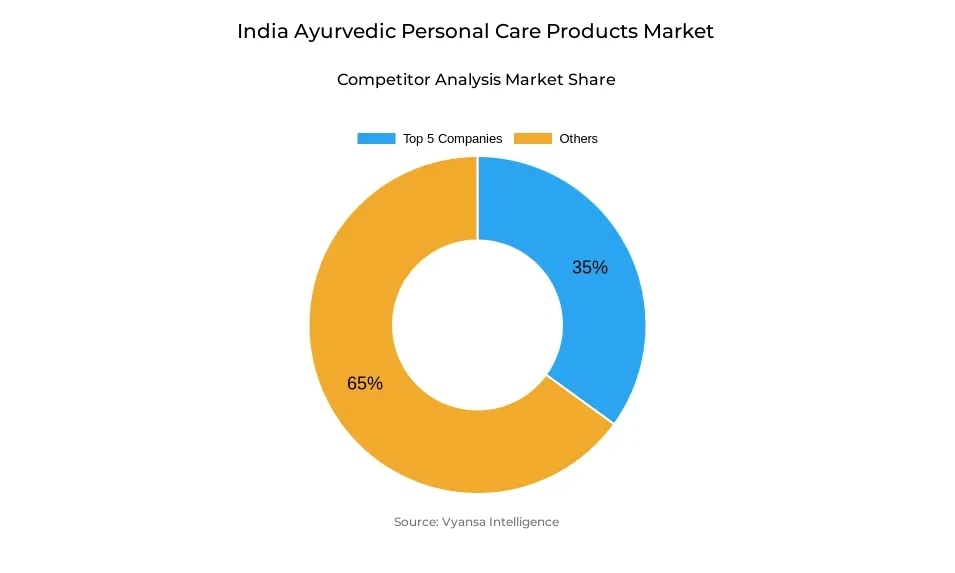
- Top 5 companies acquired around 35% of the market share.
- Biotique, Forest Essentials, Kama Ayurveda, Dabur India Ltd., Himalaya Wellness Company etc., are few of the top companies.
- Gender
- Women grabbed 52% of the market.
India Ayurvedic Personal Care Products Market Outlook
The India ayurvedic personal care products market was valued at USD 5.6 billion in 2025, establishing a commercially powerful foundation at the convergence of traditional wellness science and mainstream personal care consumption. Projected to advance from USD 6.2 billion in 2026 to USD 19.4 billion by 2032, the sector registers a compound annual growth rate of 19.42% across the forecast horizonrepresenting one of the most aggressive expansion trajectories within the broader Indian consumer goods landscape. This near-tripling of market value across the forecast period reflects a structural transformation in consumer self-care behavior, wherein Ayurvedic personal care products have transcended their historical positioning as niche wellness alternatives to become mainstream, daily-relevance categories embedded in skin care, hair care, and personal hygiene routines across socioeconomic segments.
The depth of consumer trust underpinning this trajectory is documented with remarkable precision by the Ministry of Ayush, whose national survey data reveals awareness of Ayush systems reaching 94.8% in rural India and 96% in urban India. Within this awareness base, 46.3% of rural respondents and 52.9% of urban respondents report active Ayush usage for prevention or treatment within the preceding 365 daysdemonstrating that category engagement is not aspirational but behavioral, reflecting habitual integration of Ayurvedic products into daily personal care routines. The same survey finds that 7 out of 10 households affirm the effectiveness of Ayush medicines and 5 out of 10 characterize side effects as negligiblea trust profile that no synthetic personal care category can replicate through marketing investment alone.
Product concentration patterns reveal a market whose growth architecture is anchored in high-frequency, routine-relevance categories. Skin care commands approximately 30% of total product-type sharethe market's dominant segmentreflecting the natural alignment between Ayurvedic botanical science and daily skin wellness imperatives across hydration, repair, and preventive care functions. Women, representing approximately 52% of total market consumption, function as the primary demand engine, driving category trial velocity, formulation preference signaling, and brand advocacy dynamics across all personal care formats. The simultaneous presence of a 94.8%-plus awareness base and an 86.3% household internet penetration ratereported by the Ministry of Statistics and Programme Implementationcreates an unusually powerful commercial environment where both offline trust depth and digital discovery reach operate as concurrent demand amplifiers.
The forward outlook through 2032 is defined by the convergence of institutional quality credentialing, digital commerce acceleration, and export-linked premiumisation that is collectively elevating the Ayurvedic personal care category's competitive positioning relative to synthetic alternatives. The publication of 2,269 raw-material standards, 426 formulation standards, and 2,799 formulary specifications by the Ministry of Ayush establishes a formal quality architecture that rewards compliance-capable brands with consumer trust premiums. Simultaneously, the 6.11% growth in AYUSH and herbal exports to USD 688.89 million in 2024-25, as reported by the Ministry of Commerce and Industry, validates the international demand thesis and creates expanding headroom for premium, heritage-backed Ayurvedic personal care products in global wellness markets through 2032.
India Ayurvedic Personal Care Products Market Growth Driver
Deep Consumer Trust in Ayush Systems Sustains Structural Demand
The exceptional depth and breadth of consumer trust in Ayush systems represents the foundational structural driver of Ayurvedic personal care demand, functioning as a pre-existing attitudinal infrastructure that substantially reduces the consumer education and brand-building investment required to drive category trial and adoption. Unlike emerging wellness categories that must construct consumer trust from a zero base, Ayurvedic Personal Care Products inherit a centuries-validated credibility framework that positions them favorably against synthetic alternatives across the safety perception, natural formulation preference, and preventive wellness dimensions that increasingly define personal care purchase decisions. This trust inheritance creates a demand environment where product quality and distribution accessibility are the primary commercial variables, rather than fundamental category belief-building.
The quantitative dimensions of this trust foundation are validated with exceptional specificity by the Ministry of Ayush and MoSPI National Sample Survey data from 2025. Awareness of Ayush systems is approximately 94.8% in rural areas of India and 96% in urban areas, although 46.3% of rural respondents reported having used Ayush services over the past year for preventive or curative purposes and 52.9% of urban respondents said the same. This confirms their behavioral commitment to the system as opposed to being merely passively aware of it. Additionally, 70% of households indicated they believe that AYUSH medications are effective, and 50% classified the side effects from the medications as negligible creating an incredibly robust commercial platform for daily Personal Care Products used by consumers where confidence ultimately influences how often an individual will purchase, how loyal they will be to a brand, and whether or not they will pay a higher price until at least 2032.
India Ayurvedic Personal Care Products Market Challenge
Rising Quality Compliance Standards Stratify Market Participation Capability
One critical structural challenge facing Ayurvedic personal care manufacturers is the progressively formalized quality Standard, testing infrastructure, and compliance requirements for AYUSH product categories. This presents a progressively more challenging operational environment for Ayurvedic personal care manufacturers and systematically increases the competitive distance between the well-resourced, quality infrastructure capable brands and the greater number of smaller, less organized competitors in the marketplace. The consumer safety expectations and regulatory scrutiny in personal care categories that have daily skin/scalp contact are at their highest levels of sensitivity. Therefore, the capability to manage quality is not just a compliance obligation; it is also the key determinant of long-term commercial viability and brand trust preservation.
Documents prepared by the Ministry of Ayush provide comprehensive evidence of both the structural specificity of the compliance challenge and the rapidly expanding nature of it. Compliance with established quality standards will continue to be required by law, and there are already a total of 2,269 established raw-material quality standards, 426 established formulation standards, and 2,799 established formularies for ASU&H products providing manufacturers with access to an established, continually expanding source of regulatory reference architecture that they must navigate with precision and consistency. The quality testing infrastructure supporting the regulatory framework includes 34 state drug testing laboratories and 108 private laboratories accredited or licensed to perform Ayurvedic, Siddha, Sowa-Rigpa, or Unani quality assessments of drugs. Brands wanting to leverage the value of possession of quality certification as a marketplace advantage will need to make sustained investments in compliance infrastructure that provide operational reasons as well as marketplace positioning opportunities, as compliant brands enjoy the premium from the consumer based on the trust established through compliance, thus justifying investments made through 2032.
Unlock Market Intelligence
Explore the market potential with our data-driven report
India Ayurvedic Personal Care Products Market Trend
Digital Infrastructure Democratizes Discovery and Accelerates Purchase Conversion
By enhancing consumer access to purchase Ayurvedic Personal Care Products through their use of mobile devices and the Internet, the rapid evolution of Digital Consumer Infrastructure in India is making it possible for consumers to discover products at a wider geographic level than previously through physically constrained, proximity dependent means. Collectively, these have removed both the distribution and awareness barriers that have limited the purchase of Ayurvedic Personal Care Products to those purchasing from an organized retail location. For brands, this digital infrastructure transformation creates both an unprecedented consumer reach opportunity and an intensifying competitive pressure to build sophisticated digital engagement, content marketing, and online reputation management capabilities.
The quantitative foundation of this transformative trend is documented with precision by MoSPI's Comprehensive Modular Survey on Telecom from 2025.86.3% of households in India have access to the internet at home while 85.5% of those households also have at least one smartphone.These figures suggest that a significant amount of the Indian population now has access to digital media and is able to explore and purchase natural products online. with expansive numbers of young people accessing the internet, we see that 15-29 year olds use the internet predominantly in rural areas (92.7% vs. 95.7% of urban users) while younger people use online banking with UPI as their primary method of transferring money (99.5%).This considerable convergence of the two trends will continue to fuel growth in the digital commerce segment of the Ayurvedic personal care space and alter the dynamics of customer acquisition until 2032.
India Ayurvedic Personal Care Products Market Opportunity
Export Momentum and Premiumisation Create Dual-Track Growth Headroom
The rapidly growing global interest in Ayurveda has been aided through growing domestic conscious consumerism. This helps to create two-ways of expanding revenue in the category of domestic growth as well as international demand for Ayurveda. Simply put, the growth potential of this ecosystem goes well beyond pure volume-led or domestic growth expectations. There has been an increase in global demand for natural, authentic products created using established and trusted sources. This offers Indian Ayurvedic manufacturers a unique position to command a premium price for their product in the growing area of clean beauty where primarily plant-based ingredients and authenticity of traditional sources are the basis of premium pricing when compared with synthetic alternatives. The continuing importance placed on certification, traceability of ingredients, and evidence of product performance has created an opportunity for brands investing in true quality documentation and authentic storytelling to gain a competitive advantage through the domestic premiumisation of their products.
The commercial evidence validating both dimensions of this opportunity is documented across multiple official sources. The Ministry of Commerce and Industry reports that AYUSH and herbal exports advanced 6.11% to USD 688.89 million in 2024-25, rising from USD 649.2 million in 2023-24demonstrating sustained and growing international commercial demand for Indian Ayurvedic products. Complementing this export momentum, the Ministry of Ayush reports that medicinal plant trade under HS Code 1211 reached INR 1,855.72 crore in April-August 2025 alonereflecting the raw material supply chain depth that enables credible, traceable ingredient sourcing for premium Ayurvedic personal care formulations. Brands that successfully integrate export-ready quality documentation, compelling heritage brand narratives, and premium positioning strategies will capture disproportionate value from both domestic premiumisation and international market expansion opportunities through 2032.
Unlock Market Intelligence
Explore the market potential with our data-driven report
India Ayurvedic Personal Care Products Market Segmentation Analysis
By Product Type
- Skin Care
- Hair Care
- Oral Care
- Bath & Body Care
- Baby Care
- Grooming Products
- Hygiene/Wellness Personal Care
The segment with highest market share under the product type is skin care, accounting for approximately 30% of the total market. This leading position reflects the fundamental compatibility between Ayurvedic botanical science and the daily skin wellness imperatives that anchor modern personal care routinesa compatibility that gives Ayurvedic skin care products an inherent relevance advantage over synthetic alternatives among consumers seeking gentler, plant-derived formulations for regular use. Skin care's commanding share confirms that the Ayurvedic personal care market's commercial center of gravity lies in high-frequency, routine-integration categories rather than occasional or treatment-specific product formats, creating a demand structure characterized by strong repeat purchase velocity and durable brand loyalty dynamics.
The structural leadership of skin care within the Ayurvedic personal care category is reinforced by its unique positioning at the intersection of beauty, hygiene, and preventive wellnessthree consumer value dimensions that Ayurvedic formulations address simultaneously in ways that synthetic Personal Care Products struggle to replicate authentically. Consumers increasingly seek skin care solutions that deliver visible routine benefits while aligning with broader wellness lifestyle valuesa dual expectation that Ayurvedic skin care products are structurally equipped to fulfill through ingredient heritage, formulation gentleness, and preventive care positioning. As certification, evidence-led product communication, and formalization gain importance across the broader Ayush ecosystem, skin care brands that invest in clinical demonstration and ingredient provenance storytelling will deepen their category authority and purchase frequency advantages through 2032.
By Gender
- Men
- Women
- Unisex
The segment with highest market share under the gender is women, accounting for approximately 52% of the total market. This substantial market presence is indicative of women typically being more engaged than men in their care routines, which span multiple dimensions of personal care (i.e., skin care, hair care, hygiene), involving either naturally based products, such as ayurvedic formulations, or those with higher perceived safety profiles versus other products as well as fit into the larger holistic wellness lifestyle. Therefore, women's leadership within ayurvedic products in personal care is not only characterized by their overall volume, but also by their qualitative impact through their ability to drive innovative formulations, the communication choices made related to those formulations, and brand loyalty, all of which impact the competitive environment for all types of Personal Care Products.
The structural centrality of women consumers to this market's commercial development is reinforced by the routine-use nature of Ayurvedic personal care categories and the strong alignment between women's daily self-care priorities and Ayurvedic products' core value propositions of gentleness, preventive benefit, and natural ingredient integrity. Women demonstrate disproportionately higher receptivity to the combined beauty-wellness positioning that distinguishes Ayurvedic personal care from both conventional beauty products and clinical wellness interventionsmaking them the most commercially responsive audience for ingredient storytelling, quality certification communication, and lifestyle-integrated brand narratives. As the market continues to evolve toward premium formulation complexity and personalized benefit positioning, brands that invest in women-centric innovation, texture development, and targeted communication frameworks will sustain the strongest consumer engagement and loyalty metrics through 2032.
List of Companies Covered in India Ayurvedic Personal Care Products Market
The companies listed below are highly influential in the India ayurvedic Personal Care Products market, with a significant market share and a strong impact on industry developments.
- Biotique
- Forest Essentials
- Kama Ayurveda
- Dabur India Ltd.
- Himalaya Wellness Company
- Patanjali Ayurved Ltd.
- Emami Ltd.
- Vicco Laboratories
- Lotus Herbals
- Lever Ayush
Market News & Updates
- Dabur India Ltd., 2025:
Dabur launched 100% Pure Aloe Vera Gel enriched with Hyaluronic Acid in January 2025 as a new natural personal care product designed for evolving skincare needs. This is relevant to the India Ayurvedic Personal Care Products market because it blends a trusted herbal ingredient with a modern hydrating active, strengthening Dabur’s position in daily-care and problem-solution skin care within the broader natural personal care segment.
- Emami Ltd., 2025:
Emami launched Pure Glow in April 2025, entering the brightening cream segment with a new skincare product positioned around visible brightness, moisturization, and dark-spot reduction. This matters for the India Ayurvedic Personal Care Products market because it expands Emami’s skin care portfolio into a high-demand daily-use beauty and personal care category, combining herbal-led brand equity with modern efficacy-led positioning.
Frequently Asked Questions
Related Report
- Market Segmentation
- Research Scope
- Research Methodology
- Definitions and Assumptions
- Executive Summary
- India Ayurvedic Personal Care Products Market Policies, Regulations, and Standards
- India Ayurvedic Personal Care Products Market Dynamics
- Growth Factors
- Challenges
- Trends
- Opportunities
- India Ayurvedic Personal Care Products Market Statistics, 2022-2032F
- Market Size & Growth Outlook
- By Revenues in USD Million
- Market Segmentation & Growth Outlook
- By Product Type
- Skin Care- Market Insights and Forecast 2022-2032, USD Million
- Hair Care- Market Insights and Forecast 2022-2032, USD Million
- Oral Care- Market Insights and Forecast 2022-2032, USD Million
- Bath & Body Care- Market Insights and Forecast 2022-2032, USD Million
- Baby Care- Market Insights and Forecast 2022-2032, USD Million
- Grooming Products- Market Insights and Forecast 2022-2032, USD Million
- Hygiene/Wellness Personal Care- Market Insights and Forecast 2022-2032, USD Million
- By Category/Application
- Daily Care- Market Insights and Forecast 2022-2032, USD Million
- Preventive Care- Market Insights and Forecast 2022-2032, USD Million
- Problem-solution Care- Market Insights and Forecast 2022-2032, USD Million
- Premium Ritual-based Care- Market Insights and Forecast 2022-2032, USD Million
- By Ingredient Type
- Herbal/Natural- Market Insights and Forecast 2022-2032, USD Million
- Organic Ayurvedic- Market Insights and Forecast 2022-2032, USD Million
- Classical Ayurvedic Ingredient-based- Market Insights and Forecast 2022-2032, USD Million
- Hybrid Ayurvedic + Modern Actives- Market Insights and Forecast 2022-2032, USD Million
- By Age Group
- Infants & Children (0-12 Years)- Market Insights and Forecast 2022-2032, USD Million
- Teenagers (13-19 Years)- Market Insights and Forecast 2022-2032, USD Million
- Adults (20-59 Years)- Market Insights and Forecast 2022-2032, USD Million
- Seniors (60 Years & Above)- Market Insights and Forecast 2022-2032, USD Million
- By Gender
- Men- Market Insights and Forecast 2022-2032, USD Million
- Women- Market Insights and Forecast 2022-2032, USD Million
- Unisex- Market Insights and Forecast 2022-2032, USD Million
- By Price
- Premium- Market Insights and Forecast 2022-2032, USD Million
- Mass- Market Insights and Forecast 2022-2032, USD Million
- By Sales Channel
- Retail Offline- Market Insights and Forecast 2022-2032, USD Million
- General Trade- Market Insights and Forecast 2022-2032, USD Million
- Modern Trade/Supermarkets/Hypermarkets- Market Insights and Forecast 2022-2032, USD Million
- Pharmacies/Chemists- Market Insights and Forecast 2022-2032, USD Million
- Specialty Stores- Market Insights and Forecast 2022-2032, USD Million
- Brand Outlets- Market Insights and Forecast 2022-2032, USD Million
- Retail Online- Market Insights and Forecast 2022-2032, USD Million
- Brand Websites/D2C- Market Insights and Forecast 2022-2032, USD Million
- E-commerce Marketplaces- Market Insights and Forecast 2022-2032, USD Million
- Quick Commerce/Online Pharmacy Platforms- Market Insights and Forecast 2022-2032, USD Million
- Social Commerce- Market Insights and Forecast 2022-2032, USD Million
- Retail Offline- Market Insights and Forecast 2022-2032, USD Million
- By Region
- North
- East
- West
- South
- By Competitors
- Competition Characteristics
- Market Share & Analysis
- By Product Type
- Market Size & Growth Outlook
- India Skin Care Market Statistics, 2022-2032
- Market Size & Growth Outlook
- By Revenues in USD Million
- Market Segmentation & Growth Outlook
- By Category/Application- Market Insights and Forecast 2022-2032, USD Million
- By Ingredient Type- Market Insights and Forecast 2022-2032, USD Million
- By Age Group- Market Insights and Forecast 2022-2032, USD Million
- By Gender- Market Insights and Forecast 2022-2032, USD Million
- By Price- Market Insights and Forecast 2022-2032, USD Million
- By Sales Channel- Market Insights and Forecast 2022-2032, USD Million
- By Region- Market Insights and Forecast 2022-2032, USD Million
- Market Size & Growth Outlook
- India Hair Care Market Statistics, 2022-2032
- Market Size & Growth Outlook
- By Revenues in USD Million
- Market Segmentation & Growth Outlook
- By Category/Application- Market Insights and Forecast 2022-2032, USD Million
- By Ingredient Type- Market Insights and Forecast 2022-2032, USD Million
- By Age Group- Market Insights and Forecast 2022-2032, USD Million
- By Gender- Market Insights and Forecast 2022-2032, USD Million
- By Price- Market Insights and Forecast 2022-2032, USD Million
- By Sales Channel- Market Insights and Forecast 2022-2032, USD Million
- By Region- Market Insights and Forecast 2022-2032, USD Million
- Market Size & Growth Outlook
- India Oral Care Market Statistics, 2022-2032
- Market Size & Growth Outlook
- By Revenues in USD Million
- Market Segmentation & Growth Outlook
- By Category/Application- Market Insights and Forecast 2022-2032, USD Million
- By Ingredient Type- Market Insights and Forecast 2022-2032, USD Million
- By Age Group- Market Insights and Forecast 2022-2032, USD Million
- By Gender- Market Insights and Forecast 2022-2032, USD Million
- By Price- Market Insights and Forecast 2022-2032, USD Million
- By Sales Channel- Market Insights and Forecast 2022-2032, USD Million
- By Region- Market Insights and Forecast 2022-2032, USD Million
- Market Size & Growth Outlook
- India Bath & Body Care Market Statistics, 2022-2032
- Market Size & Growth Outlook
- By Revenues in USD Million
- Market Segmentation & Growth Outlook
- By Category/Application- Market Insights and Forecast 2022-2032, USD Million
- By Ingredient Type- Market Insights and Forecast 2022-2032, USD Million
- By Age Group- Market Insights and Forecast 2022-2032, USD Million
- By Gender- Market Insights and Forecast 2022-2032, USD Million
- By Price- Market Insights and Forecast 2022-2032, USD Million
- By Sales Channel- Market Insights and Forecast 2022-2032, USD Million
- By Region- Market Insights and Forecast 2022-2032, USD Million
- Market Size & Growth Outlook
- India Baby Care Market Statistics, 2022-2032
- Market Size & Growth Outlook
- By Revenues in USD Million
- Market Segmentation & Growth Outlook
- By Category/Application- Market Insights and Forecast 2022-2032, USD Million
- By Ingredient Type- Market Insights and Forecast 2022-2032, USD Million
- By Age Group- Market Insights and Forecast 2022-2032, USD Million
- By Gender- Market Insights and Forecast 2022-2032, USD Million
- By Price- Market Insights and Forecast 2022-2032, USD Million
- By Sales Channel- Market Insights and Forecast 2022-2032, USD Million
- By Region- Market Insights and Forecast 2022-2032, USD Million
- Market Size & Growth Outlook
- India Grooming Products Market Statistics, 2022-2032
- Market Size & Growth Outlook
- By Revenues in USD Million
- Market Segmentation & Growth Outlook
- By Category/Application- Market Insights and Forecast 2022-2032, USD Million
- By Ingredient Type- Market Insights and Forecast 2022-2032, USD Million
- By Age Group- Market Insights and Forecast 2022-2032, USD Million
- By Gender- Market Insights and Forecast 2022-2032, USD Million
- By Price- Market Insights and Forecast 2022-2032, USD Million
- By Sales Channel- Market Insights and Forecast 2022-2032, USD Million
- By Region- Market Insights and Forecast 2022-2032, USD Million
- Market Size & Growth Outlook
- India Hygiene/Wellness Personal Care Market Statistics, 2022-2032
- Market Size & Growth Outlook
- By Revenues in USD Million
- Market Segmentation & Growth Outlook
- By Category/Application- Market Insights and Forecast 2022-2032, USD Million
- By Ingredient Type- Market Insights and Forecast 2022-2032, USD Million
- By Age Group- Market Insights and Forecast 2022-2032, USD Million
- By Gender- Market Insights and Forecast 2022-2032, USD Million
- By Price- Market Insights and Forecast 2022-2032, USD Million
- By Sales Channel- Market Insights and Forecast 2022-2032, USD Million
- By Region- Market Insights and Forecast 2022-2032, USD Million
- Market Size & Growth Outlook
- Competitive Outlook
- Company Profiles
- Dabur India Ltd.
- Business Description
- Product Portfolio
- Collaborations & Alliances
- Recent Developments
- Financial Details
- Others
- Himalaya Wellness Company
- Business Description
- Product Portfolio
- Collaborations & Alliances
- Recent Developments
- Financial Details
- Others
- Patanjali Ayurved Ltd.
- Business Description
- Product Portfolio
- Collaborations & Alliances
- Recent Developments
- Financial Details
- Others
- Emami Ltd.
- Business Description
- Product Portfolio
- Collaborations & Alliances
- Recent Developments
- Financial Details
- Others
- Vicco Laboratories
- Business Description
- Product Portfolio
- Collaborations & Alliances
- Recent Developments
- Financial Details
- Others
- Biotique
- Business Description
- Product Portfolio
- Collaborations & Alliances
- Recent Developments
- Financial Details
- Others
- Forest Essentials
- Business Description
- Product Portfolio
- Collaborations & Alliances
- Recent Developments
- Financial Details
- Others
- Kama Ayurveda
- Business Description
- Product Portfolio
- Collaborations & Alliances
- Recent Developments
- Financial Details
- Others
- Lotus Herbals
- Business Description
- Product Portfolio
- Collaborations & Alliances
- Recent Developments
- Financial Details
- Others
- Lever Ayush
- Business Description
- Product Portfolio
- Collaborations & Alliances
- Recent Developments
- Financial Details
- Others
- Dabur India Ltd.
- Company Profiles
- Disclaimer
| Segment | Sub-Segment |
|---|---|
| By Product Type |
|
| By Category/Application |
|
| By Ingredient Type |
|
| By Age Group |
|
| By Gender |
|
| By Price |
|
| By Sales Channel |
|
| By Region |
|
Research Methodology
This study followed a structured approach comprising four key phases to assess the size and scope of the electro-oxidation market. The process began with thorough secondary research to collect data on the target market, related markets, and broader industry context. These findings, along with preliminary assumptions and estimates, were then validated through extensive primary research involving industry experts from across the value chain. To calculate the overall market size, both top-down and bottom-up methodologies were employed. Finally, market segmentation and data triangulation techniques were applied to refine and validate segment-level estimations.
Secondary Research
The secondary research phase involved gathering data from a wide range of credible and published sources. This step helped in identifying industry trends, defining market segmentation, and understanding the market landscape and value chain.
Sources consulted during this phase included:
- Company annual reports, investor presentations, and press releases
- Industry white papers and certified publications
- Trade directories and market-recognized databases
- Articles from authoritative authors and reputable journals
- Gold and silver standard websites
Secondary research was critical in mapping out the industry's value chain and monetary flow, identifying key market segments, understanding regional variations, and tracking significant industry developments.
Other key sources:
- Financial disclosures
- Industry associations and trade bodies
- News outlets and business magazines
- Academic journals and research studies
- Paid industry databases
Primary Research
To validate secondary data and gain deeper market insights, primary research was conducted with key stakeholders across both the supply and demand sides of the market.
On the demand side, participants included decision-makers and influencers from end-user industries—such as CIOs, CTOs, and CSOs—who provided first-hand perspectives on market needs, product usage, and future expectations.
On the supply side, interviews were conducted with manufacturers, industry associations, and institutional participants to gather insights into current offerings, product pipelines, and market challenges.
Primary interviews provided critical inputs such as:
- Market size and revenue data
- Product and service breakdowns
- Market forecasts
- Regional and application-specific trends
Stakeholders consulted included:
- Leading OEM and solution providers
- Channel and distribution partners
- End users across various applications
- Independent consultants and industry specialists
Market Size Estimation and Data Triangulation
- Identifying Key Market Participants (Secondary Research)
- Goal: To identify the major players or companies in the target market. This typically involves using publicly available data sources such as industry reports, market research publications, and financial statements of companies.
- Tools: Reports from firms like Gartner, Forrester, Euromonitor, Statista, IBISWorld, and others. Public financial statements, news articles, and press releases from top market players.
- Extracting Earnings of Key Market Participants
- Goal: To estimate the earnings generated from the product or service being analyzed. This step helps in understanding the revenue potential of each market player in a specific geography.
- Methods: Earnings data can be gathered from:
- Publicly available financial reports (for listed companies).
- Interviews and primary data sources from professionals, such as Directors, VPs, SVPs, etc. This is especially useful for understanding more nuanced, internal data that isn't publicly disclosed.
- Annual reports and investor presentations of key players.
- Data Collation and Development of a Relevant Data Model
- Goal: To collate inputs from both primary and secondary sources into a structured, data-driven model for market estimation. This model will incorporate key market KPIs and any independent variables relevant to the market.
- Key KPIs: These could include:
- Market size, growth rate, and demand drivers.
- Industry-specific metrics like market share, average revenue per customer (ARPC), or average deal size.
- External variables, such as economic growth rates, inflation rates, or commodity prices, that could affect the market.
- Data Modeling: Based on this data, the market forecasts are developed for the next 5 years. A combination of trend analysis, scenario modeling, and statistical regression might be used to generate projections.
- Scenario Analysis
- Goal: To test different assumptions and validate how sensitive the market is to changes in key variables (e.g., market demand, regulatory changes, technological disruptions).
- Types of Scenarios:
- Base Case: Based on current assumptions and historical data.
- Best-Case Scenario: Assuming favorable market conditions, regulatory environments, and technological advancements.
- Worst-Case Scenario: Accounting for adverse factors, such as economic downturns, stricter regulations, or unexpected disruptions.












