Brazil Digestive Remedies Market Report: Trends, Growth and Forecast (2026-2032)
By Product Type (Paediatric Digestive Remedies (Paediatric Diarrhoeal Remedies, Paediatric Indigestion & Heartburn Remedies, Paediatric Laxatives, Paediatric Motion Sickness Remedies), Diarrhoeal Remedies, IBS Treatments, Indigestion & Heartburn Remedies (Antacids, Antiflatulents, Digestive Enzymes, H2 Blockers, Proton Pump Inhibitors), Laxatives, Motion Sickness Remedies), By Age Group (Children & Adolescents (01-17 years), Adults (18-65 years), Geriatric (65+ years)), By Sales Channel (Retail Online, Retail Offline (Hospitals, Clinics, Pharmacies)), By Region (North, Center-West, Northeast, Southeast, South) ... Read more
|
Major Players
|
Brazil Digestive Remedies Market Statistics and Insights, 2026
- Market Size Statistics
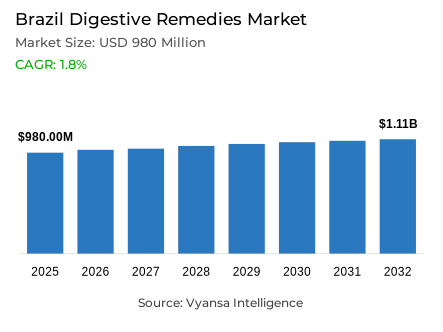
- Digestive remedies market size in Brazil was valued at USD 980 million in 2025 and is estimated at USD 985.8 million in 2026.
- The market size is expected to grow to USD 1.11 billion by 2032.
- Market to register a CAGR of around 1.8% during 2026-32.
- Product Type Shares
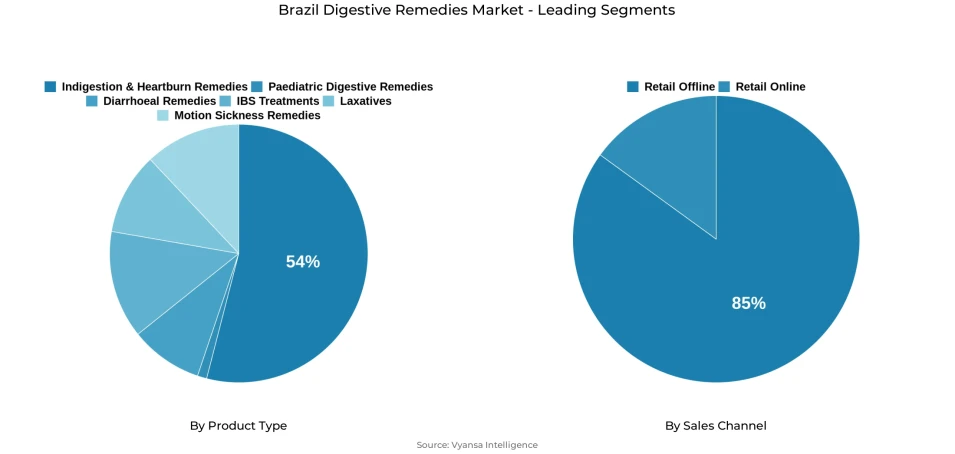
- Indigestion & heartburn remedies grabbed market share of 54%.
- Competition
- More than 15 companies are actively engaged in producing digestive remedies in Brazil.
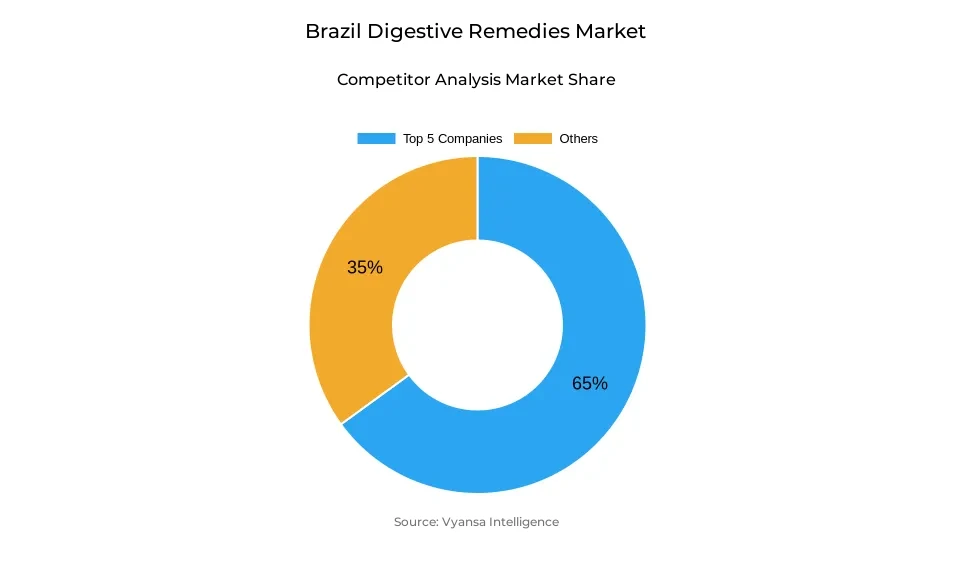
- Top 5 companies acquired around 65% of the market share.
- Uniao Quimica Farmaceutica Nacional SA, Johnson & Johnson Industrial Ltda, Medley SA Industria Farmaceutica, Hypera SA, GlaxoSmithKline Brasil Ltda etc., are few of the top companies.
- Sales Channel
- Retail offline grabbed 85% of the market.
Brazil Digestive Remedies Market Outlook
The Brazil digestive remedies market size was valued at USD 980 million in 2025 and is projected to grow from USD 985.8 million in 2026 to USD 1.11 billion by 2032, exhibiting a CAGR of around 1.8% during the forecast period. Growth is supported by steady demand for products that provide quick relief from indigestion, heartburn, and other digestive discomforts linked with modern eating habits. Increasing consumption of processed and ultra-processed foods is reinforcing the need for fast and accessible solutions, which keeps digestive care products relevant for everyday symptom management.
Changes in dietary habits are keeping the need for fast relief products. In Brazil, the Ministry of Health reported that out of almost 39,000 packaged food and beverage launches, over 60% were ultra-processed; about 18% were fresh or minimally processed. As a result of this trend, many people use fast-acting self-medication after eating due to experiencing post-meal gastrointestinal discomfort. Of the various types of digestive aids, indigestion and heartburn medications account for about 54% of all sales due to being the most relevant products when it comes to providing immediate relief from common digestive problems.
However, preventive digestive health solutions remain less accessible for the broader population. Premium natural products and Amazonian superfoods are gaining attention, but affordability limits their wider adoption. According to Brazilian Institute of Geography and Statistics (IBGE), Brazil’s per capita household earnings reach R$2,316 in 2025, which encourages consumers to prioritise lower-priced symptomatic digestive remedies instead of higher-cost preventive options. This keeps everyday digestive care largely focused on fast relief rather than long-term preventive approaches.
Retail structure also shapes how consumers access digestive solutions. Retail offline channels account for about 85% of sales, as purchases often happen when symptoms appear and require immediate relief. Physical pharmacies and stores support quick buying decisions, especially for convenient formats such as sachets, chewable tablets, and single-dose liquids. In addition, demographic changes are creating long-term demand, with people aged 60 and above representing 16.1% of the population in 2024, according to IBGE, reinforcing the relevance of digestive remedies for regular digestive support and daily wellbeing.
Brazil Digestive Remedies Market Growth DriverPoorer Eating Habits Keep Fast Relief Relevant
One of the factors that have led to the growth of the market of digestive remedies in Brazil is the growing need to relieve food-related digestive discomfort quickly. Customers are increasingly abandoning traditional meals in favor of processed foods that are saltier, fattier, and higher in sugars, which increases the demand of remedies that counter indigestion, heartburn, and post-meal discomfort. This trend keeps the digestive remedies relevant because most consumers are more inclined to self-medicate instantly instead of waiting until the symptoms worsen.
The official data on the food market supports this pattern. In 2025, Brazil’s Ministry of Health reported that, out of nearly 39,000 packaged foods and beverages introduced in the country between November 2020 and November 2024, 62% were classified as ultra‑processed, while only 18.4% were fresh or minimally processed. This nutritional climate therefore directly contributes to an increased demand of products that alleviate digestive symptoms rapidly.
Brazil Digestive Remedies Market ChallengePremium Preventive Gut Health Still Struggles to Scale
The major issue facing the category is that preventive gut-health solutions are still too expensive to be adopted by a large number of people. Natural digestive products and Amazonian superfoods are getting traction, but their higher-end positioning limits them to a comparatively small, higher-income consumer base. As a result, the market is marked by the increased interest in prevention, whereas mainstream demand is focused on cheaper symptomatic relief.
This affordability barrier is highlighted in official income data. According to IBGE, the per-capita household income in Brazil was R$2,316 in 2025. In this regard, a large number of consumers will tend to focus on cheaper digestive products rather than high-quality preventive products. This dynamic limits the rate at which natural and lifestyle-based gut-health propositions can proliferate throughout the mass market, despite the fact that awareness of and interest in prevention are on the rise.
Unlock Market Intelligence
Explore the market potential with our data-driven report
Brazil Digestive Remedies Market TrendConvenient, Multi-Format Relief Gains Ground
One of the obvious trends in Brazil is the transition to more convenient and flexible forms of digestive remedies. Single-dose liquids, single-dose sachets, chewable pills, and combinations of active ingredients are gaining popularity due to their faster and easier action. These formats are more compatible with the daily lives of the consumers as they save on the amount of money spent on a purchase and are easy to use, transport, and repeat, thus making them more attractive to a wider range of consumers.
The trend is also consistent with the wider gastrointestinal utilisation cases. In 2025, Anvisa granted more restrictive prescription and dispensing controls of GLP-1 agonists under RDC 973/2025 and IN 360/2025, which became effective after 60 days. Symptoms like diarrhoea, nausea, reflux, and constipation are linked to the increasing use of GLP-1 medicines, which is why practical digestive remedies with flexible formats are gaining more and more relevance.
Brazil Digestive Remedies Market OpportunityAn Older Consumer Base Opens More Room for Gut Support
One of the key opportunities of the category is based on the ageing population in Brazil. The problem of upper digestion is still one of the primary concerns of consumers aged 60 and older, and the demographic transition is raising the number of people who are inherently more susceptible to digestive discomfort. This opens room to brands to position digestive remedies not just to relieve symptoms immediately but also to support the digestive system on a regular basis and overall well-being.
The latest official demographic release supports that direction. IBGE’s 2025 publication on household and population characteristics shows that people aged 60 years or over account for 16.1% of Brazil’s population in 2024, based on National Household Sample Survey (PNAD) Contínua results released in 2025. That is the newest official reading available and it underlines why senior-focused digestive support has clear long-term commercial space.
Unlock Market Intelligence
Explore the market potential with our data-driven report
Brazil Digestive Remedies Market Segmentation Analysis
By Product Type
- Paediatric Digestive Remedies
- Paediatric Diarrhoeal Remedies
- Paediatric Indigestion & Heartburn Remedies
- Paediatric Laxatives
- Paediatric Motion Sickness Remedies
- Diarrhoeal Remedies
- IBS Treatments
- Indigestion & Heartburn Remedies
- Antacids
- Antiflatulents
- Digestive Enzymes
- H2 Blockers
- Proton Pump Inhibitors
- Laxatives
- Motion Sickness Remedies
The segment has the highest share around product type under the category, with indigestion & heartburn remedies accounting for 54%. This leadership identifies antacids as the largest individual category and highlights strong self-medication demand for quick relief from post-meal heartburn and indigestion. These products remain central because they address common symptoms that consumers want to solve quickly and conveniently.
The broader food environment also supports this position. Brazil’s Ministry of Health reported in 2025 that 62% of nearly 39,000 packaged food and drink launches in the country are ultra-processed, while only 18.4% are fresh or minimally processed. This helps explain why indigestion and heartburn remedies continue to dominate digestive care purchases.
By Sales Channel
- Retail Online
- Retail Offline
- Hospitals
- Clinics
- Pharmacies
The segment has the highest share around the sales channel, where retail offline grabs 85% of the market. This dominance fits the category’s purchase pattern, as digestive remedies are often bought for immediate symptom relief and benefit from strong visibility in physical stores and pharmacies. The sachets, chewables, and single-dose liquids are being used to make purchases easier and more practical in everyday retail settings.
Offline strength is also reinforced by consumer spending realities. IBGE reports that Brazil’s per capita household earnings reach R$2,316 in 2025, which supports demand for smaller-ticket, easy-to-grab digestive products sold through physical retail. In a price-conscious environment, offline outlets remain important because they support quick comparison, immediate access, and low-outlay purchases.
List of Companies Covered in Brazil Digestive Remedies Market
The companies listed below are highly influential in the Brazil digestive remedies market, with a significant market share and a strong impact on industry developments.
- Uniao Quimica Farmaceutica Nacional SA
- Johnson & Johnson Industrial Ltda
- Medley SA Industria Farmaceutica
- Hypera SA
- GlaxoSmithKline Brasil Ltda
- Reckitt Benckiser (Brasil) Ltda
- Libbs Farmaceutica Ltda
- Aspen Pharma Industria Farmaceutica do Brasil Ltda
- Abbott Laboratorios do Brasil Ltda
- EMS SA
Competitive Landscape
In 2025, the competitive landscape of digestive remedies in Brazil is led by Hypera SA with a 30.1% retail value share, followed by GlaxoSmithKline Brasil Ltda with 17.4%. Hypera benefits from a strong portfolio across key categories such as antacids and IBS treatments, positioning the company to capitalise on rising demand linked to poor dietary habits, increasing digestive health concerns and an ageing population. GlaxoSmithKline also maintains a notable presence through well-established digestive health brands and wide distribution. Overall category growth is being supported by stronger consumer awareness of gut health, higher incidence of digestive disorders and innovation in convenient product formats. However, the category is also facing increasing long-term competition from dietary supplements, functional foods and “biotic” based products that promote preventive gut health solutions rather than symptom-based treatment.
Frequently Asked Questions
Related Report
- Market Segmentation
- Research Scope
- Research Methodology
- Definitions and Assumptions
- Executive Summary
- Brazil Digestive Remedies Market Policies, Regulations, and Standards
- Brazil Digestive Remedies Market Dynamics
- Growth Factors
- Challenges
- Trends
- Opportunities
- Brazil Digestive Remedies Market Statistics, 2022-2032F
- Market Size & Growth Outlook
- By Revenues in USD Million
- Market Segmentation & Growth Outlook
- By Product Type
- Paediatric Digestive Remedies- Market Insights and Forecast 2022-2032, USD Million
- Paediatric Diarrhoeal Remedies- Market Insights and Forecast 2022-2032, USD Million
- Paediatric Indigestion & Heartburn Remedies- Market Insights and Forecast 2022-2032, USD Million
- Paediatric Laxatives- Market Insights and Forecast 2022-2032, USD Million
- Paediatric Motion Sickness Remedies- Market Insights and Forecast 2022-2032, USD Million
- Diarrhoeal Remedies- Market Insights and Forecast 2022-2032, USD Million
- IBS Treatments- Market Insights and Forecast 2022-2032, USD Million
- Indigestion & Heartburn Remedies- Market Insights and Forecast 2022-2032, USD Million
- Antacids- Market Insights and Forecast 2022-2032, USD Million
- Antiflatulents- Market Insights and Forecast 2022-2032, USD Million
- Digestive Enzymes- Market Insights and Forecast 2022-2032, USD Million
- H2 Blockers- Market Insights and Forecast 2022-2032, USD Million
- Proton Pump Inhibitors- Market Insights and Forecast 2022-2032, USD Million
- Laxatives- Market Insights and Forecast 2022-2032, USD Million
- Motion Sickness Remedies- Market Insights and Forecast 2022-2032, USD Million
- Paediatric Digestive Remedies- Market Insights and Forecast 2022-2032, USD Million
- By Age Group
- Children & Adolescents (01-17 years)- Market Insights and Forecast 2022-2032, USD Million
- Adults (18-65 years)- Market Insights and Forecast 2022-2032, USD Million
- Geriatric (65+ years)- Market Insights and Forecast 2022-2032, USD Million
- By Sales Channel
- Retail Online- Market Insights and Forecast 2022-2032, USD Million
- Retail Offline- Market Insights and Forecast 2022-2032, USD Million
- Hospitals- Market Insights and Forecast 2022-2032, USD Million
- Clinics- Market Insights and Forecast 2022-2032, USD Million
- Pharmacies- Market Insights and Forecast 2022-2032, USD Million
- By Region
- North
- Center-West
- Northeast
- Southeast
- South
- By Competitors
- Competition Characteristics
- Market Share & Analysis
- By Product Type
- Market Size & Growth Outlook
- Brazil Paediatric Digestive Remedies Market Statistics, 2022-2032
- Market Size & Growth Outlook
- By Revenues in USD Million
- Market Segmentation & Growth Outlook
- By Age Group- Market Insights and Forecast 2022-2032, USD Million
- By Sales Channel- Market Insights and Forecast 2022-2032, USD Million
- By Region- Market Insights and Forecast 2022-2032, USD Million
- Market Size & Growth Outlook
- Brazil Diarrhoeal Remedies Market Statistics, 2022-2032
- Market Size & Growth Outlook
- By Revenues in USD Million
- Market Segmentation & Growth Outlook
- By Age Group- Market Insights and Forecast 2022-2032, USD Million
- By Sales Channel- Market Insights and Forecast 2022-2032, USD Million
- By Region- Market Insights and Forecast 2022-2032, USD Million
- Market Size & Growth Outlook
- Brazil IBS Treatments Market Statistics, 2022-2032
- Market Size & Growth Outlook
- By Revenues in USD Million
- Market Segmentation & Growth Outlook
- By Age Group- Market Insights and Forecast 2022-2032, USD Million
- By Sales Channel- Market Insights and Forecast 2022-2032, USD Million
- By Region- Market Insights and Forecast 2022-2032, USD Million
- Market Size & Growth Outlook
- Brazil Indigestion & Heartburn Remedies Market Statistics, 2022-2032
- Market Size & Growth Outlook
- By Revenues in USD Million
- Market Segmentation & Growth Outlook
- By Age Group- Market Insights and Forecast 2022-2032, USD Million
- By Sales Channel- Market Insights and Forecast 2022-2032, USD Million
- By Region- Market Insights and Forecast 2022-2032, USD Million
- Market Size & Growth Outlook
- Brazil Laxatives Market Statistics, 2022-2032
- Market Size & Growth Outlook
- By Revenues in USD Million
- Market Segmentation & Growth Outlook
- By Age Group- Market Insights and Forecast 2022-2032, USD Million
- By Sales Channel- Market Insights and Forecast 2022-2032, USD Million
- By Region- Market Insights and Forecast 2022-2032, USD Million
- Market Size & Growth Outlook
- Brazil Motion Sickness Remedies Market Statistics, 2022-2032
- Market Size & Growth Outlook
- By Revenues in USD Million
- Market Segmentation & Growth Outlook
- By Age Group- Market Insights and Forecast 2022-2032, USD Million
- By Sales Channel- Market Insights and Forecast 2022-2032, USD Million
- By Region- Market Insights and Forecast 2022-2032, USD Million
- Market Size & Growth Outlook
- Competitive Outlook
- Company Profiles
- Hypera SA
- Business Description
- Product Portfolio
- Collaborations & Alliances
- Recent Developments
- Financial Details
- Others
- GlaxoSmithKline Brasil Ltda
- Business Description
- Product Portfolio
- Collaborations & Alliances
- Recent Developments
- Financial Details
- Others
- Reckitt Benckiser (Brasil) Ltda
- Business Description
- Product Portfolio
- Collaborations & Alliances
- Recent Developments
- Financial Details
- Others
- Libbs Farmaceutica Ltda
- Business Description
- Product Portfolio
- Collaborations & Alliances
- Recent Developments
- Financial Details
- Others
- Aspen Pharma Industria Farmaceutica do Brasil Ltda
- Business Description
- Product Portfolio
- Collaborations & Alliances
- Recent Developments
- Financial Details
- Others
- Uniao Quimica Farmaceutica Nacional SA
- Business Description
- Product Portfolio
- Collaborations & Alliances
- Recent Developments
- Financial Details
- Others
- Uniao Quimica Farmaceutica Nacional SA
- Business Description
- Product Portfolio
- Collaborations & Alliances
- Recent Developments
- Financial Details
- Others
- Johnson & Johnson Industrial Ltda
- Business Description
- Product Portfolio
- Collaborations & Alliances
- Recent Developments
- Financial Details
- Others
- Medley SA Industria Farmaceutica
- Business Description
- Product Portfolio
- Collaborations & Alliances
- Recent Developments
- Financial Details
- Others
- Abbott Laboratorios do Brasil Ltda
- Business Description
- Product Portfolio
- Collaborations & Alliances
- Recent Developments
- Financial Details
- Others
- Hypera SA
- Company Profiles
- Disclaimer
| Segment | Sub-Segment |
|---|---|
| By Product Type |
|
| By Age Group |
|
| By Sales Channel |
|
| By Region |
|
Research Methodology
This study followed a structured approach comprising four key phases to assess the size and scope of the electro-oxidation market. The process began with thorough secondary research to collect data on the target market, related markets, and broader industry context. These findings, along with preliminary assumptions and estimates, were then validated through extensive primary research involving industry experts from across the value chain. To calculate the overall market size, both top-down and bottom-up methodologies were employed. Finally, market segmentation and data triangulation techniques were applied to refine and validate segment-level estimations.
Secondary Research
The secondary research phase involved gathering data from a wide range of credible and published sources. This step helped in identifying industry trends, defining market segmentation, and understanding the market landscape and value chain.
Sources consulted during this phase included:
- Company annual reports, investor presentations, and press releases
- Industry white papers and certified publications
- Trade directories and market-recognized databases
- Articles from authoritative authors and reputable journals
- Gold and silver standard websites
Secondary research was critical in mapping out the industry's value chain and monetary flow, identifying key market segments, understanding regional variations, and tracking significant industry developments.
Other key sources:
- Financial disclosures
- Industry associations and trade bodies
- News outlets and business magazines
- Academic journals and research studies
- Paid industry databases
Primary Research
To validate secondary data and gain deeper market insights, primary research was conducted with key stakeholders across both the supply and demand sides of the market.
On the demand side, participants included decision-makers and influencers from end-user industries—such as CIOs, CTOs, and CSOs—who provided first-hand perspectives on market needs, product usage, and future expectations.
On the supply side, interviews were conducted with manufacturers, industry associations, and institutional participants to gather insights into current offerings, product pipelines, and market challenges.
Primary interviews provided critical inputs such as:
- Market size and revenue data
- Product and service breakdowns
- Market forecasts
- Regional and application-specific trends
Stakeholders consulted included:
- Leading OEM and solution providers
- Channel and distribution partners
- End users across various applications
- Independent consultants and industry specialists
Market Size Estimation and Data Triangulation
- Identifying Key Market Participants (Secondary Research)
- Goal: To identify the major players or companies in the target market. This typically involves using publicly available data sources such as industry reports, market research publications, and financial statements of companies.
- Tools: Reports from firms like Gartner, Forrester, Euromonitor, Statista, IBISWorld, and others. Public financial statements, news articles, and press releases from top market players.
- Extracting Earnings of Key Market Participants
- Goal: To estimate the earnings generated from the product or service being analyzed. This step helps in understanding the revenue potential of each market player in a specific geography.
- Methods: Earnings data can be gathered from:
- Publicly available financial reports (for listed companies).
- Interviews and primary data sources from professionals, such as Directors, VPs, SVPs, etc. This is especially useful for understanding more nuanced, internal data that isn't publicly disclosed.
- Annual reports and investor presentations of key players.
- Data Collation and Development of a Relevant Data Model
- Goal: To collate inputs from both primary and secondary sources into a structured, data-driven model for market estimation. This model will incorporate key market KPIs and any independent variables relevant to the market.
- Key KPIs: These could include:
- Market size, growth rate, and demand drivers.
- Industry-specific metrics like market share, average revenue per customer (ARPC), or average deal size.
- External variables, such as economic growth rates, inflation rates, or commodity prices, that could affect the market.
- Data Modeling: Based on this data, the market forecasts are developed for the next 5 years. A combination of trend analysis, scenario modeling, and statistical regression might be used to generate projections.
- Scenario Analysis
- Goal: To test different assumptions and validate how sensitive the market is to changes in key variables (e.g., market demand, regulatory changes, technological disruptions).
- Types of Scenarios:
- Base Case: Based on current assumptions and historical data.
- Best-Case Scenario: Assuming favorable market conditions, regulatory environments, and technological advancements.
- Worst-Case Scenario: Accounting for adverse factors, such as economic downturns, stricter regulations, or unexpected disruptions.












