Baltic States 120mm Tank Ammunition Market Report: Trends, Growth and Forecast (2026-2032)
By Ammunition Type (APFSDS (Armor-Piercing Fin-Stabilized Discarding Sabot), HEAT (High-Explosive Anti-Tank), HE (High-Explosive), MP/Multi-Purpose, Programmable/Smart Ammunition, Training/Practice Rounds), By Tank Platform Compatibility (NATO Standard 120mm (Smoothbore), Non-NATO/Other 120mm Systems), By End User (Army/Land Forces, Defense Contractors, Training & Testing Institutions), By Guidance Type (Unguided, Programmable/Airburst, Precision-Guided), By Country (Estonia, Latvia, Lithuania) ... Read more

|
Major Players
|
Baltic States 120mm Tank Ammunition Market Statistics and Insights, 2026
- Market Size Statistics
- 120mm tank ammunition market size in Baltic States was estimated at USD 30 million in 2025.
- The market size is expected to grow to USD 45 million by 2032.
- Market to register a CAGR of around 5.96% during 2026-32.
- Ammunition Type Shares
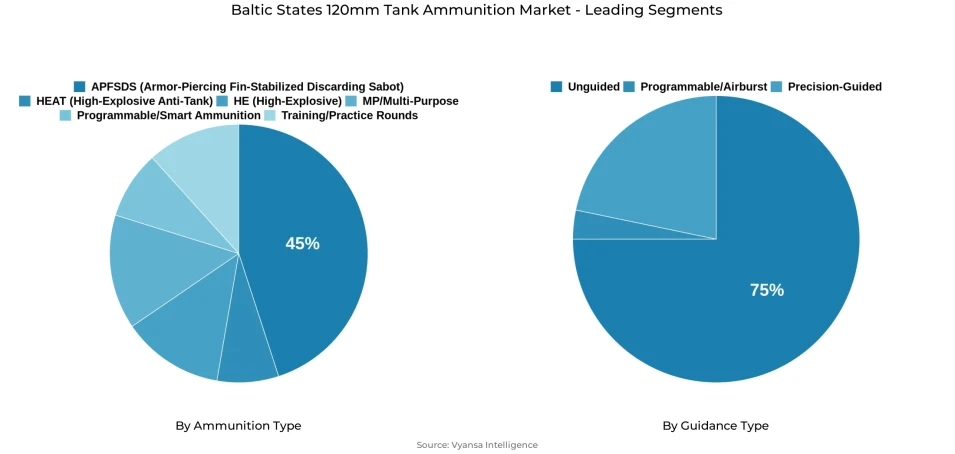
- Apfsds (armor-piercing fin-stabilized discarding sabot) grabbed market share of 45%.
- Competition
- 120mm tank ammunition in Baltic States is currently being catered to by more than 10 companies.
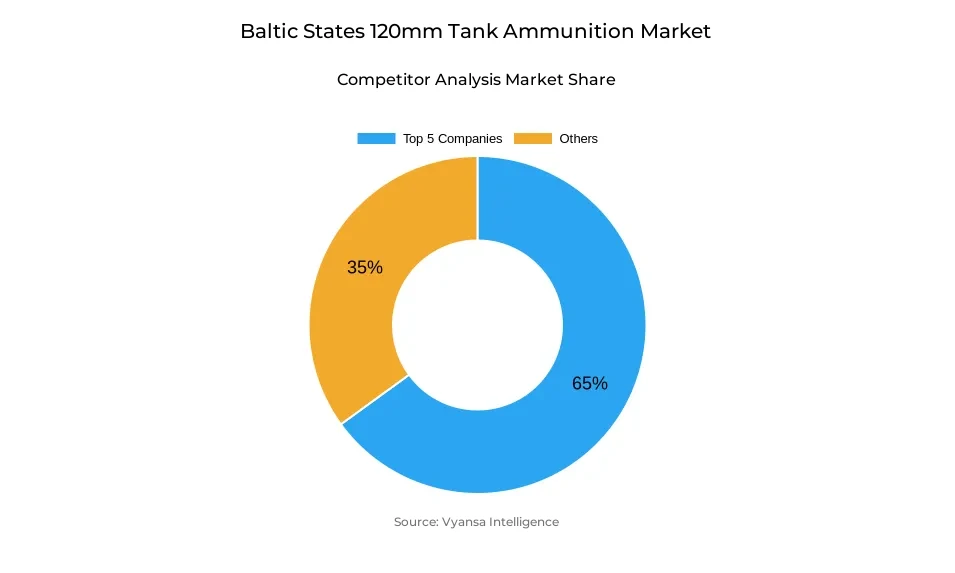
- Top 5 companies acquired around 65% of the market share.
- Elbit Systems, General Dynamics Ordnance and Tactical Systems, Northrop Grumman, Rheinmetall, KNDS etc., are few of the top companies.
- Guidance Type
- Unguided grabbed 75% of the market.
- Country
- Lithuania leads with a 40% share of the Baltic States market.
Baltic States 120mm Tank Ammunition Market Outlook
The Baltic States 120mm tank ammunition market size was valued at USD 30 million in 2025 and is projected to grow from USD 35 million in 2026 to USD 45 million by 2032, exhibiting a CAGR of around 5.96% during the forecast period. This growth is underpinned by a significant surge in defence spending across the region, with 2026 budgets set at roughly 4.91%-5.38% of GDP, reflecting an urgent focus on military readiness and stockpile buildup.
A key driver of demand is the introduction of new main battle tank capabilities, including a contract for 44 LEOPARD 2 A8 tanks worth €950 million signed by a Baltic state. This structurally lifts recurring requirements for 120mm rounds across training, qualification, and war-reserve inventories. Procurement is increasingly channelled through NATO's centralized contracting framework, with NSPA placing its first call-off of around €200 million under a 2025 framework agreement, streamlining ordering and improving delivery planning for smaller buyers.
APFSDS (Armor-Piercing Fin-Stabilized Discarding Sabot) leads the ammunition type category with a 45% market share, being the anchor ammunition for deterrence loads and combat-ready stocks because of its support for NATO gunnery requirements. In the guidance category, unguided 120mm tank ammunition leads with a 75% market share, preferred for its simplicity of integration, storage, and logistics for small fleets.
Lithuania currently leads the market with a 40% market share, thanks to its €4.79 billion defence budget in 2026, which supports long-term supply contracts and procurement continuity. Locally, a proposed €300 million ammunition factory indicates a strong policy commitment to supply security, making Lithuania the key demand anchor and presenting opportunities for suppliers who can provide value addition to their ammunition offerings.
Baltic States 120mm Tank Ammunition Market Growth DriverRising Defense Allocations Strengthen Armored Capability Development
Across the Baltics, 2026 defence budgets are set at around five percent of GDP, a steep step-up that prioritises stockpiling of high-consumption items such as tank rounds. Parliamentary-approved 2026 budgets place defence allocations in a tight 4.91%-5.38% of GDP band, signalling that ammunition procurement is treated as an immediate readiness task, not a discretionary buy.
The spending surge is paired with a new main battle tank capability: a Baltic state holds a contract for 44 LEOPARD 2 A8 tanks in a €950 million deal that includes spares and logistics. As the LEOPARD 2 family fires 120mm rounds, standing up a tank unit structurally lifts recurring demand for training, qualification, and war-reserve lots of NATO-standard 120mm round types, and it increases the need for consistent lot quality and long-term storage planning.
Baltic States 120mm Tank Ammunition Market ChallengeIndustrial Bottlenecks and Regulatory Delays Constrain Supply Expansion
Baltic buyers rely on external NATO/European supply chains, but scaling munitions output still runs into industrial fragmentation and slow throughput flagged in EU defence-industry assessments. Even when investment is available, new filling and assembly lines can sit idle while environmental approvals and local opposition are resolved, keeping capacity growth uneven and hard to schedule. That uncertainty complicates delivery planning for time-sensitive readiness buys.
A live example is Rheinmetall’s RWM Italia site: the Financial Times reports a €50 million munitions facility remained idle for years until Italy’s government approved the environmental impact report, clearing production to begin. For 120mm tank ammunition, such stop-start capacity additions tighten delivery slots, push buyers toward earlier contracting, and force small fleets to carry higher buffers to avoid training interruptions.
Unlock Market Intelligence
Explore the market potential with our data-driven report
Baltic States 120mm Tank Ammunition Market TrendGrowing Traction Towards Centralized NATO Procurement Mechanisms
Procurement is increasingly routed through NATO’s centralized contracting instead of bespoke national tenders. Rheinmetall reports that the NATO Support and Procurement Agency (NSPA) places its first call-off-around €200 million-under a 2025 framework agreement for 120mm tank ammunition, with “various NATO countries” as end customers. This normalises pooled demand, improves price visibility, and reduces duplicated tender work across small buyers.
The same update notes a ‘Basic Contractual Instrument’ signed with NSPA in July 2025 that fixes the terms, technical specifications, and standards for several 120mm ammunition types. For Baltic customers, this trend standardises qualification and QA paperwork, improves interoperability with allied stocks, and speeds ordering by letting purchases ride on pre-negotiated NATO conditions. It also makes delivery planning more structured through framework call-offs.
Baltic States 120mm Tank Ammunition Market OpportunityStrategic Localization of Ammunition Manufacturing Enhances Supply Security
Baltic governments actively build a domestic munitions industrial footprint, creating space for suppliers that pair 120mm rounds with local value-add (assembly, packaging, testing, storage and training support). In Lithuania, Rheinmetall signs contracts on 29 November 2024 to begin construction of a modern ammunition plant, backed by a government supply contract. This signals a clear policy preference for security-of-supply arrangements, not just spot purchases.
Lithuanian public reporting on the same project describes a €300 million plant plan and at least 150 new jobs, underlining that industrial offsets and long-term supply deals are politically supported. For 120mm vendors, this environment rewards partnership models that improve resilience-such as local warehousing, certified handling capacity, and through-life technical support-even when core round production remains outside the Baltics.
Baltic States 120mm Tank Ammunition Market Country Analysis
By Country
- Estonia
- Latvia
- Lithuania
Lithuania leads with a 40% share of the Baltic States market. The country allocates €4.79 billion to defense in 2026, reinforcing its structured and sustained investment in military capability enhancement and ammunition readiness planning.
This absolute allocation level strengthens procurement continuity, inventory replenishment cycles, and long-term supply agreements. Lithuania’s consistent funding visibility supports stable acquisition planning, positioning it as the principal demand anchor across the Baltic region without duplicating previously stated GDP-based spending metrics.
Unlock Market Intelligence
Explore the market potential with our data-driven report
Baltic States 120mm Tank Ammunition Market Segmentation Analysis
By Ammunition Type
- APFSDS (Armor-Piercing Fin-Stabilized Discarding Sabot)
- HEAT (High-Explosive Anti-Tank)
- HE (High-Explosive)
- MP/Multi-Purpose
- Programmable/Smart Ammunition
- Training/Practice Rounds
The segment with the highest share under the ammunition type is APFSDS (Armor-Piercing Fin-Stabilized Discarding Sabot) with a 45% share. This dominance reflects how 120mm tank fleets prioritise assured penetration against modern armour, making APFSDS the default choice for deterrence loads and combat-ready stocks. It also aligns with the need for a “go-to” round that commanders trust across scenarios.
APFSDS stays on top because it fits established NATO gunnery tables and qualification routines, so the same round family supports both training progression and operational readiness. For procurement teams, keeping APFSDS as the anchor simplifies storage planning, lot tracking, and compatibility management across different gun barrels and fire-control updates. Other round types are then added as mission-specific complements, without changing the core supply chain logic.
By Guidance Type
- Unguided
- Programmable/Airburst
- Precision-Guided
The segment with the highest share under the Guidance Type is Unguided with 75% of the market. Unguided 120mm rounds fit existing NATO tank fire-control systems and can be fielded without extra integration, which keeps procurement, safety certification, and troop training steps lean. This makes unguided natures the practical “volume backbone” for both readiness and routine live-fire.
This mix also reflects logistics reality: unguided rounds are easier to store, transport, and rotate because they rely on long-established handling and inspection procedures. That reduces administrative friction for small fleets and helps planners keep predictable training calendars. Buyers therefore keep unguided rounds as the standard issue while selectively adding niche natures for special missions, without reshaping the whole support chain.
Various Market Players in Baltic States 120mm Tank Ammunition Market
The companies mentioned below are highly active in the Baltic States 120mm tank ammunition market, occupying a considerable portion of the market and shaping industry progress.
- Elbit Systems
- General Dynamics Ordnance and Tactical Systems
- Northrop Grumman
- Rheinmetall
- KNDS
- Nammo
- ZVS Holding
- MSM Group
- MESKO (PGZ)
- Poongsan
Market News & Updates
- Rheinmetall, 2026:
Rheinmetall’s February 13, 2026 disclosure of an NSPA-backed procurement for 35,000 rounds of 120mm tank ammunition is strategically relevant to the Baltic States because it demonstrates an “off-the-shelf” NATO contracting lane for rapid stock rebuilds, which can be leveraged by Baltic defence planners as 120mm demand rises alongside armour modernization and interoperability requirements, while simultaneously indicating that a meaningful share of 2026 European 120mm capacity is already spoken for—an immediate consideration for Baltic acquisition timing, safety stocks, and supplier diversification.
- KNDS, 2025:
On December 11, 2025, KNDS announced a signed contract with Lithuania’s Ministry of Defence to build an assembly plant in Kaunas for producing up to 41 LEOPARD 2 A8 tanks—an industrial move on NATO’s eastern flank that structurally increases Lithuania’s (and therefore the Baltic region’s) embedded LEOPARD lifecycle footprint and predictably elevates recurring 120mm ammunition requirements across training, qualification, and warstock planning, with downstream effects on Baltic 120mm sourcing strategies (frameworking, storage, and multi-year lot planning) as local sustainment capacity becomes more formalized.
Frequently Asked Questions
Related Report
- Market Segmentation
- Research Scope
- Research Methodology
- Definitions and Assumptions
- Executive Summary
- Baltic States 120mm Tank Ammunition Market Policies, Regulations, and Standards
- Baltic States 120mm Tank Ammunition Market Dynamics
- Growth Factors
- Challenges
- Trends
- Opportunities
- Baltic States 120mm Tank Ammunition Market Statistics, 2022-2032F
- Market Size & Growth Outlook
- By Revenues in USD Million
- Market Segmentation & Growth Outlook
- By Ammunition Type
- APFSDS (Armor-Piercing Fin-Stabilized Discarding Sabot)- Market Insights and Forecast 2022-2032, USD Million
- HEAT (High-Explosive Anti-Tank)- Market Insights and Forecast 2022-2032, USD Million
- HE (High-Explosive)- Market Insights and Forecast 2022-2032, USD Million
- MP/Multi-Purpose- Market Insights and Forecast 2022-2032, USD Million
- Programmable/Smart Ammunition- Market Insights and Forecast 2022-2032, USD Million
- Training/Practice Rounds- Market Insights and Forecast 2022-2032, USD Million
- By Tank Platform Compatibility
- NATO Standard 120mm (Smoothbore)- Market Insights and Forecast 2022-2032, USD Million
- Non-NATO/Other 120mm Systems- Market Insights and Forecast 2022-2032, USD Million
- By End User
- Army/Land Forces- Market Insights and Forecast 2022-2032, USD Million
- Defense Contractors- Market Insights and Forecast 2022-2032, USD Million
- Training & Testing Institutions- Market Insights and Forecast 2022-2032, USD Million
- By Guidance Type
- Unguided- Market Insights and Forecast 2022-2032, USD Million
- Programmable/Airburst- Market Insights and Forecast 2022-2032, USD Million
- Precision-Guided- Market Insights and Forecast 2022-2032, USD Million
- By Country
- Estonia
- Latvia
- Lithuania
- By Competitors
- Competition Characteristics
- Market Share & Analysis
- By Ammunition Type
- Market Size & Growth Outlook
- Estonia 120mm Tank Ammunition Market Statistics, 2022-2032F
- Market Size & Growth Outlook
- By Revenues in USD Million
- Market Segmentation & Growth Outlook
- By Ammunition Type- Market Insights and Forecast 2022-2032, USD Million
- By Tank Platform Compatibility- Market Insights and Forecast 2022-2032, USD Million
- By End User- Market Insights and Forecast 2022-2032, USD Million
- By Guidance Type- Market Insights and Forecast 2022-2032, USD Million
- Market Size & Growth Outlook
- Latvia 120mm Tank Ammunition Market Statistics, 2022-2032F
- Market Size & Growth Outlook
- By Revenues in USD Million
- Market Segmentation & Growth Outlook
- By Ammunition Type- Market Insights and Forecast 2022-2032, USD Million
- By Tank Platform Compatibility- Market Insights and Forecast 2022-2032, USD Million
- By End User- Market Insights and Forecast 2022-2032, USD Million
- By Guidance Type- Market Insights and Forecast 2022-2032, USD Million
- Market Size & Growth Outlook
- Lithuania 120mm Tank Ammunition Market Statistics, 2022-2032F
- Market Size & Growth Outlook
- By Revenues in USD Million
- Market Segmentation & Growth Outlook
- By Ammunition Type- Market Insights and Forecast 2022-2032, USD Million
- By Tank Platform Compatibility- Market Insights and Forecast 2022-2032, USD Million
- By End User- Market Insights and Forecast 2022-2032, USD Million
- By Guidance Type- Market Insights and Forecast 2022-2032, USD Million
- Market Size & Growth Outlook
- Competitive Outlook
- Company Profiles
- Rheinmetall
- Business Description
- Product Portfolio
- Collaborations & Alliances
- Recent Developments
- Financial Details
- Others
- KNDS
- Business Description
- Product Portfolio
- Collaborations & Alliances
- Recent Developments
- Financial Details
- Others
- Nammo
- Business Description
- Product Portfolio
- Collaborations & Alliances
- Recent Developments
- Financial Details
- Others
- ZVS Holding
- Business Description
- Product Portfolio
- Collaborations & Alliances
- Recent Developments
- Financial Details
- Others
- MSM Group
- Business Description
- Product Portfolio
- Collaborations & Alliances
- Recent Developments
- Financial Details
- Others
- Elbit Systems
- Business Description
- Product Portfolio
- Collaborations & Alliances
- Recent Developments
- Financial Details
- Others
- General Dynamics Ordnance and Tactical Systems
- Business Description
- Product Portfolio
- Collaborations & Alliances
- Recent Developments
- Financial Details
- Others
- Northrop Grumman
- Business Description
- Product Portfolio
- Collaborations & Alliances
- Recent Developments
- Financial Details
- Others
- MESKO (PGZ)
- Business Description
- Product Portfolio
- Collaborations & Alliances
- Recent Developments
- Financial Details
- Others
- Poongsan
- Business Description
- Product Portfolio
- Collaborations & Alliances
- Recent Developments
- Financial Details
- Others
- Rheinmetall
- Company Profiles
- Disclaimer
| Segment | Sub-Segment |
|---|---|
| By Ammunition Type |
|
| By Tank Platform Compatibility |
|
| By End User |
|
| By Guidance Type |
|
| By Country |
|
Research Methodology
This study followed a structured approach comprising four key phases to assess the size and scope of the electro-oxidation market. The process began with thorough secondary research to collect data on the target market, related markets, and broader industry context. These findings, along with preliminary assumptions and estimates, were then validated through extensive primary research involving industry experts from across the value chain. To calculate the overall market size, both top-down and bottom-up methodologies were employed. Finally, market segmentation and data triangulation techniques were applied to refine and validate segment-level estimations.
Secondary Research
The secondary research phase involved gathering data from a wide range of credible and published sources. This step helped in identifying industry trends, defining market segmentation, and understanding the market landscape and value chain.
Sources consulted during this phase included:
- Company annual reports, investor presentations, and press releases
- Industry white papers and certified publications
- Trade directories and market-recognized databases
- Articles from authoritative authors and reputable journals
- Gold and silver standard websites
Secondary research was critical in mapping out the industry's value chain and monetary flow, identifying key market segments, understanding regional variations, and tracking significant industry developments.
Other key sources:
- Financial disclosures
- Industry associations and trade bodies
- News outlets and business magazines
- Academic journals and research studies
- Paid industry databases
Primary Research
To validate secondary data and gain deeper market insights, primary research was conducted with key stakeholders across both the supply and demand sides of the market.
On the demand side, participants included decision-makers and influencers from end-user industries—such as CIOs, CTOs, and CSOs—who provided first-hand perspectives on market needs, product usage, and future expectations.
On the supply side, interviews were conducted with manufacturers, industry associations, and institutional participants to gather insights into current offerings, product pipelines, and market challenges.
Primary interviews provided critical inputs such as:
- Market size and revenue data
- Product and service breakdowns
- Market forecasts
- Regional and application-specific trends
Stakeholders consulted included:
- Leading OEM and solution providers
- Channel and distribution partners
- End users across various applications
- Independent consultants and industry specialists
Market Size Estimation and Data Triangulation
- Identifying Key Market Participants (Secondary Research)
- Goal: To identify the major players or companies in the target market. This typically involves using publicly available data sources such as industry reports, market research publications, and financial statements of companies.
- Tools: Reports from firms like Gartner, Forrester, Euromonitor, Statista, IBISWorld, and others. Public financial statements, news articles, and press releases from top market players.
- Extracting Earnings of Key Market Participants
- Goal: To estimate the earnings generated from the product or service being analyzed. This step helps in understanding the revenue potential of each market player in a specific geography.
- Methods: Earnings data can be gathered from:
- Publicly available financial reports (for listed companies).
- Interviews and primary data sources from professionals, such as Directors, VPs, SVPs, etc. This is especially useful for understanding more nuanced, internal data that isn't publicly disclosed.
- Annual reports and investor presentations of key players.
- Data Collation and Development of a Relevant Data Model
- Goal: To collate inputs from both primary and secondary sources into a structured, data-driven model for market estimation. This model will incorporate key market KPIs and any independent variables relevant to the market.
- Key KPIs: These could include:
- Market size, growth rate, and demand drivers.
- Industry-specific metrics like market share, average revenue per customer (ARPC), or average deal size.
- External variables, such as economic growth rates, inflation rates, or commodity prices, that could affect the market.
- Data Modeling: Based on this data, the market forecasts are developed for the next 5 years. A combination of trend analysis, scenario modeling, and statistical regression might be used to generate projections.
- Scenario Analysis
- Goal: To test different assumptions and validate how sensitive the market is to changes in key variables (e.g., market demand, regulatory changes, technological disruptions).
- Types of Scenarios:
- Base Case: Based on current assumptions and historical data.
- Best-Case Scenario: Assuming favorable market conditions, regulatory environments, and technological advancements.
- Worst-Case Scenario: Accounting for adverse factors, such as economic downturns, stricter regulations, or unexpected disruptions.












