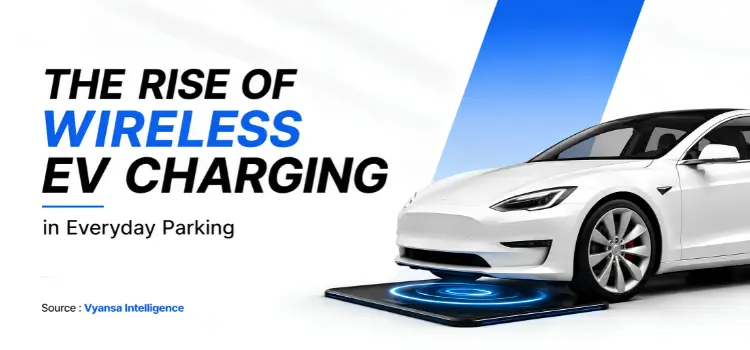
The Rise of Wireless EV Charging in Everyday Parking
June 23, 2026
Parking spaces are beginning to take on a more active role in electric mobility. Earlier, they were simply places where vehicles waited between trips. With Wireless EV Charging, those same spaces can become power points, allowing parked vehicles to receive energy without cable handling, connector exposure, or repeated driver action. Growing EV adoption has made charging convenience more important across homes, workplaces, apartment complexes, fleet depots, retail parking areas, and public mobility locations.
Plug-in systems remain central to EV infrastructure, but daily charging behavior still depends on users remembering to connect, disconnect, and manage charging equipment. For private owners, that creates repeated effort. For fleet operators, missed charging can directly affect vehicle readiness, route planning, and daily utilization.
Wireless EV Charging addresses that gap by making energy transfer part of parking itself. A vehicle stops over a charging pad, system alignment begins, and power transfer can take place with limited physical intervention. Such a shift changes how charging is viewed.
Cable-First Charging Created an Early EV Habit
Plug-in charging shaped early EV adoption because it was familiar, visible, and easier to install across residential and public locations. Drivers understood cable-based charging because it resembled existing refueling logic, where users stop, connect, wait, and move again.
However, daily EV use has exposed limits of cable-dependent charging behavior. Private users need to remember charging schedules, manage connectors, handle cables in poor weather, and confirm whether charging has started properly. Shared residential parking creates another layer of difficulty when multiple users depend on limited charging points. Commercial operators face more operational pressure, especially when vehicles must return ready for scheduled routes.
Cable handling may appear minor for a single vehicle, but repeated across fleets, depots, delivery vans, shuttle buses, airport vehicles, and high-use mobility operations, manual charging becomes a workflow issue. Missed charging, damaged connectors, misplaced cables, blocked charging bays, and inconsistent user behavior can affect vehicle availability.
Parking Time Becomes Charging Time
Parking is central to practical deployment because EVs spend far more time stopped than moving. Every stationary period creates an opportunity for energy transfer, especially when charging hardware is built into locations where vehicles already stop.
Home parking offers overnight charging windows. Workplace parking supports long daytime dwell periods. Retail locations can provide top-up charging during shopping visits. Fleet depots can support predictable charging cycles between routes. Bus stops, taxi stands, logistics yards, and airport ground support areas can create charging opportunities without requiring vehicles to leave operating zones.
Wireless EV Charging fits these environments because it changes charging from a separate task into part of parking. A vehicle parks above a charging pad, alignment systems detect position, and power transfer begins through ground-side and vehicle-side equipment. For users, charging becomes less visible.
Cables no longer need to stretch across bays, sidewalks, or depot floors. Charging hardware can sit below or close to surface level, reducing clutter and improving space efficiency in locations where vehicle movement, pedestrian access, and equipment safety matter.
Cable-Free Charging Turns Convenience into Utilization
Cable-free charging matters because it changes charging from a driver-managed action into a location-enabled process. Wireless EV Charging becomes more valuable when it improves how consistently vehicles receive power during routine stops, especially across homes, shared parking areas, fleet depots, and high-use mobility locations.
Key operational advantages include the following:
-
Reduced driver dependency: Charging no longer depends entirely on users remembering to connect cables after every trip. Vehicles can begin receiving power once parked correctly over a charging pad.
-
Higher charging consistency: Routine parking windows can become more productive, helping reduce missed charging events across private EV use, shared residential spaces, and fleet operations.
-
Better vehicle readiness: Fleets can improve dispatch reliability when vehicles return to depots and recharge without additional manual plug-in checks after every shift.
-
Cleaner parking environments: Cable-free charging can reduce exposed connectors, floor-level clutter, and equipment handling across garages, commercial parking zones, and depot layouts.
-
Stronger infrastructure utilization: Charging assets deliver greater value when used more consistently. Plugless access supports repeated charging behavior because energy transfer becomes part of parking itself.
-
Improved user experience: Drivers do not need to treat charging as a separate task each time they park. Charging becomes quieter, simpler, and more naturally connected to daily EV movement.
Wireless EV Charging therefore moves beyond convenience. Its practical value sits in utilization, reliability, and charging discipline, especially in locations where vehicles stop frequently and need to remain ready for their next use.
Deployment Momentum Becomes Measurable
Practical deployment is becoming more visible because charging decisions are moving closer to real use cases. Buyers are no longer evaluating Wireless EV Charging only as a futuristic convenience. They are looking at where it can reduce cable dependency, support repeat charging behavior, and improve EV readiness across homes, workplaces, commercial parking zones, and fleet depots.
-
Wireless EV Charging market size was valued at USD 91 million in 2025 and is estimated at USD 134 million in 2026, with expected value reaching USD 933 million by 2032 at around 39.45% CAGR during 2026-32, reflecting stronger interest in charging formats that can become part of parking infrastructure rather than remaining limited to conventional plug-in points.
-
Procurement discussions are becoming more practical, with buyers focusing on installation cost, receiver readiness, alignment accuracy, maintenance access, charging efficiency, and uptime rather than only evaluating plugless charging as a premium convenience feature
-
Site owners are beginning to assess charging locations through space efficiency, user safety, cable-free layouts, energy access, and integration with existing electrical infrastructure, making deployment decisions more connected to property planning.
-
Charging operators are giving greater attention to software control, session monitoring, payment systems, diagnostics, and energy management because plugless charging still needs a dependable digital layer behind each physical charging point.
-
Adoption momentum now depends on how well hardware, vehicle receivers, safety systems, installation models, and operating software work together, creating a path where Wireless EV Charging can move from pilot visibility to repeatable deployment.
Trends Turning Parking Spaces into Power Points
Parking-led charging is gaining practical relevance because it connects energy transfer with locations where EVs already remain idle. Several trends show how parking spaces are beginning to function as active power points rather than passive vehicle-holding areas.
Static Charging Becomes the First Practical Route
Fixed parking locations are becoming the clearest starting point for Wireless EV Charging because they offer controlled positioning, easier installation, and repeatable charging windows. Stationary/static wireless charging holds 70% share, reflecting stronger adoption around parked vehicles rather than road-embedded charging routes. Garages, depots, office bays, retail parking, and controlled mobility sites can turn defined parking spaces into reliable power points.
Private Parking Shapes Everyday Charging Behavior
Private parking is emerging as a strong daily-use setting because vehicles remain idle for longer durations at homes, workplaces, and private fleet yards. Home/private charging holds 55% share, showing that Wireless EV Charging is gaining relevance where charging can merge with overnight routines, office parking, and scheduled downtime. This trend shifts charging from a manual action into part of regular parking behavior.
Supplier Activity Moves Toward Integrated Deployment
Wireless EV Charging requires more than charging pads, as vehicle receivers, software control, safety systems, and installation support must work together. More than 20 companies currently serve the space, while top five companies held around a 15% share in 2026, showing active but still distributed participation. InductEV Inc., Continental AG, Robert Bosch GmbH, Electreon Wireless Ltd., and WiTricity AI Tech LLC are among notable participants shaping practical deployment pathways.
Asia Pacific Anchors Early Deployment Scale
Regional scale is becoming important because Wireless EV Charging needs EV production depth, infrastructure readiness, urban demand, and localized technology support. Asia Pacific leads with 50% share, supported by dense mobility networks, expanding charging infrastructure, and strong EV manufacturing activity. Parking-heavy cities across the region create stronger potential for cable-free charging formats that improve access without adding visible equipment clutter.
Innovation Signals Moving Concept Closer to Daily Use
Recent activity shows Wireless EV Charging moving toward formats that can be tested, deployed, and repeated in controlled environments. Product updates, acquisitions, and standards-led coordination are helping shift plugless charging from demonstration value toward practical use.
-
WiTricity AI Tech showcased its MR/1 wireless charging system at the 2026 PGA Show and introduced a 600-watt version for golf carts and light electric vehicles. Smaller-format applications matter because campuses, golf courses, communities, and controlled mobility sites can test plugless charging through repeated parking behavior.
-
Electreon completed its acquisition of InductEV in March 2026, combining dynamic, semi-dynamic, and stationary wireless charging capabilities. Combined capabilities support different charging needs, including in-road charging, planned-stop top-ups, and depot-based overnight charging.
-
Japan’s EV Wireless Power Transfer Council highlights growing attention toward coordination, compatibility, and rollout readiness. Wireless EV Charging requires more than pads and receivers, since standards, safety requirements
-
Recent developments point toward controlled locations as an important proving ground. Parking bays, depots, campuses, and light mobility environments allow suppliers and operators to validate reliability before wider deployment.
Innovation activity is therefore reinforcing the same direction as parking-led adoption. Wireless EV Charging becomes more credible when product design, fleet use cases, standards coordination, and site-level deployment move closer together.
Barriers That Still Need Operational Discipline
Wireless EV Charging still faces practical barriers before it becomes common across private and public locations.
Vehicle receivers remain critical. Without receiver integration across more EV models, charging pads cannot serve a broad user base. Alignment accuracy also matters because energy transfer depends on correct positioning between ground and vehicle assemblies. Drivers, automated parking systems, and fleet parking layouts all influence charging performance.
Interoperability will be another decisive factor. Buyers need confidence that a charging pad installed today can support multiple vehicle types, software systems, payment models, and service providers tomorrow. Fleet operators also need durability, uptime monitoring, maintenance support, and predictable operating costs.
-
Vehicle-side readiness: Receiver hardware must become easier to integrate across models.
-
System compatibility: Pads, receivers, software, and safety systems must work across suppliers.
-
Installation economics: Property owners need clear cost, maintenance, and utilization logic.
-
Operational trust: Users must believe charging begins reliably when vehicles park.
-
Safety assurance: Electromagnetic compatibility, foreign object detection, and weather resilience must remain central.
Practical deployment will depend on how efficiently these barriers are handled across homes, depots, commercial parking, and urban locations.
Parking Bays Evolving into Charging-Ready Assets
Parking assets are gradually becoming part of EV energy planning. A parking bay can now support charging access, session monitoring, billing, energy management, and fleet scheduling. This shift changes how property owners, automakers, charging providers, and fleet operators think about parking design.
Future-ready parking may include embedded charging pads, digital occupancy tracking, payment integration, grid-aware energy management, and vehicle identification systems. For fleets, depot software can link parking position with charging status and dispatch planning. For residential users, garage-based charging can become nearly invisible. For commercial locations, wireless pads can offer premium charging without cable-heavy layouts.
Wireless EV Charging could become most valuable when it fades into daily routine. Drivers park. Vehicles charge. Operators monitor performance. Property owners manage access. Charging becomes less of a visible task and more of an embedded service.
Conclusion
Wireless EV Charging is moving into practical deployment because parking spaces are becoming more than idle vehicle locations. They are evolving into power points that support private convenience, fleet readiness, commercial site value, and urban charging access.
Static pads, home/private charging, supplier participation, and Asia Pacific leadership all point toward one clear direction: early adoption is strongest where vehicles already stop. Next phase will depend on receiver integration, interoperability, installation economics, safety validation, and software coordination. If these elements mature together, parking time can become charging time across homes, depots, workplaces, and high-density mobility locations.