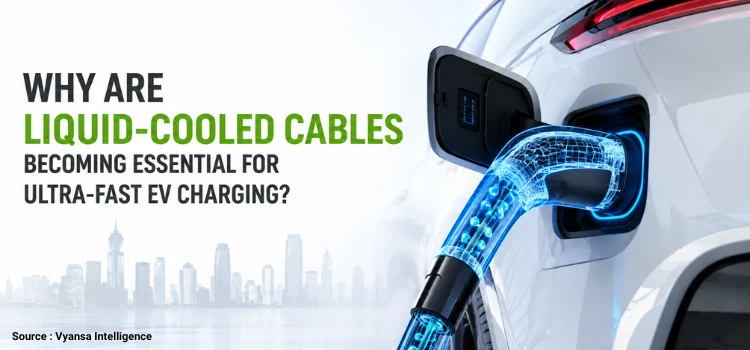
Why Are Liquid-Cooled Cables Becoming Essential for Ultra-Fast EV Charging?
June 12, 2026
Ultra-fast EV charging is no longer defined only by how much power a charger can deliver. It is increasingly defined by whether the cable assembly can move that power safely, repeatedly, and without becoming too heavy for everyday use. As charging networks shift toward higher current levels, the cable is turning into one of the most important performance layers in the charging process.
This is where liquid-cooled cable design becomes critical. High-current charging generates heat inside conductors, terminals, and connector interfaces. If that heat is not controlled, charging speed can be limited, connector life can decline, and public charging sites can face avoidable downtime. The Electric Vehicle (EV) Charging Cable is therefore moving from a passive connection point to an engineered thermal system built for speed, safety, and reliability.
Defining Liquid Cooling at the Cable Level
An Electric Vehicle (EV) Charging Cable designed with liquid cooling uses an internal coolant pathway to remove heat during high-power charging. The cooling medium moves through the cable assembly and helps control temperature near the conductors, terminals, and connector sections where thermal stress is most concentrated.
This design allows the cable to support higher current levels without becoming excessively bulky. In ultra-fast charging, that matters because power delivery must remain stable across repeated charging sessions, especially at public charging hubs and fleet depots.
The purpose is not simply to make charging faster. The purpose is to make high-power charging physically practical. A charging cable must be lifted, bent, connected, disconnected, and stored by real users in real locations. Liquid cooling supports faster charging while preserving usability, which is why it is becoming a central design feature for high-power cable assemblies.
Older Cable Logic Breaks at High Current
Traditional charging cables were suitable for slower or moderate charging conditions because their main requirement was safe power transfer over predictable current levels. They could rely on conductor size, insulation quality, and mechanical durability to support routine charging.
Ultra-fast charging changes that equation. When current rises, heat generation rises with it. The simplest way to handle this is to make the cable thicker, but that creates a second problem: the cable becomes heavier, stiffer, and harder for drivers to position correctly. In public locations, this affects more than comfort. It can increase cable strain, connector damage, and long-term maintenance needs.
This is the core limitation of conventional high-power cable design. It can either support more current by adding more material, or it can stay manageable for users. Liquid cooling helps reduce that trade-off by controlling heat inside the cable instead of relying only on cable mass.
Why Current Density Turns Heat into a Charging Constraint
Higher charging speed depends on higher current movement between the charger and the vehicle. As current flows through conductors and connector interfaces, resistance generates heat. At lower power levels, this heat can be managed through conventional cable construction. At ultra-fast levels, the thermal load becomes harder to control.
Heat affects several parts of the charging process:
- Connector stability: Elevated temperature can strain the connector interface and reduce long-term reliability.
- Charging consistency: If temperature rises too quickly, the system may reduce output to protect components.
- Cable ergonomics: Oversized conductors can make the cable too heavy for convenient public use.
- Service life: Repeated heat exposure can accelerate wear on insulation, seals, and connector materials.
This is why thermal control has become a charging performance issue. A fast charger cannot deliver its full value if the cable cannot safely handle the current. Liquid-cooled cable assemblies address that constraint by transferring heat away from critical zones during operation.
Where Liquid-Cooled Designs Deliver the Highest Operational Value
Liquid-cooled cables are most valuable where charging intensity is high, charging windows are short, and downtime has a direct operating cost. They are not required for every charging environment. Their strongest role is in locations where repeated high-power sessions are part of daily use.
Several use cases stand out:
- Highway charging corridors: Drivers expect shorter stops, reliable connectors, and consistent charging speeds across long-distance routes.
- Urban fast-charging hubs: Sites with high vehicle turnover need cable systems that can perform across frequent daily session
- Fleet depots: Logistics, ride-hailing, and delivery operators need shorter charging windows to keep vehicles available.
- Commercial charging yards: Heavy-use sites require cables that can withstand repeated handling and higher electrical loads.
- Public DC fast-charging points: These locations need cable assemblies that balance speed, safety, durability, and user handling.
DC fast-charging stations account for 35 percent of installed public charging points worldwide, creating demand for advanced multi-core cables capable of supporting up to 500 A continuous current. This explains why liquid-cooled assemblies are becoming more important in high-power charging design.
Connector Readiness Decides Whether Speed Can Scale
Thermal control is only one part of the deployment challenge. A liquid-cooled cable must also match the connector standards used by vehicles and charging providers. Different regions and vehicle platforms continue to use connector systems such as CCS, CHAdeMO, GB/T, Type 1, Type 2, and NACS/Tesla.
This creates practical complexity for charging operators. A cable may be technically capable of high-power transfer, but if it does not match the vehicle mix at a site, its value is limited. Connector readiness affects procurement, maintenance planning, replacement inventory, and user access.
For high-power charging networks, cable design must therefore address two requirements at the same time: thermal stability and connector compatibility. The strongest cable assemblies will be those that can support higher current levels while fitting regional charging standards and vehicle-side connector demand.
Such coordination is especially important as charging providers move toward multi-standard locations. Operators need cable configurations that reduce friction for users while keeping maintenance and inventory complexity under control.
Growth Case Behind High-Power Cable Investment
The commercial case for liquid-cooled cable design reflects the infrastructure shift already underway. The Electric Vehicle (EV) Charging Cable industry was valued at USD 1.88 billion in 2025 and is projected to reach USD 5.46 billion by 2032, expanding at a CAGR of 16.45 percent during 2026-2032.
This trajectory is supported by several operating realities:
- More than 3.4 million public chargers are operational globally. This expands the installed base that depends on reliable cable systems. As charging points increase, cable durability and performance consistency become more important.
- A global EV base exceeding 16 million vehicles is creating recurring need for charging access. It also supports demand for cable replacement and cable upgrades. This makes cable reliability important across home, workplace, public, and fleet charging locations.
- Private charging accounts for 60 percent of application demand. This shows that cable use is not limited to public fast-charging sites. Residential and workplace charging continue to support steady demand for safe and easy-to-handle cable formats.
- Asia holds a 55 percent share, supported by large charging networks and manufacturing scale across China, Japan, and South Korea. This gives the region strong production depth for cable design and connector compatibility. It also supports faster development of advanced cable assemblies for high-power charging.
The importance of liquid-cooled designs will rise fastest where charging speed, site utilization, and component reliability become linked to operating performance.
Barriers That Operators Cannot Ignore
Liquid-cooled cable adoption is advancing, but it carries practical challenges that charging operators and suppliers need to address carefully.
Higher System Complexity
A liquid-cooled cable is more advanced than a conventional cable assembly. It includes cooling channels, seals, connector integration, and thermal management components that must perform reliably across repeated use. This can raise production cost and maintenance expectations.
Certification and Regional Approval
Charging cables must meet regional safety and performance requirements. Approval processes can differ across North America, Europe, and Asia, which can slow deployment for suppliers serving multiple geographies. Certification readiness is therefore a major procurement factor.
Maintenance and Replacement Planning
Public charging cables face bending, pulling, weather exposure, and connector wear. Liquid-cooled assemblies must be evaluated not only for initial performance but also for serviceability, spare availability, and expected replacement cycles.
Cooling Loop Reliability
Liquid-cooled assemblies depend on the consistent performance of coolant pathways, seals, and connector-side thermal control. Any weakness in the cooling loop can affect charging consistency and increase service intervention. Operators need cable systems that are tested for repeated high-current use, not only peak charging performance.
Site-Level Service Readiness
High-power charging locations require trained service teams, spare cable availability, and clear replacement procedures. If a cable issue takes too long to resolve, the charging point may remain unavailable even when the charger itself is functional. Service readiness therefore becomes part of cable selection, especially for public hubs and fleet depots.
These challenges do not reduce the need for liquid-cooled design. They show why high-power cable selection must be treated as an infrastructure decision, not a component-level afterthought.
Conclusion
Liquid-cooled cables are becoming essential for ultra-fast EV charging because charging speed now depends on more than charger output. The cable must manage heat, support high current, protect connector interfaces, remain practical for users, and withstand repeated daily operation.
As public charging, fleet depots, and highway corridors move toward higher-power formats, cable design will have a direct effect on uptime and user experience. The next stage of ultra-fast charging will be shaped by cable assemblies that combine thermal control, connector readiness, mechanical durability, and safe current transfer. In that transition, the Electric Vehicle (EV) Charging Cable becomes one of the most critical layers in charging infrastructure performance.